
When you’re weighing claims about quantum resonant therapy for neurodegenerative conditions, it helps to separate a therapy’s description from evidence that it affects a disease. If you’re managing Parkinson’s disease, Alzheimer’s disease, or another diagnosis, it’s understandable to want clear information about potential benefits and safety.
Some providers describe Quantum Resonant Therapy as frequency-based or bio-informational care. The information available here doesn’t establish that it diagnoses, treats, slows, or prevents neurodegenerative conditions. Quantum research in medicine, including work on sensors and computing, is a separate field and doesn’t validate these therapy claims.
This guide explains what the therapy refers to, how to distinguish a proposed mechanism from clinical evidence, and what research would be needed to support treatment claims. It also offers practical questions to raise with your neurologist and any therapy provider, including whether a complementary approach could affect your current care. The Quantum Resonant Healing Center describes its approach as a proprietary, frequency-based holistic offering. A personal appointment with Dr. Lonnie Meisel can be a setting to ask questions, not a substitute for guidance from your established neurology team.
Key Takeaways
- Neurodegenerative conditions are a broad group. A proposed frequency-based approach is not evidence that a therapy treats them.
- When assessing claims about quantum resonant therapy for neurodegenerative conditions, look for well-designed clinical studies and independent replication.
- Use the checklist in this article to ask providers about their claims, qualifications, records, and what a session can and cannot establish.
- Before exploring a complementary approach, discuss it with your neurology team and keep your clinician-directed care in place.
- A private appointment at the Quantum Resonant Healing Center can help you clarify how the center describes its approach, but it is not a promise of disease benefit.
What Does Quantum Resonant Therapy Mean in the Context of Neurodegenerative Conditions?
Neurodegenerative conditions are a broad group of disorders involving changes in the nervous system. They do not share one cause or a single treatment approach. Quantum Resonant Therapy is the Quantum Resonant Healing Center’s proprietary, frequency-based holistic approach. The information provided does not establish it as an effective treatment for any neurodegenerative condition.
This distinction matters when researching quantum resonant therapy for neurodegenerative conditions. A provider’s description explains the therapy’s framework, not whether it has been shown to improve a clinical outcome. Those are separate questions, and the latter calls for relevant clinical evidence.
Which Conditions Does the Term Neurodegenerative Usually Include?
The term can refer to conditions such as Alzheimer’s disease, Parkinson’s disease, and amyotrophic lateral sclerosis (ALS). These conditions do not have identical care needs. Your diagnosis and treatment plan should be based on assessment by qualified clinicians familiar with your health and circumstances. A broad label alone can’t establish which care is appropriate for you.
What Does Frequency-Based Therapy Claim to Address?
The center describes its approach using terms such as “frequency-based” and bio‑informational healing. In plain language, this is the center’s framework for considering the body’s informational field and resonant frequencies. That description is not proof that disease-related changes can be measured or corrected by an external frequency. The proposed mechanism is not an established explanation for treating neurodegenerative disease.
For wider context, the overview of energy medicine includes a critical discussion of Bioresonance therapy. It may help explain how related terms are used, but a general overview is not clinical evidence that a particular therapy benefits a specific diagnosis.
The center also describes Quantum Resonant Remedies as non-pharmaceutical, bio-informational tools. The information provided does not establish that these remedies improve neurological symptoms, alter disease progression, or treat Alzheimer’s disease, Parkinson’s disease, ALS, or another neurodegenerative condition. Assess claims about specific outcomes separately from the terminology used to describe the approach.
In short, the name and proposed framework tell you how the center describes its approach. They don’t establish that it diagnoses or treats a neurological condition. To assess that question, look for clinical studies of the therapy in people with the condition that measure meaningful outcomes. The next section explains what to check when reviewing such evidence.
What Evidence Would Show Whether Quantum Resonant Therapy Helps?
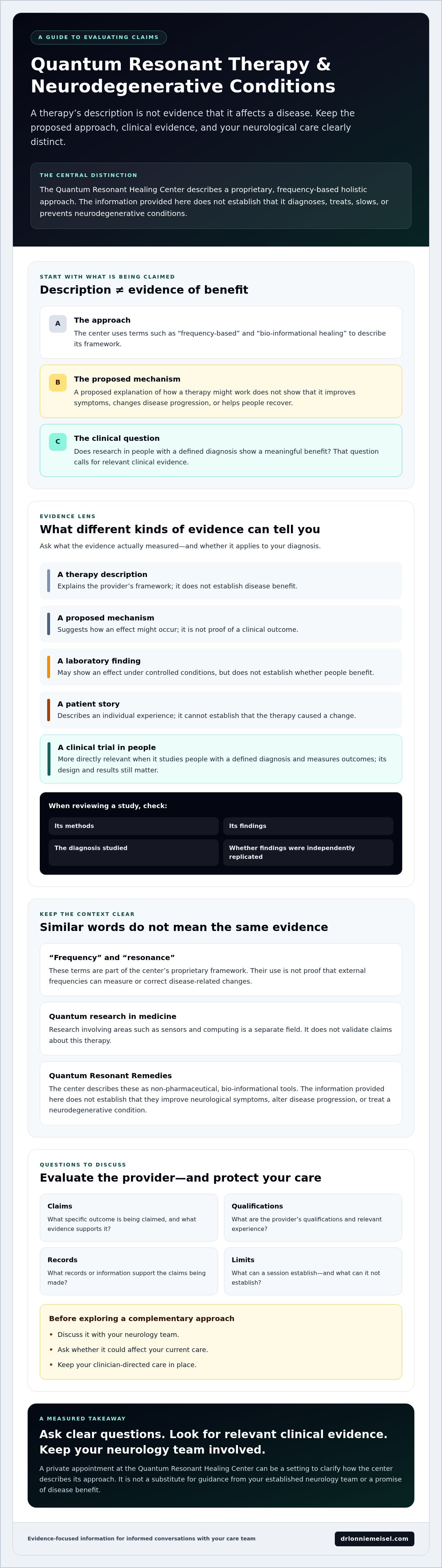
To assess a claim about quantum resonant therapy for neurodegenerative conditions, identify what kind of evidence supports it. A proposed mechanism explains how a therapy might work. A laboratory finding may show an effect under controlled conditions, but not whether people benefit. A patient story describes an individual’s experience, but cannot establish that the therapy caused a change. A clinical trial that measures outcomes in people with a defined diagnosis is more directly relevant, depending on its design and results.
A plausible mechanism alone does not prove that a therapy improves symptoms, changes disease progression, or helps people recover. The information provided for this article does not include clinical evidence establishing that Quantum Resonant Therapy is effective for treating a neurodegenerative condition. This is a limit of the evidence provided here, not a review of every possible publication. Before drawing conclusions from a paper cited to support a claim, check its methods, findings, and relevance.
How to Read Claims About Frequency, Resonance, and the Brain
“Frequency” generally refers to how often a repeating signal occurs. “Resonance” describes a response that can happen when a system is exposed to certain frequencies. The Quantum Resonant Healing Center uses these terms as part of its proprietary, frequency-based framework. That terminology should not be confused with established findings about the nervous system or treated as proof that external frequencies can correct a neurological disease process.
Research involving the brain or nervous system does not automatically test this specific approach. Memorial Sloan Kettering Cancer Center describes bioresonance claims as unproven and not supported by scientific data in its overview of the unproved device. This source provides context about related claims, but it is not a clinical trial of Quantum Resonant Therapy for neurodegenerative conditions. Claims of disease modification, symptom relief, or recovery require evidence directly relevant to the therapy and condition.
What Makes a Clinical Study Relevant to Your Diagnosis?
Look beyond a headline or testimonial. Check whether a study evaluated the same therapy and included participants with the diagnosis and disease stage relevant to the claim. Look for a suitable comparison group, clearly defined outcomes, limitations reported by the researchers, and independent replication. A result from a different condition, an uncontrolled observation, or a laboratory experiment may not answer whether the therapy benefits someone with your diagnosis.
- Study design: How were participants assessed and compared?
- Participants: Did they have the diagnosis and stage relevant to you?
- Outcomes: Were symptom changes or other claimed benefits measured clearly?
- Limitations and replication: What uncertainties did the authors report, and have independent researchers confirmed the finding?
If a provider refers to a study, ask for its title or full text and discuss its relevance with your neurology team. A private appointment with Dr. Meisel can also be an opportunity to ask what the center’s approach does and does not establish. The conversation itself is not evidence of clinical benefit.
Can Quantum Resonant Therapy Replace Standard Neurological Care?
No. The information provided for this article does not establish Quantum Resonant Therapy as a replacement for neurological care or as a proven treatment for a neurodegenerative condition. If you’re considering a complementary approach, don’t stop, delay, or change prescribed treatment based on this article or a provider’s claims. Discuss the therapy with the clinician who knows your diagnosis and care plan.
Clinician-directed neurological care and a complementary service have different purposes. Your neurology team can guide diagnosis, treatment, and monitoring. The Quantum Resonant Healing Center describes its approach as proprietary and frequency-based, but the available information does not show that it can diagnose or treat a neurological condition. Memorial Sloan Kettering Cancer Center’s discussion of evidence for bioresonance therapy provides context on related claims. It does not establish the effects of this specific service.
| Approach | Purpose to clarify | Evidence to verify | Who to consult |
|---|---|---|---|
| Clinician-directed neurological care | Diagnosis, treatment planning, and monitoring tailored to your circumstances. | Ask how recommendations relate to your diagnosis, health history, and care goals. | Your neurologist or treating clinician. |
| Complementary frequency-based service | A provider-described approach that may be explored alongside established care. | Ask for evidence specific to the therapy, your diagnosis, and the claimed outcome. | Your treating clinician and the therapy provider. |
What Should You Ask Your Neurologist Before Trying a Complementary Approach?
Bring the exact therapy description, any written instructions, and the ingredient list for any remedy you’re considering. Ask whether the approach could affect your current care plan, monitoring, or other treatments. Your clinician can help assess individual suitability and possible interactions. Don’t assume a complementary service is risk-free because it is described as holistic or non-pharmaceutical. Also ask which changes in your symptoms should prompt clinical attention in your specific situation.
Why Testimonials Cannot Establish Treatment Effectiveness
Personal accounts can matter to the person sharing them, but they can’t show what would have happened without the therapy or establish that it caused a change. One person’s experience also can’t predict safety or results for someone else. You can listen respectfully while still asking whether controlled research supports the claim.
If you choose to explore the center’s approach, a personal appointment with Dr. Meisel can be a chance to ask what it does and does not establish. Keep your neurology team informed and use its guidance when making decisions about your care.
How Can You Evaluate a Therapy Provider and Discuss Safety?
Before considering quantum resonant therapy for neurodegenerative conditions, get clear answers about the provider’s claims, what happens during a session, and how the approach fits alongside your existing care. A useful discussion should help you understand what is being offered without presenting a session as a diagnosis or proof of treatment benefit.
A practical checklist: verify the claim, ask about qualifications, understand what the session can establish, protect your records, and review proposed remedies with your treating clinician.
- Clarify the claim. Ask what the therapy is intended to do and what evidence supports that specific claim for your diagnosis.
- Ask about qualifications. Request information about the provider’s relevant training and experience. Verify any credentials that matter to you.
- Understand the session. Ask what happens, what findings mean, and what they cannot establish. Don’t assume a session result confirms a medical diagnosis.
- Discuss records and privacy. Ask how your medical information is handled and whether or how it may be shared with your care team. Confirm the arrangements directly rather than assuming a particular level of confidentiality.
- Coordinate before making changes. Share written therapy descriptions and information about any proposed Quantum Resonant Remedies with your treating clinician.
Questions to Ask Before a Quantum Resonant Testing Session
Ask what Quantum Resonant Testing involves, where it may take place, and how the provider interprets its findings. The center describes a relaxed session that may occur at the clinic or at your home and may last 1‑3 hours. That is a possible duration, not a required session length. Ask directly what the findings can and cannot tell you about your health.
You can also ask how records are handled and whether the provider can share information with your neurology team, with your permission. Clear answers can help you make an informed decision and keep your medical care coordinated.
How to Keep Your Existing Care Team Informed
Bring the provider’s written description, session information, and any remedy details to your neurology appointment. Ask how changes in symptoms should be assessed within your current care plan, and agree on whom to contact with questions. Don’t stop, delay, or alter prescribed care based on a therapy session or its findings. A complementary session is not a substitute for neurological care or emergency medical attention.
If you’d like to ask about the center’s approach in a personal appointment, you can contact Dr. Meisel about an appointment. Use that conversation to clarify what is offered and what it does not establish, and continue to discuss care decisions with your established clinician.
What to Expect When Exploring the Quantum Resonant Healing Center
Dr. Lonnie Meisel operates the Quantum Resonant Healing Center, which describes its approach as holistic and frequency-based. If you’re exploring quantum resonant therapy for neurodegenerative conditions, a private appointment can give you an opportunity to ask how the center describes its approach. It should not be treated as confirmation that the approach diagnoses or treats a neurological condition. The information provided does not establish efficacy for neurodegenerative conditions.
How the Center Describes Its Proprietary Approach
The center describes Quantum Resonant Remedies as “Non‑pharmaceutical, bio‑informational tools designed to support the intestinal lining’s resonant state and reduce inflammation.” This is the center’s description of the remedies, not evidence that they affect neurological symptoms or disease progression.
For more detail on the center’s terminology, read Quantum Resonant Remedies Explained. As you review it, distinguish the center’s framework and intended use from findings established through clinical research on neurodegenerative conditions.
Deciding Whether a Private Consultation Fits Your Needs
Before arranging a conversation, consider what you want to understand. Write down questions about what the center’s approach involves, what a session can and cannot establish, and how any proposed remedies are described. Ask for clear answers, then bring relevant written information to your neurologist to discuss whether the approach is appropriate alongside your current care.
A private appointment offers a setting to ask questions directly. Privacy and discretion may matter when discussing personal health information, so ask how records and information are handled rather than assuming particular arrangements. Concierge access describes a care model; it does not establish clinical effectiveness for a specific diagnosis.
Keep expectations clear. The center’s materials do not show that Quantum Resonant Therapy diagnoses, treats, slows, or reverses a neurodegenerative condition. Don’t use an appointment or remedy as a reason to delay, stop, or change clinician-directed neurological care. If you choose to explore the center’s approach, ask about a personal appointment with Dr. Meisel while continuing to work with your established neurology team.
Make Your Next Care Decision With Clarity
When considering quantum resonant therapy for neurodegenerative conditions, keep the central distinction in view: a frequency-based explanation is not proof of clinical benefit. The information available here doesn’t establish that this approach treats a neurodegenerative condition. Review any evidence carefully, and discuss proposed complementary therapies and remedies with your neurology team before making changes to your care.
The Quantum Resonant Healing Center describes its approach as proprietary and frequency-based. A personal appointment with Dr. Meisel can give you an opportunity to ask what the approach involves and what it does and does not establish. It isn’t a substitute for guidance from your established clinician.
If you’d like to learn more, learn about a private appointment with Dr. Meisel. Bring your questions and continue working with your neurological care team. Clear, informed conversations can help you choose your next steps with greater confidence.
Frequently Asked Questions
Can Quantum Resonant Therapy treat neurodegenerative conditions?
The information provided doesn’t establish that Quantum Resonant Therapy treats, slows, or reverses any neurodegenerative condition. The Quantum Resonant Healing Center describes a proprietary, frequency-based approach, but that description isn’t proof of clinical benefit. If you’re considering quantum resonant therapy for neurodegenerative conditions, ask for evidence relevant to your diagnosis and discuss the proposal with your neurologist. Don’t stop or delay prescribed care based on an unverified claim.
Is Quantum Resonant Therapy scientifically proven for Alzheimer’s disease or Parkinson’s disease?
No clinical evidence establishing effectiveness for Alzheimer’s disease or Parkinson’s disease was provided for this article. A theory, testimonial, or study of a different intervention doesn’t prove benefit for this therapy or either diagnosis. Ask for full study details, including who participated, how the study was conducted, what outcomes were measured, and what limitations the researchers reported. Review that information with a qualified clinician familiar with your care before drawing conclusions.
Can I use Quantum Resonant Remedies alongside my current treatment?
Whether Quantum Resonant Remedies are suitable for you depends on your care, the specific remedy information, and any other treatments you receive. The center describes them as non-pharmaceutical, bio-informational tools, but that description doesn’t establish safety or effectiveness for your condition. Share the exact remedy details with your neurologist or pharmacist before use. Don’t change prescribed treatment without consulting the clinician responsible for your care.
What happens during Quantum Resonant Testing?
The center describes Quantum Resonant Testing as a diagnostic session in a relaxed atmosphere that may take place at the clinic or your home and may last 1-3 hours. Ask the provider what the session involves and what its findings can and can’t establish. Don’t assume a session can diagnose a neurological disease or replace clinical assessment. You can also ask how your health information is handled and whether it can be shared with your care team.
Can a complementary therapy replace a neurologist or prescribed medication?
No information provided for this article establishes Quantum Resonant Therapy as a replacement for neurological care or prescribed treatment. Don’t stop, delay, or adjust medication because of a complementary therapy claim or this article. Before considering an approach, discuss it with your treating clinician, who can consider your diagnosis, current care, and individual circumstances. Keep your neurology team informed about any remedies or services you’re exploring so decisions can be discussed in context.
How can I tell whether a therapy claim is supported by evidence?
Look for research on the specific therapy and diagnosis, rather than broad statements about frequencies or wellness. Check who took part, how outcomes were measured, whether there was a suitable comparison group, and whether independent researchers replicated the findings. Patient stories can describe individual experiences, but they can’t establish predictable results or show what would have happened without the therapy. If a claim could affect your care, ask a qualified clinician to help assess the evidence.
Is Quantum Resonant Therapy an emergency medical service?
No. The Quantum Resonant Healing Center doesn’t offer emergency medical services, inpatient hospital treatment, or insurance-based primary care. A therapy session isn’t a substitute for urgent assessment. If you face a medical emergency or a sudden, serious change in your health, contact local emergency services or seek urgent medical care. For non-emergency questions about a complementary approach, speak with your established clinician before making changes to your care.


