
What if executive holistic health management didn’t mean adding another demanding routine to your calendar, but creating a private system for making clearer decisions? A practical framework can help you organize priorities, appointments, records, and daily habits without trying to manage everything at once.
You may already know that health deserves consistent attention. Yet demanding work can make routines difficult to maintain, while advice gathered across appointments can feel fragmented. When you seek personalized support, discretion and a clear understanding of the service matter alongside convenience.
This guide will help you identify what needs attention, make health routines realistic for your schedule, and assess personalized support using practical criteria. You’ll also consider how to take private next steps while respecting your existing care relationships. The Quantum Resonant Healing Center offers personal appointments with Dr. Meisel and a proprietary approach to holistic support. You can ask how it works and whether it aligns with your preferences, without treating it as a replacement for established medical care.
Key Takeaways
- Shape executive holistic health management around your priorities and responsibilities, rather than adding a rigid routine to your schedule.
- Organize your concerns, current care, routines, and questions, while keeping personal observations distinct from clinical findings.
- Compare personalized support by how clearly it explains its approach, privacy practices, evidence, communication, and coordination with your existing care.
- Use a manageable checklist to identify next steps and prepare focused questions for qualified professionals.
- Learn how the Quantum Resonant Healing Center describes its VIP Concierge Service, personal appointments with Dr. Meisel, and proprietary approach.
Executive Holistic Health Management: Why a Private Framework Matters
Executive holistic health management is a personalized way to coordinate health priorities with the demands of work and daily life. It is a framework for organizing attention and decisions, not a fixed protocol or promise of a particular result. Your priorities, schedule, health history, and existing care all affect what may be appropriate for you.
Leadership responsibilities can make health feel like a series of disconnected tasks: an appointment squeezed between meetings, a question postponed during travel, or advice that is hard to relate to your current care. A private framework helps you gather concerns and prepare questions, so your next step is deliberate rather than driven by the latest interruption.
What does executive holistic health management include?
Start with areas you want to discuss, not assumptions about what is wrong. These might include physical concerns, emotional well-being, sleep, movement, nutrition, or the effect of work routines on your ability to care for yourself. A wellness approach considers the person as a whole; the term is often used to describe efforts to optimize well-being across more than one aspect of life.
Keep clear distinctions between what you notice, what a clinician has evaluated, and what a test result says. For example, you could note that your energy feels different during demanding weeks and bring that observation to a qualified health professional, without treating it as a diagnosis. Holistic support can complement thoughtful health planning, but it doesn’t replace appropriate medical evaluation, prescribed care, or established relationships with your clinicians.
Why privacy and time matter in executive care
Your health information is personal. Before sharing it with a provider, ask how information is collected, stored, accessed, and shared. Confirm that the provider’s communication practices fit your expectations. Don’t assume a discreet service offers specific confidentiality terms; ask for clear answers before deciding what to share.
Time is another practical consideration. A service may sound personalized, but you’ll want to know how appointments are arranged, what preparation is expected, and how follow-up fits your schedule. Before an appointment, prepare a concise list of priorities and questions, then ask which records or details would be useful to discuss. This can make the conversation more focused without requiring a demanding new routine.
The right framework is one you can maintain and discuss with appropriate professionals. It should respect your privacy preferences, account for real calendar constraints, and support informed decisions without displacing the care you already receive.
Build a Whole-Person Health Picture Without Losing Clinical Context
A useful health picture brings your concerns, current care, everyday routines, and questions into one place. For executive holistic health management, this can help you prepare for focused conversations while keeping personal observations distinct from medical conclusions. The National Center for Complementary and Integrative Health describes Whole person health as an approach that considers different aspects of health and well-being together. That perspective can inform your planning without blurring the role of clinical evaluation.
Supportive wellness planning helps you organize questions and priorities; medical diagnosis and treatment decisions belong with qualified health professionals.
Which health priorities should you document first?
Keep your inventory concise and factual. Note what you’ve noticed, when it tends to occur, and what you’d like help discussing. Include relevant medical history, current providers, treatments or medications, and test findings you already have. You might also record routines that affect your day, such as sleep patterns, travel, or demanding work periods, without assuming they explain a symptom.
- Concerns: What would you most like to discuss?
- Existing care: Which professionals are involved, and what treatments or recommendations are already in place?
- Observations: What have you noticed, and when?
- Questions: What do you want clarified before considering another service or approach?
Label your own notes as observations, and keep test reports and clinician assessments in their original context. Don’t change a treatment or medication based on an article or wellness discussion. Bring questions about any proposed change to the professional responsible for your care.
How can holistic support fit alongside medical care?
Providers can have different roles, methods, and scopes of service. Before adding complementary support, discuss it with your existing healthcare professionals and ask how it may fit with your care. Request a clear explanation of what the service does, what it does not do, and how its approach relates to clinical evaluation. That information can help you make a considered choice while maintaining continuity with your current care team.
The Quantum Resonant Healing Center describes bio-informational healing as an approach focused on the body’s informational field and resonant frequencies, rather than only chemical processes. This is the Center’s description of its approach, not proof that a method diagnoses or treats a medical condition. Ask what the approach is based on, seek clarity about any claims, and keep clinical findings separate from the service’s own framework.
If you want to discuss your priorities in a personalized appointment, you can learn about appointments with Dr. Meisel and consider how that support may fit alongside your existing care.
Evaluate Holistic Health Support: Personalization, Evidence, and Boundaries
Personalized attention can be valuable, but it is only one part of a sound decision. For executive holistic health management, compare what a service offers with what you need, how clearly it explains its approach, and how it fits alongside your existing care. Use the criteria below to guide your questions, not to assume that every provider works the same way.
Personalization
Does the provider ask about your priorities and explain how appointments are shaped around your needs?
Communication
Can you understand the proposed approach, its limitations, and what follow-up may involve?
Evidence transparency
Does the provider distinguish established clinical evidence from its own theory, experience, or proprietary method?
Privacy
Will the provider explain how your information is handled and who may access it?
Coordination
Will the service clarify how its role relates to your existing healthcare professionals and care?
Before beginning, ask what the service does and does not provide. Confirm how appointments are structured, what information you should bring, how uncertainty is explained, and what follow-up is available. Ask about privacy practices directly instead of assuming particular protections. Clear answers help you judge whether the service suits your needs and expectations.
Separate a provider’s approach from evidence
A provider may describe a proprietary method using its own framework or terminology. That description tells you how the provider presents the method; it does not, by itself, establish that the method is clinically proven to diagnose, prevent, or treat a condition. Ask what evidence supports relevant claims, whether the information comes from independent research, and where the provider sees limitations. A careful explanation should leave room for uncertainty rather than present a theory as settled clinical fact.
Notice pressure and overstatement
Pause if you hear guarantees, sweeping claims about treating many conditions, or pressure to abandon another provider or prescribed care. Testimonials may describe an individual’s experience, but they don’t show that a method works for everyone. For questions about diagnosis, treatment, or changes to prescribed care, seek guidance from a qualified clinical professional.
Holistic services have defined roles and aren’t automatically a substitute for primary care, emergency care, or prescribed treatment. A responsible choice respects those boundaries. Before deciding, you should be able to understand what is offered, what falls outside the service’s scope, and how your existing care relationships will be considered.
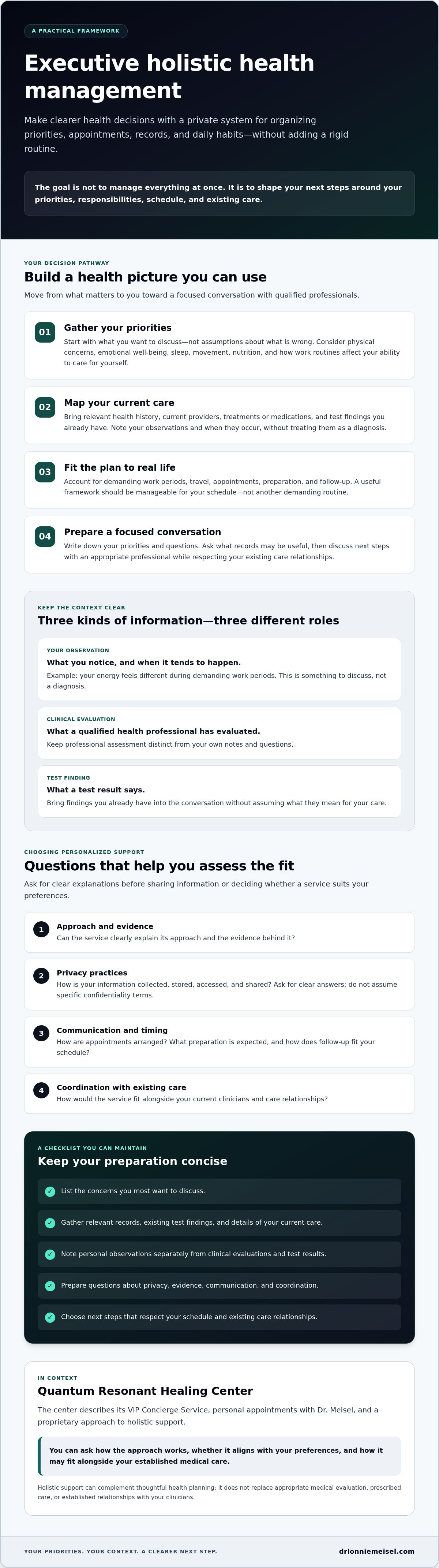
Create an Executive Health Management Checklist You Can Maintain
A useful checklist makes health decisions easier to organize, rather than becoming another obligation competing for your attention. Treat it as a working note to revisit with your care team. Keep only the detail that helps you prepare, decide, and follow through.
- Set your priorities. Write down the concerns you most want to discuss and what a helpful conversation would clarify. Separate immediate questions from longer-term wellness interests.
- Map your existing care. Note the healthcare professionals involved, current treatments or medications, and relevant health records. Keep information accurate and share it only through channels you’ve discussed with the provider.
- Prepare focused questions. Ask about the purpose, evidence, limitations, and follow-up for any service you’re considering. Clarify how its role may fit alongside your current care.
- Confirm consultation preparation. Before an appointment, ask what records or details the provider would like you to bring and whether any preparation is requested. Requirements can vary, so don’t assume a particular exam or test is necessary.
- Choose workable next steps. Discuss priorities with appropriate professionals and select actions that fit your schedule and individual needs. Avoid adopting a universal routine or changing treatment based on general guidance.
- Review and update. At a suitable follow-up point, consider what remains relevant, what has changed, and what questions should go back to your care team. Adjust the plan with professional input.
Keep the plan realistic during demanding weeks
Your schedule will not look the same every week. Decide with your care team which priorities are practical during a busy period, and revisit the plan when your responsibilities or circumstances change. If you miss an action, treat that as information about what is workable, not as a personal failure. Simplify or reschedule where appropriate, and ask a qualified professional if you’re unsure what should take precedence.
For related considerations when evaluating private, personalized support, read this private holistic health advisor guide. You can also explore this holistic optimization for high performers guide for adjacent context. These resources can inform your questions, but they don’t replace advice tailored to your circumstances by qualified professionals.
A sustainable approach to executive holistic health management is one you can review, adapt, and discuss without losing sight of existing care. If you’d like to consider personalized support, ask about an appointment with Dr. Meisel and clarify how it may fit your priorities and current care relationships.
Explore Personalized Support at the Quantum Resonant Healing Center
The Quantum Resonant Healing Center offers a VIP Concierge Service and personal appointments with Dr. Meisel. These appointments can provide an opportunity to discuss your priorities and learn how the Center describes its approach. Discretion and personalized attention are service attributes, not guarantees of a health outcome. Consider whether the model fits your needs, expectations, and existing care relationships before making an inquiry.
What is the Center’s approach to personalized holistic support?
The Center describes its proprietary method as Quantum Resonant Therapy, an approach involving quantum resonant technologies. Its Quantum Resonant Remedies are described as “Non-pharmaceutical, bio-informational tools designed to support the intestinal lining’s resonant state and reduce inflammation.” This is the Center’s description of its approach, not a claim that these methods are independently established to diagnose or treat a medical condition or produce a specific result.
Ask for a plain-language explanation of what an appointment involves, what the Center’s approach is intended to address, and where its scope ends. The VIP Concierge Service is not emergency care or insurance-based primary care. It should not be treated as a substitute for appropriate medical evaluation, prescribed treatment, or care from your existing healthcare professionals.
How can you decide whether to make an inquiry?
Before proceeding, identify what you hope to discuss and ask practical questions about service scope, appointment preparation, communication, and how the Center’s approach may fit alongside your current care. You can also ask how your information is handled and confirm privacy practices directly. Clear answers can help you decide whether the service is suitable, without pressure or assumptions.
If you’re comparing private-care models, this concierge medicine guide offers broader context. Use it to inform your questions, not as a substitute for advice from qualified health professionals about diagnosis or treatment.
A considered next step is a discreet inquiry to learn whether the Center’s services align with your priorities. Learn about Dr. Meisel’s services.
Make Your Next Health Decision With Clarity
Effective executive holistic health management is a private, adaptable process: clarify your priorities, prepare questions, and assess support carefully. Keep personal observations distinct from clinical findings, and discuss health decisions with qualified professionals who understand your existing care. A manageable framework should fit your responsibilities without becoming another rigid demand.
If you’re considering personalized holistic support, the Quantum Resonant Healing Center offers a VIP Concierge Service and personal appointments with Dr. Meisel. The Center describes its personalized care as based on proprietary Quantum Resonant Therapy. Before deciding whether to proceed, ask about the service’s scope, preparation, privacy practices, and how its approach may fit alongside your current care.
Learn about Dr. Meisel’s personalized services and consider whether an inquiry is the right next step for you. With clear questions and thoughtful guidance, you can move forward at a pace that respects both your health priorities and your time.
Frequently Asked Questions
What is executive holistic health management?
Executive holistic health management is a personalized framework for coordinating your health priorities with work and daily responsibilities. It can help you organize concerns, existing care, routines, and questions for discussion with qualified professionals. It isn’t a fixed protocol or a diagnosis. The aim is to support informed decisions while keeping clinical findings and personal observations distinct and preserving the care relationships already serving you.
How can executives manage their health when they have demanding schedules?
Choose a small number of priorities to discuss with your healthcare professionals, then prepare questions and relevant records before appointments. Keep any personal plan adaptable to your calendar rather than adopting a rigid routine. During especially demanding weeks, review what remains workable and adjust with appropriate professional input. If you miss an action, treat it as a cue to reassess the plan, not as a reason to abandon it.
Can holistic health support work alongside conventional medical care?
Holistic support may be considered alongside conventional care, but discuss a proposed service with your existing healthcare professionals. Ask how its approach fits with your current care and clarify what the provider does and does not offer. Keep diagnoses and treatment decisions with qualified clinical professionals. Don’t stop prescribed medication or change treatment based on an article or wellness discussion; bring those questions to the professional responsible for your care.
What should you ask before choosing a private holistic health service?
Ask how appointments are structured, what information to prepare, and how the provider explains its methods, evidence, limitations, and follow-up. Confirm the service’s scope and how it may coordinate with your existing care. Ask directly how your information is collected, stored, accessed, and shared. A clear provider should explain what the service offers and what it doesn’t, so you can assess whether it fits your needs and expectations.
Is a holistic health service a substitute for a primary care physician?
No. A holistic health service should not be assumed to replace primary care, emergency care, clinical evaluation, or prescribed treatment. Providers can have different roles and scopes, so confirm exactly what a service offers before beginning. Continue to discuss diagnosis and treatment with qualified healthcare professionals. If you have a health concern that needs medical assessment, contact an appropriate clinician rather than relying on a wellness service to provide care outside its scope.
How can you protect privacy when seeking personalized health support?
Ask the provider to explain its privacy practices before sharing personal health information. Find out how information is collected, stored, accessed, and shared, and which communication channels are used. Share relevant records through a method you’ve confirmed with the provider, and don’t assume discretion means specific privacy protections. You can decide what information to provide after you understand the provider’s process and feel comfortable with how your details will be handled.
What does the Quantum Resonant Healing Center offer executives?
The Quantum Resonant Healing Center offers a VIP Concierge Service, personal appointments with Dr. Meisel, and holistic healing through Quantum Resonant Remedies. The Center describes its approach as proprietary Quantum Resonant Therapy. It characterizes Quantum Resonant Remedies as Non-pharmaceutical, bio-informational tools designed to support the intestinal lining’s resonant state and reduce inflammation. These descriptions reflect the Center’s approach, not independently established outcomes. Its services are not emergency care or insurance-based primary care.


