
A frequency measured at 40 Hz is not, by itself, proof of a treatment for memory loss. Research into frequency therapy for cognitive decline includes specific sensory-stimulation methods, such as flickering light or rhythmic sound. Marketed frequency-based therapies may use entirely different approaches. Similar language can make very different claims sound equally established.
If you’re finding the headlines difficult to assess, that’s understandable. Studies of gamma rhythms and 40-Hz stimulation have drawn attention, but a promising research signal is not proof that an approach can prevent, slow, or reverse cognitive decline. The method tested, the people studied, and the outcomes measured all matter.
This article explains how formal 40-Hz research differs from other frequency-based therapies, what current findings can and can’t tell you, and how to assess claims about evidence and safety. You’ll also find practical questions to raise with a qualified clinician, including how a proposed approach relates to diagnosis and established care. The goal is to help you prepare for that conversation, not replace medical guidance.
Key Takeaways
- Understand why frequency therapy for cognitive decline describes different approaches, not one standardized treatment.
- Learn how animal research, human feasibility studies, and controlled trials answer different questions about 40-Hz stimulation.
- Assess what reported findings measure and which questions about cognitive outcomes remain unanswered.
- Prepare focused questions for a qualified healthcare professional, especially if memory or thinking changes are new, worsening, or concerning.
- Explore how the Quantum Resonant Healing Center describes its personalized care and Quantum Resonant Remedies without confusing them with 40-Hz research or established cognitive treatments.
What Does Frequency Therapy for Cognitive Decline Mean?
Changes in memory or thinking can feel worrying, and online claims about possible solutions can be difficult to assess. “Frequency therapy for cognitive decline” is a broad label, not the name of one standardized treatment. It may refer to approaches using light, sound, electrical signals, or other methods. Those approaches do not necessarily share a mechanism or an evidence base.
That distinction matters. Research into one defined method cannot establish that every therapy described as “frequency-based” has the same effects. Emerging findings are not proof of an established treatment for cognitive decline, and they should not replace clinical assessment.
What do researchers mean by 40-Hz gamma stimulation?
Gamma rhythms are patterns of brain activity. “40-Hz” refers to the rhythm or rate being studied, not to a demonstrated treatment outcome. A gamma wave is associated with cognitive functions such as attention and memory, but that association alone does not show that changing gamma activity improves those abilities.
MIT’s reporting on 40-Hz research discusses sensory stimulation, such as rhythmic light or sound, as a way to investigate this question. Researchers are testing whether a carefully defined sensory signal can influence brain activity and whether that influence might have a meaningful effect. This does not mean every service or product mentioning “frequency” uses the same method or has been tested in the same way.
How is frequency-based research different from a clinical treatment?
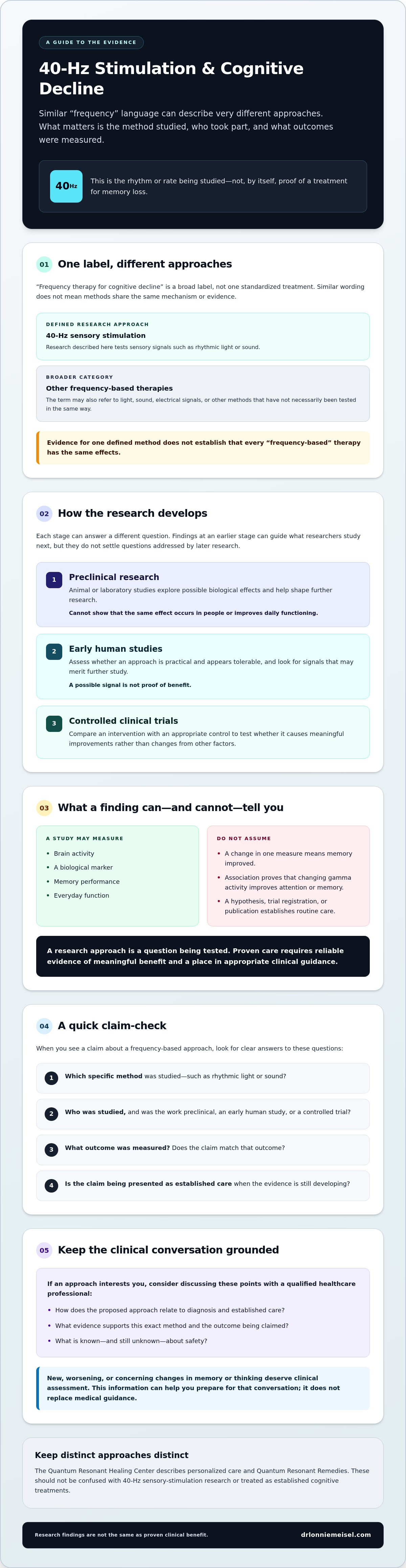
A hypothesis proposes a question researchers can test. A registered trial records a planned investigation, while a published study reports findings from completed research. None of these steps, by itself, establishes that an approach is effective or recommended for routine care. Study design, comparison groups, participant numbers, outcomes, and independent replication all affect how much confidence a result can support.
A research approach is a question being tested; proven care requires reliable evidence of meaningful benefit and a place in appropriate clinical guidance. Taking part in a trial does not guarantee benefit, and publication alone does not settle whether a method improves memory or daily functioning. When you encounter a frequency-based claim, check which specific method was studied, what outcome was measured, and whether the claim matches the evidence. These details help distinguish 40-Hz sensory-stimulation research from other therapies that use similar language.
How Do Researchers Study 40-Hz Stimulation and Cognitive Decline?
Researchers are testing whether repeated sensory stimulation at 40 Hz, such as light or sound, can affect brain activity and lead to meaningful changes in people with cognitive impairment. The question remains under investigation. MIT’s reporting describes developing research across animal and human studies; it does not establish clinical guidance or confirm that 40-Hz stimulation is an effective treatment.
Evidence develops in stages, and each stage answers a different question:
- Preclinical research: Animal or laboratory studies can explore biological effects and help researchers decide what to investigate next. They cannot show that the same effect occurs in people or improves daily functioning.
- Early human studies: These can assess whether an approach is practical and appears tolerable, while looking for possible signals that merit further research. A signal is not proof of benefit.
- Controlled clinical trials: Comparing an intervention with an appropriate control can help test whether it causes meaningful improvements rather than changes arising from other factors.
This progression matters when assessing claims about frequency therapy for cognitive decline. Findings at one stage can guide the next, but they should not be presented as if they answer questions addressed at a later stage.
What can preclinical and human studies tell us?
Preclinical research takes place before conclusions can be drawn about routine human care. Animal findings can help identify possible effects and refine research questions, but they do not establish safety or effectiveness for people. Early human studies add information about feasibility and safety and may identify outcomes worth testing. Stronger controlled evidence is needed before researchers can support treatment claims.
Pay attention to what a study measures. It may assess brain activity, a biological marker, memory performance, or everyday function. A change in one measure does not automatically mean a person experiences better cognition or greater independence.
What does a clinical-trial listing establish?
A trial registry shows that a study has been listed with details such as its purpose and design. Registration is not a result and does not confirm clinical effectiveness. The Alzheimer’s.gov page for a clinical trial on light therapy offers an example of research into 40-Hz light combined with cognitive games. Check the listing’s current status and details before describing the study as active or drawing conclusions from it.
Trial registration documents an investigation; only reported results, carefully assessed, can inform whether an intervention may offer benefit. If you’d like a private conversation about the Quantum Resonant Healing Center’s distinct approach, a personal appointment with Dr. Meisel is an opportunity to discuss it, not a substitute for clinical assessment or established care.
What Does the Evidence Say, and What Can It Not Prove Yet?
MIT’s reporting describes 40-Hz sensory stimulation as an active area of research, with work spanning animal and human studies. That is a reason to follow the research, not a basis for concluding that the approach prevents, slows, treats, or reverses cognitive decline. Judge evidence by what a study actually measured and whether its findings show meaningful benefit for people.
It helps to separate research activity from conclusions that can be drawn from the evidence:
| Research stage or activity | What it may demonstrate | What remains unanswered |
|---|---|---|
| Animal studies | Whether a defined stimulation protocol produces biological or behavioral effects in an animal model. | Whether the same effects occur in people, or improve memory, thinking, or daily function. |
| Early human studies | Whether an approach can be studied with people, and whether it appears feasible or tolerable in the setting examined. Researchers may also look for preliminary signals. | Whether those signals represent reliable, meaningful cognitive benefit, and whether they apply beyond the participants and conditions studied. |
| Controlled clinical trials | When well designed and completed, a comparison can help test whether a specified intervention produces an outcome beyond what might occur otherwise. | Whether results are consistent, clinically meaningful, and sufficient to inform routine care. |
What is promising, and what remains uncertain?
The research question is specific: what effects, if any, might a defined 40-Hz sensory-stimulation protocol have on people with cognitive decline? MIT’s report provides context on developing research, but research coverage is not a clinical guideline or proof of effectiveness. Human benefit remains unproven unless verified results support a narrower, clearly described conclusion. For example, a change in a laboratory measure would not, by itself, show that a person’s memory or independence improved.
Why should readers distinguish different frequency-based approaches?
40-Hz sensory stimulation uses a specified light or sound pattern to study gamma activity. Bio-informational healing is a distinct complementary approach involving the body’s informational field and resonant frequencies. Similar wording does not make the methods equivalent. Evidence from one stimulation protocol cannot validate unrelated therapies, including Quantum Resonant Therapy or Quantum Resonant Remedies. The center’s offerings are not established treatments for cognitive decline.
When assessing a claim about frequency therapy for cognitive decline, look for the exact method studied, the outcomes measured, and evidence in people. Then check whether the claim stays within what those findings can support.
How Can You Evaluate a Frequency Therapy Claim Safely?
If memory or thinking changes are new, worsening, or concerning, arrange a timely assessment with a qualified healthcare professional. Don’t rely on an online description or a therapy provider to determine the cause. An assessment can help clarify what is happening and whether further evaluation or care is appropriate.
Before considering frequency therapy for cognitive decline, ask for precise information about the proposed method. The word “frequency” alone doesn’t tell you what is delivered, what evidence applies, or what risks may matter in your circumstances. Bring those details to a qualified healthcare professional who understands your health history and current care.
What questions should you ask before considering an intervention?
A focused conversation can help separate a specific research finding from a broader marketing claim. Consider asking:
- What exact method is being offered? Is it the same light, sound, or other protocol used in the cited research, or a different approach?
- What evidence supports this specific method? Does it come from animal research, early human studies, or controlled trials?
- What outcomes were measured? Did researchers assess brain activity or a biomarker, or changes in memory and everyday function?
- Do the findings apply to someone in my situation? Ask about the people studied, study limitations, and whether results have been independently confirmed.
- What risks or side effects are known? Ask what monitoring is recommended and who you should contact if concerns arise.
- How will this fit with my current care? Ask whether your healthcare team can coordinate, and whether trying the intervention could delay an assessment or established care.
Be cautious if a provider guarantees results, claims to cure a disease, or advises you to stop prescribed treatment. Discuss those claims with your healthcare professional before acting. Don’t change prescribed care without consulting the clinician responsible for it.
When should you seek medical assessment?
Seek prompt advice from a qualified healthcare professional for memory or thinking changes that concern you. Avoid self-diagnosis. If symptoms begin suddenly or feel urgent, contact appropriate local medical services rather than waiting to explore a complementary approach.
Complementary care should not delay clinical assessment or replace prescribed care. If you’d like to discuss the Quantum Resonant Healing Center’s distinct approach, you can request a personal appointment with Dr. Meisel. Treat that conversation as an opportunity to understand the approach, not as a diagnosis or a substitute for established medical care.
How Does the Quantum Resonant Healing Center Approach Personalized Care?
Dr. Lonnie Meisel operates the Quantum Resonant Healing Center, which offers personalized appointments, VIP Concierge services, proprietary Quantum Resonant Therapy, and Quantum Resonant Remedies. These are the center’s own offerings, distinct from the 40-Hz light and sound protocols being investigated in research. Similar language about frequencies does not mean two approaches use the same method or share the same evidence.
The center describes Quantum Resonant Remedies as holistic healing solutions delivered through its proprietary resonant methods. That description does not establish an effect on memory, thinking, or cognitive decline. Quantum Resonant Therapy and Quantum Resonant Remedies are not established treatments for cognitive decline or substitutes for clinical assessment and established care.
What does the center offer?
Personal appointments with Dr. Meisel provide an opportunity to learn about the center’s approach and ask questions about its services. VIP Concierge Service is also among its offerings. These services are not emergency care, insurance-based primary care, or established cognitive treatments. If you’re considering frequency therapy for cognitive decline, keep this distinction clear: research findings about a specific sensory-stimulation protocol should not be applied to separate offerings without evidence that directly studies those offerings.
Ask the center to explain what a proposed service involves, what it is intended to support, and what evidence applies to that exact approach. Clear answers about the service’s scope and limits can help you make an informed decision. A provider’s description of a service and published evidence of a health outcome are not the same thing.
How can you discuss the approach responsibly?
Keep your qualified healthcare professional informed about any complementary approach you’re considering. Share the information you receive from the center and ask how it may fit alongside your current assessment and care. You can also ask the center how it coordinates with your existing healthcare team, what evidence supports the specific service, and whether there are reasons to avoid or delay it in your situation.
Base your decision on clear information, personal discretion, and continued communication with your clinician. If you would like to learn more about the center’s personalized approach, Learn about the Quantum Resonant Healing Center.
Make Your Next Decision With Clarity
The evidence on frequency therapy for cognitive decline depends on the specific method being studied. Research into 40-Hz sensory stimulation is not proof that every frequency-based approach has the same effects, and promising research should not be mistaken for established treatment.
If you or someone close to you has concerning memory changes, discuss them with a qualified healthcare professional. Before considering an intervention, ask what exact method is offered, what evidence supports it, what risks are known, and how it would fit with existing care. Don’t stop prescribed treatment or delay an assessment based on a promise of a cure.
Dr. Lonnie Meisel offers personalized appointments through the Quantum Resonant Healing Center. The center’s proprietary Quantum Resonant Therapy is distinct from 40-Hz research and is not an established treatment for cognitive decline. To learn more about the center’s approach, visit the Quantum Resonant Healing Center.
Careful questions and informed clinical guidance can help you move forward with greater confidence and discretion.
Frequently Asked Questions
Can frequency therapy treat cognitive decline?
There’s no basis to treat “frequency therapy” as one proven treatment for cognitive decline. The phrase can describe different approaches, and evidence about one method does not establish that another works. Research into 40-Hz sensory stimulation is ongoing, but it doesn’t prove that frequency-based therapies prevent, slow, treat, or reverse cognitive decline. If you’re considering an approach, ask a qualified healthcare professional about its specific evidence and how it fits with your care.
What is 40-Hz gamma stimulation?
40-Hz gamma stimulation refers to research using sensory signals, such as rhythmic light or sound, at a rate of 40 times per second. Gamma rhythms are patterns of brain activity, not a treatment outcome. Researchers are investigating whether this type of stimulation affects brain activity and whether it may have meaningful effects for people. The term doesn’t describe every therapy that mentions frequencies, and findings from one protocol shouldn’t be generalized to others.
Is 40-Hz stimulation proven to help Alzheimer’s disease?
No. Research into 40-Hz stimulation is ongoing, and current findings do not establish it as a proven treatment for Alzheimer’s disease. Animal studies, early human research, and controlled clinical trials provide different levels of evidence. A change in brain activity or a biological marker also doesn’t necessarily mean memory or daily function has improved. Ask whether claims you encounter are based on results in people and whether those results apply to the specific method being offered.
What does the Light and Cognitive Therapy for Alzheimer’s Disease trial study?
The Alzheimer’s.gov listing describes a study of 40-Hz light therapy combined with cognitive games. It provides information about the research question and study methods, but a listing is not a report of results or proof of benefit. Trial status and details can change, so verify the current registry information before relying on it. Even when a trial has results, those findings need careful review to understand what outcomes were measured and what conclusions they support.
Can Quantum Resonant Therapy reverse memory loss?
The Quantum Resonant Healing Center does not describe Quantum Resonant Therapy as an established treatment for memory loss or cognitive decline. It is a proprietary service offered by Dr. Lonnie Meisel, distinct from 40-Hz sensory-stimulation research. If you’re interested in the center’s approach, ask what the service involves and what evidence applies to it. Keep communicating with your qualified healthcare professional, and don’t substitute complementary care for clinical assessment or established care.
Should you stop medication before trying frequency therapy?
No. Don’t stop or change prescribed medication to try a frequency-based intervention without first speaking with the clinician who manages your care. Ask about the proposed method, possible risks, and how it may fit with your treatment plan. Share relevant information with your healthcare professional, including any claims or instructions provided by a therapy provider. Be cautious of anyone who guarantees results or advises you to stop prescribed care without clinical guidance.
When should you see a clinician about memory changes?
Speak with a qualified healthcare professional if memory or thinking changes are new, worsening, or concerning to you. Don’t rely on self-diagnosis or wait to see whether a complementary approach helps before seeking assessment. A clinician can discuss your concerns and advise on appropriate next steps. If symptoms come on suddenly or feel urgent, contact appropriate local medical services. Keep your clinician informed about any intervention you’re considering.


