
Could a holistic approach to neuroinflammation support your wellbeing without being mistaken for treatment? Start by understanding what researchers mean by neuroinflammation, what current evidence can show, and where it remains limited.
If you’re experiencing changes in memory, mood, focus, or energy, it’s understandable to wonder whether inflammation is involved. These symptoms can have many causes and don’t confirm neuroinflammation on their own. A considered approach begins with appropriate medical evaluation, not assumptions or wellness claims.
This article explains neuroinflammation in plain language, outlines how researchers study it, and reviews evidence on supportive habits such as diet, physical activity, sleep, and stress management. You’ll also learn how to assess supplement claims and discuss individualized holistic care while maintaining medical oversight.
At the Quantum Resonant Healing Center, Dr. Lonnie Meisel provides personalized holistic care through his proprietary Quantum Resonant Therapy. You can explore this approach while keeping its role distinct from established clinical evidence and avoiding expectations that a wellness practice will cure a medical condition.
Key Takeaways
- Neuroinflammation is a biological process, not a diagnosis you can determine from symptoms alone. Changes in cognition, mood, sleep, or pain can have many causes.
- Researchers study immune signals and microglia to understand nervous-system responses, but research models are not personal diagnostic tests.
- A holistic approach to neuroinflammation can include sleep, movement, nutrition, and stress management as supportive habits, while recognizing the limits of the evidence.
- Note your symptoms, when they began, how they affect daily life, and what you hope to address. This can help you discuss your concerns clearly with a qualified medical professional.
- Dr. Meisel’s Quantum Resonant Therapy and Quantum Resonant Remedies are part of the center’s proprietary approach. They are not established treatments for neuroinflammation.
What Does Neuroinflammation Mean, and What Can Symptoms Tell You?
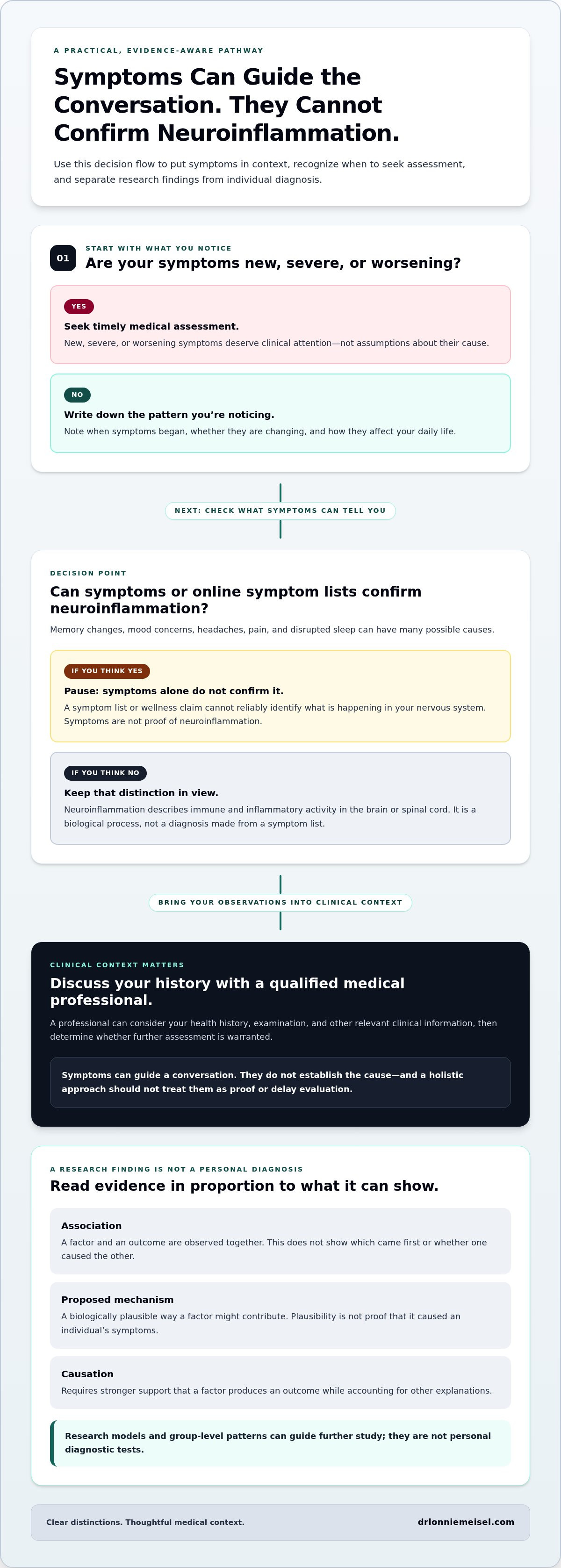
A memory lapse, persistent headache, or restless night can raise understandable concerns about brain health. But symptoms don’t reveal their cause on their own. Neuroinflammation is a biological process involving immune activity in the nervous system, not a diagnosis made from a symptom list. Keeping that distinction clear helps you seek useful answers without assuming inflammation is responsible.
Definition box: In research, “neuroinflammation” describes immune and inflammatory activity in the brain or spinal cord. For an individual, symptoms alone don’t confirm that this process is occurring or establish its cause. Clinical interpretation depends on the person’s broader health context.
How neuroinflammation differs from everyday inflammation
Inflammation is part of the body’s defense and repair response. In the central nervous system, which includes the brain and spinal cord, immune signaling involves cells and chemical messages that help respond to changes or threats. This activity is not automatically harmful or evidence of disease. Its meaning depends on what is happening, how long it lasts, and the surrounding context.
Microglia are immune cells that help monitor the brain and spinal cord. They respond to signals in their environment and participate in immune activity within nervous tissue. Researchers use “neuroinflammation” to describe processes involving these and other components. The term covers varied mechanisms, not one single condition. A plain-language overview appears in Neuroinflammation: An Overview.
A biological response is not the same as a clinical diagnosis. A process described in research cannot be inferred in one person simply because a symptom seems consistent with it.
When symptoms need broader clinical context
Memory changes, mood concerns, headaches, pain, and disrupted sleep may prompt questions about neurological health. Each can have many possible causes, including different health conditions, medication effects, emotional strain, or changes in sleep and daily routine. Symptoms may occur together without sharing one cause. They can guide a conversation, but they don’t establish neuroinflammation.
Symptoms alone cannot confirm neuroinflammation. They need to be interpreted alongside your history, examination, and other relevant clinical information. Online symptom lists and wellness claims cannot reliably identify what is happening in your nervous system.
Note what you notice, when it began, whether it is changing, and how it affects daily life. Share that history with an appropriately qualified medical professional, who can consider possible explanations and determine whether further assessment is warranted. Seek timely medical assessment for symptoms that are new, severe, or worsening. A holistic approach to neuroinflammation should respect this clinical context rather than treating symptoms as proof or delaying evaluation.
How Neuroinflammation Develops: What Research Says About Brain Immune Signaling
Research on neuroinflammation draws on different kinds of evidence, and each can answer different questions. Some studies identify patterns in groups of people. Others test biological explanations in laboratory or animal models. These findings can guide further research, but they don’t all carry the same weight when considering a possible cause of symptoms in an individual.
Microglia, cytokines, and the nervous system
Researchers examine how immune-related signals and cells may change under particular conditions. A study might measure an inflammatory marker, observe a difference between groups, or test how a proposed pathway behaves in a model system. These methods can point to a possible relationship, but a marker is not a stand-alone explanation for symptoms, and a model is not a personal diagnostic assessment.
The distinction is useful: an association means a factor and an outcome are observed together. It doesn’t show which came first or whether one caused the other. A proposed mechanism describes a biologically plausible way a factor might contribute. Evidence for causation requires stronger support that the factor produces the outcome while accounting for other explanations. Harvard Medical School’s discussion of Neuroinflammation’s Impact on Brain Health addresses concerns about uncontrolled activity and brain health, but general findings cannot establish what is happening in a particular person.
A plausible biological pathway can guide research, but it is not proof that the pathway caused an individual’s symptoms. This distinction helps keep emerging findings in perspective, especially when a wellness claim presents one mechanism as a complete explanation.
Stress and other proposed influences in the research
Research reviews discuss psychosocial stress, early-life adversity, and infection as factors that may relate to immune pathways. A review summarizes findings from multiple studies and may identify patterns or propose explanations. It cannot, by itself, prove that a factor causes neuroinflammation in every person. The strength of a claim depends on the underlying studies, their methods, and whether findings are consistent across different kinds of evidence.
For example, a study may find an association between an exposure and a biological measure. Researchers may then investigate whether a mechanism could explain that link. Neither result alone establishes that the exposure caused a person’s symptoms. Health history and other circumstances may also matter.
Reviews published in 2025-2026 have synthesized research into gut-brain communication and neurological conditions. Treat these as summaries of an active research area, not individualized clinical guidance. A holistic approach to neuroinflammation can acknowledge possible influences without turning them into a personal diagnosis or certainty about cause.
If you want to explore a personalized holistic perspective alongside appropriate medical care, you can learn about Dr. Meisel’s holistic approach.
Holistic Strategies for Neuroinflammation: Evidence, Limits, and Comparisons
A holistic approach to neuroinflammation may include habits that support general wellbeing, but that doesn’t establish them as treatments for inflammation in the brain. Consider what a practice may reasonably support, how strong the evidence is for that outcome, and whether it suits your circumstances.
Lifestyle practices as general health support
Sleep, physical activity, balanced nutrition, and relaxation can contribute to overall health. Their effects vary, and evidence about general wellbeing should not be presented as proof that a habit reduces neuroinflammation for every person. The comparison below separates a reasonable rationale from evidence limits and practical considerations.
| Practice | Rationale and evidence limits | Feasibility to consider |
|---|---|---|
| Sleep | Consistent, restorative sleep supports daily functioning. That doesn’t prove a particular sleep routine treats neuroinflammation. | Work schedules, caregiving, pain, and sleep conditions can affect what is achievable. |
| Physical activity | Movement supports general health. Any direct effect on neuroinflammation requires evidence for a defined outcome. | Your abilities, symptoms, health history, and access to safe activity matter. |
| Balanced nutrition | A UK Biobank study of more than 130,000 adults found an association between a Mediterranean-style anti-inflammatory diet and lower dementia risk. This is an association with dementia risk, not proof that the diet prevents or treats neuroinflammation. | Food preferences, medical needs, culture, and access shape what is practical. |
| Stress management | Relaxation practices such as meditation or breathing exercises may support stress management. Findings about stress or inflammatory markers don’t establish treatment of an individual condition. | Choose an approach that feels accessible and comfortable. It need not involve a formal program. |
There is no universal routine to follow. Your health history, current symptoms, and everyday constraints affect which changes are appropriate. Small, sustainable adjustments may be more feasible than a rigid plan, but even sensible habits shouldn’t be used to explain symptoms without clinical context.
How to read evidence about supplements and wellness claims
Evidence comes in different forms. Human clinical studies examine outcomes in people, while animal research and laboratory experiments explore possible mechanisms but may not predict what happens in humans. A theory can suggest a research question; it is not proof of benefit. Check what outcome a study measured, too: a change in one marker doesn’t automatically mean improved symptoms or a confirmed change in brain inflammation.
Be cautious with claims that a supplement will “cure” neuroinflammation, “detox” the brain, or guarantee results. Such language calls for strong, directly relevant evidence. Supplements can also interact with medicines or be unsuitable in some circumstances, so review them with a qualified medical professional before use.
Supportive habits can contribute to wellbeing, but they are not established substitutes for medical care. Keep that distinction clear as you weigh any holistic strategy, and don’t stop or delay prescribed care based on a wellness claim.
Build a Safe, Individualized Plan for Neuroinflammation Concerns
A useful plan is not a self-diagnosis checklist. It helps clarify what support you’re considering, coordinate it with your existing care, and decide how you’ll judge whether it serves your goals. Focus on practical decisions rather than trying to prove a specific biological explanation.
Prepare a clear picture of your health concerns
Before a care discussion, identify your priorities. You might want help maintaining a steady sleep routine, finding movement that fits your abilities, or understanding whether a supplement is appropriate. Bring a current list of medications and supplements, including how you take them, and note any previous reactions or concerns. This context can help the professional you consult discuss safety and possible interactions.
- Choose a specific goal. State what you hope to support, such as making a daily routine easier to sustain. Avoid framing the goal as proof that you have neuroinflammation.
- Describe the practice you’re considering. Be specific about a supplement, dietary change, or mind-body practice, including how you expect it to fit into your life.
- Ask focused questions. Discuss the evidence for the outcome you care about, possible risks, and whether the practice is suitable alongside your current care.
- Agree on a way to review it. Decide what practical outcome would matter to you and when to revisit the decision with your care team.
Personal observations can help you assess whether a routine is manageable or whether you notice a change in day-to-day functioning. They cannot establish that a biological process has changed. Avoid adding several new practices at once if doing so would make it difficult to understand what is useful or tolerable. A measured approach can make conversations clearer without turning everyday fluctuations into diagnostic evidence.
Keep holistic support coordinated and evidence-aware
Discuss complementary practices with an appropriately qualified medical professional, particularly before introducing supplements or making substantial changes to your diet or routine. Share what you plan to try, why it appeals to you, and what outcome you hope to support. Ask how it fits with your current care and whether your medical history raises specific concerns.
Don’t stop, delay, or change prescribed care based on this article or a wellness claim. If a proposed practice is described as a cure or guaranteed solution, ask what evidence supports that precise claim. A holistic approach to neuroinflammation should make room for your preferences while keeping decisions grounded in evidence and coordinated with medical care.
If broader lifestyle reflection is part of your goals, the holistic approach to chronic wellness may offer related perspective. Dr. Meisel also offers individualized appointments for people seeking holistic guidance. You can explore personal appointments with Dr. Meisel as one part of a considered plan.
How Dr. Meisel's Holistic Approach Fits Within the Evidence
Knowing the difference between research findings and established clinical guidance can help you consider personalized holistic care with appropriate expectations. Dr. Lonnie Meisel provides individualized care through the Quantum Resonant Healing Center, including VIP Concierge services and personal appointments. His approach offers a perspective on wellbeing, not an established way to diagnose or treat neuroinflammation.
What personalized holistic care can mean
Personalized care makes room for your priorities and broader health context rather than treating a general wellness claim as a one-size-fits-all answer. In an appointment with Dr. Meisel, you can discuss the concerns and goals that matter to you. A clear conversation can also make space for uncertainty: what is known, what remains a research question, and what belongs within medical evaluation.
That distinction is central to a responsible holistic approach to neuroinflammation. Individual attention may help you consider wellbeing in context, but it doesn’t establish the cause of symptoms or replace assessment by a qualified medical professional. Any complementary approach should sit alongside, not displace, appropriate medical care. You can read a related perspective in this VIP concierge holistic health guide.
How to understand Quantum Resonant Therapy and remedies
Quantum Resonant Therapy is the center’s proprietary, frequency-based approach. Its description reflects the center’s method; it should not be presented as an established neuroinflammation treatment or proof that a specific biological pathway has changed. If you’re considering this approach, keep the distinction between a wellness practice and evidence for a defined clinical outcome clear.
Quantum Resonant Remedies are non-pharmaceutical, bio-informational tools designed to support the intestinal lining’s resonant state and reduce inflammation. This description concerns the center’s approach to the intestinal lining. It doesn’t establish that the remedies reduce inflammation in the brain, treat neuroinflammation, or address the cause of neurological symptoms.
A useful conversation can focus on your goals, the limits of current evidence, and how a holistic practice fits with existing medical care. Share relevant health information and keep a qualified medical professional involved in decisions about symptoms, prescribed care, or supplements. Discretion and individualized attention support a considered discussion, while transparent language helps keep expectations grounded.
To explore this perspective in a personalized setting, learn more about personalized holistic appointments with Dr. Meisel. These appointments introduce the center’s approach; they are not a substitute for medical evaluation or a promise of treatment for neuroinflammation.
Choose Your Next Step With Clarity
Your next step doesn’t need to begin with a label for your symptoms. Start with the questions that matter to you, the changes you’ve noticed, and the kind of support you hope to explore. A thoughtful holistic approach to neuroinflammation keeps your priorities in view while treating medical evaluation and evidence as essential guides.
If you’re considering additional wellness support, discuss your goals in a private, individualized setting and keep your existing medical care central to decisions. Dr. Meisel’s appointments offer the opportunity to explore the Quantum Resonant Healing Center’s approach, including Quantum Resonant Therapy and Quantum Resonant Remedies, with clear expectations about what these methods do and don’t establish regarding neuroinflammation.
Explore personalized holistic appointments with Dr. Meisel as a considered next step. Choose care that respects your questions, supports informed decisions, and keeps expectations grounded.
Frequently Asked Questions
Can neuroinflammation be diagnosed from symptoms alone?
No. Symptoms alone can’t establish a neuroinflammation diagnosis. When discussing concerns with a clinician, ask what the evaluation can determine, what it cannot determine, and how any proposed test would affect next steps. This can help you distinguish a test that answers a specific clinical question from one that provides information without clarifying care decisions.
Is neuroinflammation always harmful?
No. Immune activity can serve protective functions, and the word “neuroinflammation” in a research paper doesn’t automatically mean a person has a harmful condition. Check how the term is being used: a study may describe a measured biological response, while a clinical diagnosis refers to an assessment of an individual. This distinction can prevent a research finding from being misread as a personal prognosis.
Can stress cause neuroinflammation?
Stress alone can’t establish the cause of neuroinflammation in your case. If stress is a concern, separate two questions in your discussion: whether you want support managing stress, and whether there is clinical evidence explaining your symptoms. You can seek help with the first without assuming the second. This keeps a wellbeing goal from becoming a conclusion about an underlying biological process.
What foods reduce neuroinflammation?
No particular food is proven to reduce neuroinflammation for every person. Rather than removing whole food groups based on a broad claim, consider whether a proposed change is nutritionally appropriate and sustainable for you. If you have a medical diet, food allergies, or concerns about restrictive eating, discuss changes with a qualified professional. Ask what specific outcome the dietary advice is intended to support.
Can meditation or yoga treat neuroinflammation?
Meditation and yoga aren’t established treatments for neuroinflammation. If you’re interested in either, choose a form that suits your comfort, mobility, and preferences, and treat it as a personal wellbeing practice rather than a medical intervention. You can consider whether it feels practical or supports relaxation, but that experience can’t show whether inflammation has changed or replace evaluation of a health concern.
What happens if I think my symptoms may be related to neuroinflammation?
Use the concern as a prompt to clarify what you need from a clinical conversation. Ask which explanations are being considered, what would make further testing useful, and what findings would change the care plan. If you already have test reports or a relevant medical history, bring them together so the discussion can focus on decisions rather than trying to interpret isolated results on your own.
Can holistic care replace conventional medical treatment for neuroinflammation?
No. Holistic care should not replace medical evaluation or prescribed treatment. If you choose to include it, its role should be clearly described and kept distinct from diagnosis or treatment claims. At the Quantum Resonant Healing Center, Quantum Resonant Therapy and Quantum Resonant Remedies are part of the center’s proprietary approach, not established substitutes for medical care. Discuss complementary practices with your medical professional before changing your care. To learn about Dr. Meisel’s private, individualized appointments, explore the Quantum Resonant Healing Center.


