
If you’ve wondered how cellular frequency imbalances cause chronic pain, you may be looking for an explanation when pain persists without a clear injury. Your experience is real, even when its source is difficult to identify. Pain science offers established ways to understand how the nervous system processes pain, while “cellular frequency imbalance” remains a proposed explanation rather than a proven cause.
This article separates recognized pain processes from what frequency-based explanations can and cannot demonstrate. You’ll learn how electrical signaling and heightened nervous-system sensitivity may contribute to persistent pain, what evidence would be needed to support a frequency-based claim, and why “cellular frequency” is not a standard medical diagnosis.
You’ll also learn how the Quantum Resonant Healing Center’s personalized approach, including bio-informational healing, fits alongside conventional medical understanding. It does not replace medical evaluation or prescribed care. The aim is to help you assess these ideas with discernment and consider informed next steps with your health and privacy in view.
Key Takeaways
- Persistent pain is real, even when its cause is unclear. Nervous-system changes can help explain how pain continues.
- How cellular frequency imbalances cause chronic pain is a proposed explanation, not an established medical diagnosis or proven cause.
- Biological signals researchers can measure are not, by themselves, evidence that a specific disruption causes an individual’s pain.
- Track your symptoms, including timing, duration, location, and effects on daily life, to support a more informed medical evaluation.
- The Quantum Resonant Healing Center offers an individualized frequency-based perspective that can be considered as complementary to, not a replacement for, medical care.
How cellular frequency imbalances relate to chronic pain: define the claim
If you live with persistent pain, your experience is real even when tests or examinations do not reveal a clear cause. The phrase “cellular frequency imbalance” may sound like a direct explanation, but it is a proposed idea, not a standard chronic-pain diagnosis. In this context, it generally refers to a possible disruption in biological signaling or rhythmic activity that is suggested to affect how the body processes pain.
A useful distinction is between a measurable biological signal and a claim about what that signal means. Researchers can measure electrical activity, chemical communication, or rhythmic patterns in specific cells and tissues. Finding a signal does not establish that it is abnormal, that it causes pain, or that changing it would improve symptoms. Each conclusion requires its own supporting evidence.
What does cellular frequency mean in a biological context?
Cells communicate through electrical changes, chemical messengers, and patterns of activity that vary over time. In some settings, scientists can record these signals and examine how they relate to a biological process. That measurable activity is different from using “frequency” as a general wellness metaphor for a body being out of balance. Cells do not all operate at one universal frequency that can diagnose pain on its own.
So, asking how cellular frequency imbalances cause chronic pain involves more than identifying a biological rhythm. A specific signal would need to be clearly defined and measured, then linked to pain through evidence that distinguishes cause from coincidence. Without that detail, “frequency imbalance” remains a broad explanatory phrase rather than a precise mechanism. A general reference such as the Chronic Pain Overview can introduce the topic, but it does not establish a cellular-frequency explanation.
What makes pain chronic rather than temporary?
Chronic pain persists or recurs over time, unlike temporary pain that may accompany an injury and settle as the body recovers. Duration describes the course of pain; it does not identify one cause. Persistent symptoms can have different contributing factors, and the same description of pain may reflect different processes in different people.
If your pain continues, returns, changes, or affects daily activities, seek an individualized clinical assessment. A clinician can consider your symptoms and health history rather than assuming that one label or proposed frequency explanation fits. Before an appointment, note when the pain began, where you feel it, and how it changes. These details can support a clearer discussion. Persistent pain deserves careful attention, even when its cause is not immediately apparent.
How recognized pain pathways can sustain chronic pain
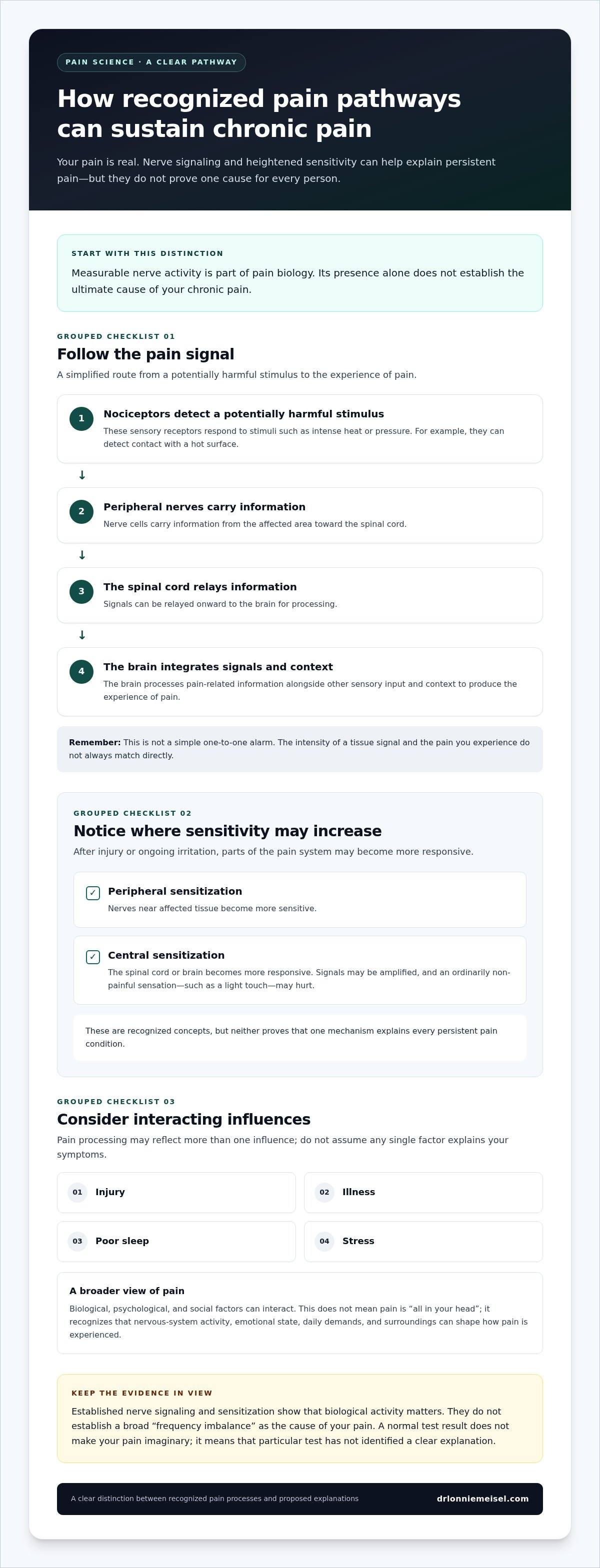
Pain signaling follows pathways scientists can study, but those pathways do not reduce your experience to a single signal or explain every person’s symptoms. Nociceptors are sensory receptors that detect potentially harmful stimuli, such as intense heat or pressure, and send information through peripheral nerves toward the spinal cord and brain. The brain processes that information alongside other signals and context to produce the experience of pain.
Key distinction: Nociceptor activity and nerve signaling are measurable parts of pain biology, but their presence alone does not prove the ultimate cause of an individual’s chronic pain.
How nerves carry and process pain signals
Imagine touching a hot surface. Nociceptors in the skin detect a potentially damaging stimulus, and nerve cells carry information toward the spinal cord, where it can be relayed to the brain. The brain integrates it with other sensory input and context. This is not a simple one-to-one alarm: the intensity of a tissue signal and the pain you experience do not always match directly. A normal test result also does not make pain imaginary. It means that particular test has not identified a clear explanation.
Why the nervous system can become more sensitive
After an injury or ongoing irritation, parts of the pain system may become more responsive. Peripheral sensitization describes increased sensitivity in nerves near affected tissue. Central sensitization refers to heightened responsiveness in the spinal cord or brain, so signals may be amplified or ordinarily non-painful sensations, such as a light touch, may hurt. These are recognized concepts, not proof that one mechanism explains every persistent pain condition.
Sensitivity can reflect interacting influences rather than one isolated trigger. Injury, illness, poor sleep, and stress may affect pain processing in some circumstances, but none should be assumed to explain your symptoms without an individualized assessment. Pain also involves biological, psychological, and social factors. That does not mean it is “all in your head.” It recognizes that nervous-system activity, emotional state, daily demands, and surroundings can interact in shaping how pain is experienced.
This distinction matters when considering claims about how cellular frequency imbalances cause chronic pain. Established nerve signaling and sensitization show that biological activity matters; they do not establish a broad “frequency imbalance” as the cause of a particular person’s pain. A proposed mechanism needs specific, measurable evidence and a demonstrated link to symptoms, not simply a description that sounds compatible with the biology.
If you’re exploring a holistic perspective alongside medical care, Dr. Meisel’s personalized appointments offer a private setting to discuss the Quantum Resonant Healing Center’s approach. Learn about personalized holistic care as a complementary perspective, not a substitute for clinical evaluation or prescribed treatment.
Cellular frequency imbalance and chronic pain: what evidence can support
Biological activity can be measured without proving that it causes a person’s pain. Researchers may record electrical signals or rhythmic activity in cells, nerves, or other tissues. To connect a finding to chronic pain, evidence must show more than a signal’s presence. It must establish that the signal is reliably related to pain and help explain why symptoms occur or persist.
The question of how cellular frequency imbalances cause chronic pain therefore depends on what “imbalance” means, how it is measured, and whether findings hold up under testing. Association, a proposed mechanism, and demonstrated clinical causation are different levels of evidence. A pattern associated with pain may be a clue, but it does not establish that the pattern caused the pain. A proposed mechanism explains how that might happen; clinical causation requires stronger evidence that the relationship is real and relevant to patients.
| Evidence category | What it can support | What it cannot establish alone |
|---|---|---|
| Established pain concepts | Recognized processes such as nerve signaling and sensitization can contribute to pain processing. | They do not identify the cause of every person’s symptoms. |
| Exploratory frequency hypotheses | A defined biological rhythm or signal may be studied for a possible relationship to pain. | A measured pattern does not prove a general “frequency imbalance” causes chronic pain. |
| Unanswered questions | Further research can test how a signal relates to symptoms and whether changing it affects outcomes. | A laboratory observation alone does not show that an assessment or intervention benefits patients. |
What research would be needed to establish causation?
Researchers would need to define the proposed frequency, specify how it is measured, use suitable comparison groups, and show that the method produces reproducible results. Independent teams would then need to replicate the findings. Even a reliable laboratory result is not the same as evidence that a test can explain an individual’s pain or that a treatment based on it improves meaningful patient outcomes. Specific cellular-frequency or electromagnetic claims need credible evidence relevant to the claim being made.
Evidence boundary: Pain signaling and sensitization are recognized biological concepts. The claim that a cellular-frequency disruption causes an individual’s chronic pain requires specific, reproducible clinical evidence.
How to interpret frequency-based explanations responsibly
Broad descriptions can be difficult to assess until the terms are defined. If a frequency-based explanation is offered, ask what is measured and what the measurement is intended to show. Find out whether the supporting evidence relates to a laboratory signal, a clinical diagnosis, or outcomes experienced by patients. These are different kinds of evidence, and one does not automatically establish the others.
- What is being measured? Ask for the specific signal or pattern and how it is recorded.
- What does the evidence establish? A laboratory observation, a proposed mechanism, and demonstrated patient benefit are not interchangeable.
- How does this fit with my care? Clarify how a complementary approach would sit alongside medical evaluation and prescribed treatment.
These questions help you assess claims without dismissing your experience or treating an unproven explanation as fact. Asking how cellular frequency imbalances cause chronic pain is reasonable; a careful answer should distinguish a hypothesis from evidence that establishes cause and clinical relevance. Keep notes on new symptoms and changes, then share them during follow-up so your care can respond to what is happening in your day-to-day life.
At the Quantum Resonant Healing Center, a bio‑informational assessment is a diagnostic process that identifies frequency disruptions within the nervous system. This is a frequency-based framework, not established medical consensus or a substitute for clinical evaluation. You can learn about Dr. Meisel’s approach while keeping medical care in view.
What to do when chronic pain has no clear explanation
An unclear cause can be frustrating, but practical steps can make your next health conversation more useful. Keep a brief record of your symptoms, seek an individualized medical evaluation, and assess proposed explanations against the evidence. If you’re considering a complementary perspective, keep it alongside appropriate medical care rather than using it to delay diagnosis or change prescribed treatment.
Prepare for a useful pain conversation
A concise timeline can help you describe what has changed and when. Note where you feel pain, when it occurs, how long it lasts, and whether it is becoming more or less intense. Record which activities it affects, such as walking, working, or sleeping. You may also note sleep, activity, stress, and relevant health history. These details can help your clinician understand your experience, but they do not prove that any one factor caused your pain.
Bring a list of treatments or evaluations you’ve already had, along with questions you want answered. You might ask what findings support a proposed explanation, what other possibilities are being considered, and how changes in your symptoms will be reviewed. If pain is severe, starts suddenly, worsens quickly, or otherwise concerns you, seek prompt medical attention. For an immediate serious concern, contact local emergency services.
Questions to ask about frequency-based claims
Broad descriptions can be difficult to assess until the terms are defined. If a frequency-based explanation is offered, ask what is measured and what the measurement is intended to show. Find out whether the supporting evidence relates to a laboratory signal, a clinical diagnosis, or outcomes experienced by patients.
- What is being measured? Ask for the specific signal or pattern and how it is recorded.
- What does the evidence establish? A laboratory observation, a proposed mechanism, and demonstrated patient benefit are not interchangeable.
- How does this fit with my care? Clarify how a complementary approach would sit alongside medical evaluation and prescribed treatment.
These questions help you assess claims without dismissing your experience or treating an unproven explanation as fact. Asking how cellular frequency imbalances cause chronic pain is reasonable; a careful answer should distinguish a hypothesis from evidence that establishes cause and clinical relevance. Keep notes on new symptoms and changes, then share them during follow-up so your care can respond to what is happening in your day-to-day life.
If you would like to explore a personalized holistic perspective in a private setting, arrange a personal appointment with Dr. Meisel. This perspective is complementary and should not replace medical evaluation or prescribed care.
A personalized holistic perspective at the Quantum Resonant Healing Center
At the Quantum Resonant Healing Center, Dr. Lonnie Meisel provides personalized holistic care through a frequency-based perspective. This framework includes bio‑informational healing, an approach that attends to the body’s informational field and resonant frequencies. It is distinct from established pain science and is not a proven explanation for chronic pain or medical consensus.
How the center frames bio-informational healing
The center uses a bio‑informational assessment to identify frequency disruptions within the nervous system. This terminology reflects the center’s framework, not a standard chronic-pain diagnosis. Questions about how cellular frequency imbalances cause chronic pain still require evidence that establishes a defined mechanism and its clinical relevance.
Quantum Resonant Testing is a diagnostic session performed in a relaxed atmosphere that can last 1-3 hours and may be conducted at the clinic or at the patient’s home. The center’s approach may also include Quantum Resonant Remedies, non-pharmaceutical, bio‑informational tools designed to support the intestinal lining’s resonant state and reduce inflammation. This describes their intended role within the center’s approach; it does not establish that they treat chronic pain or guarantee an outcome. You can explore Quantum Resonant Remedies as part of this holistic framework.
Where personalized holistic care fits
Persistent pain can involve complex personal circumstances, and a careful conversation should make room for your history, concerns, and existing care plan. Dr. Meisel’s personalized appointments provide an individualized setting with attention to privacy and discretion. The frequency-based perspective can be considered as a complementary framework while medical assessment and any prescribed treatment remain in view.
If you’re weighing this approach, keep the evidence distinction clear: a holistic explanation may offer a way to think about health, but it does not replace clinical evaluation or establish the cause of your symptoms. Share relevant medical information with your treating clinician, and do not change or delay prescribed care based on a frequency-based claim.
Exploring the center’s approach can help you understand its framework and decide whether a personalized conversation fits your priorities. The aim is not to promise a result, but to discuss holistic care in a way that keeps appropriate medical care in view.
Choose your next step with clarity
You do not need to settle on one explanation before seeking thoughtful support. Keep a record of what matters to your daily life, continue appropriate medical care, and give new ideas the same careful scrutiny you would want for any health decision. The question of how cellular frequency imbalances cause chronic pain calls for discernment: a compelling framework is not the same as established evidence about your individual symptoms.
If a personalized holistic perspective feels relevant to your priorities, consider a private conversation with Dr. Lonnie Meisel. You can discuss your circumstances and explore the Quantum Resonant Healing Center’s approach without treating it as a replacement for clinical assessment or prescribed care. Your next step can be measured, informed, and guided by what matters to you.
Explore personalized care at the Quantum Resonant Healing Center and take an informed next step.
Frequently Asked Questions
Can stress affect how strongly you experience chronic pain?
Stress may influence how you experience pain, but that does not mean the pain is imagined or that stress is its sole cause. You might notice symptoms feel harder to manage during a demanding period or after disrupted sleep. Keeping a brief record of stress, sleep, and symptoms can help you discuss possible patterns with your clinician without assuming one caused another. Persistent pain still merits individualized medical attention.
Is chronic pain always caused by tissue damage?
No. Pain can continue even when an injury has healed or tests do not show ongoing tissue damage. That does not make your pain less real, and it does not rule out a health issue that needs attention. A clinician considers test results alongside your symptoms, history, and examination. If your pain changes or new symptoms appear, share those details rather than relying on an earlier result alone.
Can electromagnetic fields from phones cause chronic pain?
A phone’s presence during symptoms does not establish that its electromagnetic fields caused your pain. To assess such a claim, research would need to define and measure the exposure, use suitable comparisons, and evaluate clinical outcomes. If you’re concerned about a possible pattern, record when symptoms occur and discuss it with your clinician. Do not treat timing alone as proof of a cause or change your care based on that assumption.
What happens if chronic pain continues despite normal test results?
A normal result means that the particular test did not identify an abnormality it was designed to detect; it does not invalidate your symptoms or answer every clinical question. Ask your clinician what the result can and cannot assess, and whether follow-up is appropriate. Bringing examples of how pain affects activities, such as climbing stairs or concentrating at work, can make the discussion more specific and useful.
Can chronic pain change how the nervous system responds to sensations?
Yes, the nervous system can become more responsive to sensory input, so a sensation that is usually comfortable may feel unpleasant or painful. For example, clothing brushing a sensitive area might cause discomfort. This possibility does not identify the cause of your symptoms or confirm a diagnosis. Tell your clinician which sensations trigger pain, where they occur, and whether the pattern is new or changing.
Are frequency-based assessments the same as standard medical tests?
No. Frequency-based assessments and standard medical tests may use different methods and address different questions. The phrase “how cellular frequency imbalances cause chronic pain” describes a proposed explanation, not a standard diagnostic result. Ask what an assessment measures, how its findings are interpreted, and whether evidence supports its use for your condition. Do not treat its results as a substitute for clinical evaluation or established medical testing.
Should you stop prescribed treatment to try a holistic approach?
No. Do not stop or change prescribed treatment without discussing it with the clinician responsible for your care. If you’re considering a holistic approach, tell your care team what you plan to try and ask how it fits with your treatment plan. This supports coordinated decisions and helps avoid delaying appropriate care. Seek prompt medical attention if symptoms are severe, sudden, worsening, or otherwise concerning.


