
A frequency-based wellness assessment is not the same as a neurological diagnosis. If you’re exploring holistic frequency therapy for neurological wellness, it helps to understand what the approach describes, what it does not establish, and how it fits alongside clinical care. Proprietary approaches may describe patterns in the body’s informational field, but they should not be presented as proven ways to diagnose or treat a neurological disorder.
It’s reasonable to want clear answers before considering a wellness approach, especially when symptoms affect your daily life. At the Quantum Resonant Healing Center, a bio‑informational assessment refers to a personalized process for identifying frequency disruptions within the nervous system. This is part of the center’s holistic framework, not a substitute for evaluation or care from a qualified medical professional. Keep neurological care and prescribed treatment guided by your clinician.
This article explains how frequency-based wellness describes the nervous system, how it differs from established neurological care, and what to clarify before considering a personalized approach. Use the questions and decision points below to assess claims and keep your goals, health history, and current care in view. The aim is to support an informed decision that respects your individual needs, privacy, and discretion.
Key Takeaways
- Holistic frequency therapy for neurological wellness is a broad wellness concept, not a standardized neurological treatment.
- Distinguish measurable nervous-system signals from interpretations used in proprietary wellness frameworks.
- Compare frequency-based approaches with established neurological care, including how clinical TMS differs in purpose and method.
- Clarify your goals and share relevant medical history and current treatment information when discussing a personalized wellness approach.
- Quantum Resonant Testing is described as a relaxed session lasting 1-3 hours, conducted at the clinic or at your home.
What Does Holistic Frequency Therapy for Neurological Wellness Mean?
You may be looking for ways to support your well-being while making sense of the language used in frequency-based care. Holistic frequency therapy for neurological wellness describes a broad wellness concept, not one standardized treatment for the brain or nervous system. The phrase alone does not tell you what a method measures, what evidence supports it, or whether it suits your needs.
In brief, holistic frequency therapy for neurological wellness can refer to wellness approaches that use frequency-related concepts to describe the body’s signals or informational patterns. The phrase does not establish a neurological diagnosis, a proven treatment, or a specific clinical outcome.
What does frequency-based wellness refer to?
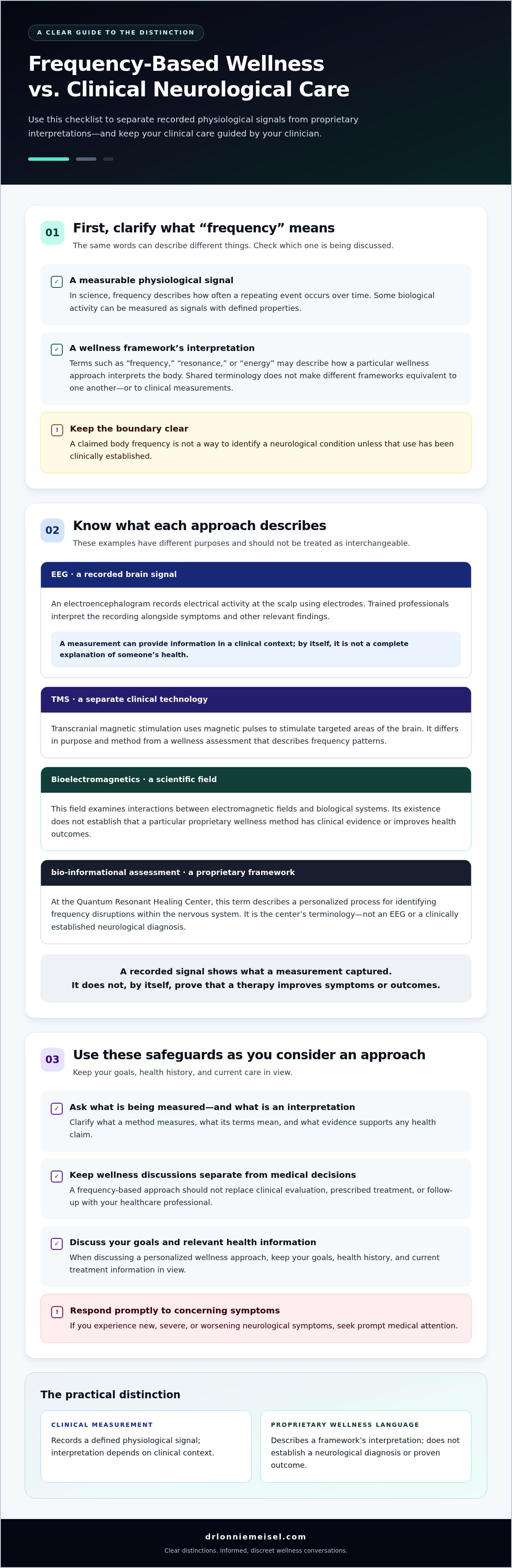
In science, frequency describes how often a repeating event occurs over time. Some biological activity can be measured as signals with defined properties. For example, an electroencephalogram (EEG) records electrical activity at the scalp. The scientific field of Bioelectromagnetics examines interactions between electromagnetic fields and biological systems.
Wellness frameworks may use terms such as “frequency,” “resonance,” or “energy” to describe their interpretations of the body. Shared terminology does not make these frameworks equivalent to one another or to a clinical measurement such as an EEG. A claimed body frequency should not be treated as a way to identify a neurological condition unless that use has been clinically established.
At the Quantum Resonant Healing Center, a bio‑informational assessment refers to a diagnostic process that identifies frequency disruptions within the nervous system. This is the center’s terminology for its personalized holistic framework. It should not be confused with a neurological diagnosis made through clinical evaluation.
How is neurological wellness different from neurological treatment?
Neurological wellness is a broad idea concerning health and function. It can help frame personal goals or conversations about supportive practices, but it does not determine the cause of symptoms. Neurological diagnosis and treatment depend on your symptoms, health history, examination, and other clinical assessment as appropriate. The right approach can differ from one person to another.
Keep wellness discussions separate from decisions about medical care. A frequency-based approach should not replace clinical evaluation, prescribed treatment, or follow-up with your healthcare professional. If you experience new, severe, or worsening neurological symptoms, seek prompt medical attention. Clear boundaries let you explore wellness options without mistaking a proprietary explanation for established clinical care.
How Do Frequency-Based Approaches Describe the Nervous System?
Your nervous system communicates through coordinated electrical and chemical activity. Neurons transmit signals, networks process information, and the brain and body respond to internal and external conditions. These complex processes cannot be reduced to one frequency that explains how your brain functions or whether you have a neurological condition.
Frequency-based wellness approaches may use terms such as “resonance” or “frequency disruption” to describe their interpretations of the body. These concepts belong to the framework using them. Distinguish them from physiological signals recorded with clinical technologies and from evidence that a particular approach improves health outcomes.
What can neurological signals and measurements tell us?
An electroencephalogram, or EEG, records electrical activity from the brain using electrodes placed on the scalp. It can provide information about brain activity in a particular clinical context, but trained professionals interpret the recording alongside a person’s symptoms and other relevant findings. A measurement alone is not a complete explanation of someone’s health.
Transcranial magnetic stimulation (TMS) is a separate clinical technology that uses magnetic pulses to stimulate targeted areas of the brain. It differs from a wellness assessment that describes frequency patterns. Similar terminology, or the existence of a measurable signal, does not establish that a proprietary wellness method has the same purpose, method, or clinical evidence.
A recorded physiological signal shows what a measurement captured. By itself, it does not prove that a therapy improves symptoms or outcomes.
What is a bio-informational assessment?
At the Quantum Resonant Healing Center, a bio‑informational assessment is described as a diagnostic process that identifies frequency disruptions within the nervous system. This wording reflects the center’s proprietary framework. It is not a description of an EEG and should not be read as a clinically established neurological diagnosis.
Keep that distinction clear as you consider holistic frequency therapy for neurological wellness. A proprietary interpretation may inform a personalized wellness discussion, but it does not replace a neurological examination or clinically indicated testing. It also does not confirm that a measured signal corresponds to a particular condition.
If you’re exploring the center’s approach, a private discussion of your goals can clarify how its terminology relates to your wellness priorities. Learn more about personalized holistic care while keeping clinical questions and existing neurological care in view.
How Does Holistic Frequency Therapy Compare With Established Neurological Care?
Frequency-based wellness and neurological care have different purposes and standards of evidence. The Quantum Resonant Healing Center describes its approach through a proprietary framework. Clinical care evaluates symptoms and uses established assessment and treatment methods suited to the person’s situation. Do not treat these approaches as interchangeable or assume they produce equivalent outcomes.
Proprietary wellness approach: Frames frequency concepts as part of a personalized holistic perspective. It should not be presented as diagnosing or treating a neurological disorder.
Clinical neurological care: Assesses symptoms and health needs to guide diagnosis, management, or treatment.
Proprietary wellness approach: May include a bio‑informational assessment as defined within the center’s framework.
Clinical neuromodulation: TMS uses magnetic pulses to stimulate targeted brain areas. It is a clinical treatment category, distinct from the center’s proprietary approach and not a Quantum Resonant Healing Center service.
Proprietary wellness approach: Ask what a specific assessment or remedy is intended to do and whether claims are supported by peer-reviewed human studies measuring clearly defined outcomes.
Clinical methods: Consider evidence and authorized uses for the particular treatment, indication, and patient context. TMS indications should be checked against current FDA information and relevant clinical guidance.
Proprietary wellness approach: Discuss any complementary role alongside your existing care.
Clinical neurological care: Guides diagnosis and treatment decisions with qualified healthcare professionals.
How do proprietary wellness approaches differ from clinical neuromodulation?
TMS is a defined clinical method involving targeted magnetic stimulation. A proprietary frequency-based approach uses its own concepts and assessment language. Similar references to brain activity or frequency do not establish the same mechanism, evidence, or clinical purpose. Suitability depends on individual circumstances and clinical guidance.
What evidence questions help put claims in context?
For claims connected to holistic frequency therapy for neurological wellness, look for specifics. Does the evidence come from peer-reviewed human research? Are the outcomes clearly defined and relevant to the claim? Testimonials may describe one person’s experience, and a proposed mechanism may explain a theory, but neither alone establishes clinical benefit.
Be cautious with statements that a wellness method diagnoses, treats, cures, or prevents a neurological disease. Such claims need strong, relevant evidence and authoritative verification. Complementary wellness approaches should never replace medical evaluation, diagnosis, or prescribed care. Discuss an approach you are considering with your healthcare professional, and keep treatment decisions grounded in clinical advice.
How Can You Consider Frequency-Based Wellness With Appropriate Safeguards?
You can explore a wellness approach thoughtfully while keeping neurological care grounded in clinical assessment. Before discussing holistic frequency therapy for neurological wellness, prepare a clear account of what you hope to understand and how the approach fits alongside your current care. A private, individualized conversation can help you discuss personal health information with discretion. Clear boundaries also make it easier to assess claims without mistaking them for medical conclusions.
What should you clarify before a wellness consultation?
Use this framework to prepare:
- Define your goal. Describe the concern you want to discuss and what you hope to understand. For example, you may want to learn how a wellness framework describes its assessment, rather than seek a neurological diagnosis from it.
- Organize relevant information. Note your symptoms, when they began, and how they have changed. Bring relevant medical records and a current list of treatments, including prescribed medication.
- Clarify the framework’s scope. Ask how the proprietary assessment is described, what it is intended to inform, and what conclusions it cannot establish. A bio‑informational assessment is the center’s term for identifying frequency disruptions within the nervous system. It should not be confused with clinical neurological testing.
- Set realistic expectations. Discuss what you can reasonably expect from a wellness approach, what evidence supports any stated benefit, and how it will remain separate from decisions about diagnosis or treatment.
Sharing relevant medical history and current treatment information supports an informed discussion. It also helps keep wellness goals in context, without asking you to disclose more than is relevant to the conversation.
When should neurological symptoms take priority?
Sudden or severe neurological symptoms need urgent medical assessment, not a wellness session. If a symptom is new, rapidly worsening, or feels like an emergency, seek immediate medical attention. For ongoing concerns, speak with an appropriately licensed clinician who can assess your symptoms and advise on next steps.
Never stop prescribed medication, change a treatment plan, or delay an evaluation or follow-up because of a frequency-based wellness claim. Complementary care must remain complementary. If you’re considering a personalized holistic discussion, schedule a conversation with Dr. Meisel while continuing to follow your clinician’s guidance.
How Does the Quantum Resonant Healing Center Personalize Frequency-Based Wellness?
At the Quantum Resonant Healing Center, Dr. Lonnie Meisel provides frequency-based care through a proprietary holistic framework. It is distinct from established neurological diagnosis and treatment. If you’re exploring holistic frequency therapy for neurological wellness, understanding what the center’s terms mean, and what they do not establish, can help you make informed choices alongside your existing clinical care.
What happens during Quantum Resonant Testing?
Quantum Resonant Testing is a diagnostic session conducted in a relaxed atmosphere. It can last 1-3 hours and may take place at the clinic or at your home. Within the center’s approach, the session includes a bio‑informational assessment, which the center describes as identifying frequency disruptions within the nervous system.
This is proprietary terminology, not a substitute for a clinical neurological examination or testing. The assessment should not be interpreted as confirming a neurological condition or determining its treatment. You can keep the discussion focused on your goals and share relevant health context, while relying on your clinician for medical evaluation and treatment decisions.
How does personalized care fit the center’s approach?
Quantum Resonant Therapy is the center’s proprietary holistic method. Personalized appointments with Dr. Meisel allow the discussion to focus on your individual priorities, with attention to privacy and discretion. This individualized approach does not establish that the method diagnoses or treats neurological disorders, or that it produces a specific neurological outcome.
Quantum Resonant Remedies are non-pharmaceutical, bio‑informational tools designed to support the intestinal lining’s resonant state and reduce inflammation. Their stated purpose is specific to the intestinal lining and inflammation. They should not be represented as a neurological treatment or a replacement for medical care.
For more detail on the center’s terminology, read Quantum Resonant Remedies explained and Quantum Resonant Therapy. If you’re considering a personalized appointment, a discreet conversation with Dr. Meisel can help you clarify your goals and understand how this holistic framework relates to your broader wellness plan. Keep established neurological care and prescribed treatment guided by your clinician.
Explore Your Wellness Options With Clarity
Frequency-based wellness uses terminology that can sound clinical, but a proprietary assessment is not the same as an established neurological test or treatment. As you consider holistic frequency therapy for neurological wellness, assess claims carefully and use complementary approaches only alongside appropriate medical evaluation and prescribed care.
The Quantum Resonant Healing Center offers a personalized holistic framework through proprietary Quantum Resonant Therapy and Quantum Resonant Testing. Testing is described as a relaxed session lasting 1-3 hours, at the clinic or your home. Personal appointments with Dr. Lonnie Meisel provide a private, personalized concierge-care setting to discuss your goals, without promising a specific neurological outcome.
If you’re interested in how this approach may fit your wellness priorities, explore personalized care at the Quantum Resonant Healing Center. Continue working with your clinician on neurological symptoms and treatment decisions. Contact the center to arrange a private conversation with Dr. Meisel.
Frequently Asked Questions
What is holistic frequency therapy for neurological wellness?
Holistic frequency therapy for neurological wellness is a broad phrase for wellness approaches that use frequency-related concepts to describe the body or nervous system. It isn’t one standardized neurological treatment. At the Quantum Resonant Healing Center, a bio‑informational assessment is described as identifying frequency disruptions within the nervous system. This is the center’s proprietary framework, not a clinically established neurological diagnosis or a substitute for evaluation by a qualified medical professional.
Can frequency therapy treat neurological conditions?
Frequency-based wellness should not be assumed to treat a neurological condition. Claims about diagnosis or treatment need relevant clinical evidence, and a proposed explanation or personal testimonial does not establish that a method improves neurological outcomes. If you have symptoms or a diagnosed condition, discuss them with an appropriate clinician. Don’t stop prescribed medication, delay an evaluation, or change your care plan because of a wellness claim.
How does Quantum Resonant Testing work?
Quantum Resonant Testing is a diagnostic session conducted in a relaxed atmosphere. It can last 1-3 hours and may take place at the clinic or at your home. The center uses its proprietary framework, including a bio‑informational assessment. This process does not replace clinical neurological examination or testing, and its findings should not be treated as confirmation of a neurological condition.
Is frequency-based wellness the same as TMS or EEG?
No. EEG uses scalp electrodes to record electrical activity from the brain, which requires interpretation in clinical context. TMS is a clinical neuromodulation method that uses magnetic pulses to stimulate targeted brain areas. Frequency-based wellness may use similar terms, but that does not make its assessment equivalent to EEG or its approach equivalent to TMS. The methods differ in purpose, process, and evidence, and should not be treated as interchangeable.
Can holistic frequency therapy replace neurological care?
No. A complementary wellness approach should not replace clinical evaluation, neurological diagnosis, prescribed treatment, or follow-up with your healthcare professional. If you’re exploring a proprietary frequency-based framework, keep it separate from decisions about medical care and discuss relevant health information with your clinician. Seek prompt medical attention for new, severe, or worsening neurological symptoms. Never stop medication or delay an assessment because of a frequency-based claim.
What are Quantum Resonant Remedies intended to support?
Quantum Resonant Remedies are non-pharmaceutical, bio‑informational tools designed to support the intestinal lining’s resonant state and reduce inflammation. That is their stated purpose. They should not be represented as a treatment for neurological conditions or as a substitute for medical evaluation and care. If you’re considering them, discuss your health history and current treatments as part of an informed conversation, and continue to follow your clinician’s guidance.


