
A frequency-based wellness session cannot establish whether your heart is healthy. If you’re considering bio-resonant therapy for cardiovascular wellness, you may want clear answers about what it offers and whether it can affect heart health. Bio-resonance has not been shown to diagnose or treat cardiovascular disease, so it cannot replace medical assessment or established care.
This article explains how to distinguish wellness language from clinical evidence, evaluate claims, and consider holistic approaches without putting your health at risk. You’ll learn what bio-resonance can and cannot establish, why relying on it instead of cardiovascular care may be harmful, and which symptoms call for prompt medical attention. Chest pressure or pain, sudden severe shortness of breath, or fainting requires urgent medical help.
At the Quantum Resonant Healing Center, Dr. Meisel offers personalized appointments exploring his proprietary Quantum Resonant Therapy as a wellness approach. It is not a cardiovascular diagnostic or treatment method. In a private setting, you can discuss your wellness goals with individual attention while keeping your existing medical care in place. The guidance below offers a measured way to explore complementary wellness while keeping evidence-based cardiovascular care central to your decisions.
Key Takeaways
- Assess bio-resonant therapy for cardiovascular wellness by separating a practitioner’s explanation from evidence of measurable heart-health outcomes.
- Understand how clinical assessment differs from wellness practices and claims that need stronger evidence.
- Keep your cardiovascular care in place. Don’t stop or change prescribed medication because of a wellness approach.
- Clarify what a therapy is intended to do, and discuss any planned changes to your care with your medical professional.
- Explore Quantum Resonant Therapy as a personalized wellness approach in a private setting, with clear expectations about its limits.
What Does Bio-Resonant Therapy Mean for Cardiovascular Wellness?
Heart-health concerns can make unfamiliar wellness claims difficult to evaluate, especially when the language sounds scientific. It helps to separate a proposed wellness approach from the methods clinicians use to assess your heart and blood vessels.
Bio-resonant therapy is a claimed frequency-based wellness approach, not a validated way to diagnose cardiovascular disease or establish heart health. Proponents describe the approach in terms of frequencies or resonance, but that framing does not prove it can identify a heart condition, change cardiovascular outcomes, or prevent disease. Supporting general wellbeing is also different from treating or preventing a clinical condition.
That distinction is central when considering bio-resonant therapy for cardiovascular wellness: you may explore it as a wellness practice, but a session cannot confirm that your heart is healthy or replace medical assessment.
What does “bio-resonant” refer to in wellness language?
In wellness language, “bio-resonant” refers to proponents’ descriptions of the body in terms of frequencies and resonance. These terms explain how supporters frame the approach; they do not establish a scientifically validated heart-related mechanism. A confident explanation of a modality is not evidence that it can detect or affect a cardiovascular condition. When you assess a heart-health claim, look for reliable clinical research that measures relevant outcomes, not only descriptions of how a device or session is said to work.
How is cardiovascular wellness different from diagnosing heart disease?
Wellness can include broad goals such as maintaining healthy routines and feeling well. Clinical assessment has a different purpose: evaluating possible conditions of the heart and blood vessels and guiding decisions about care.
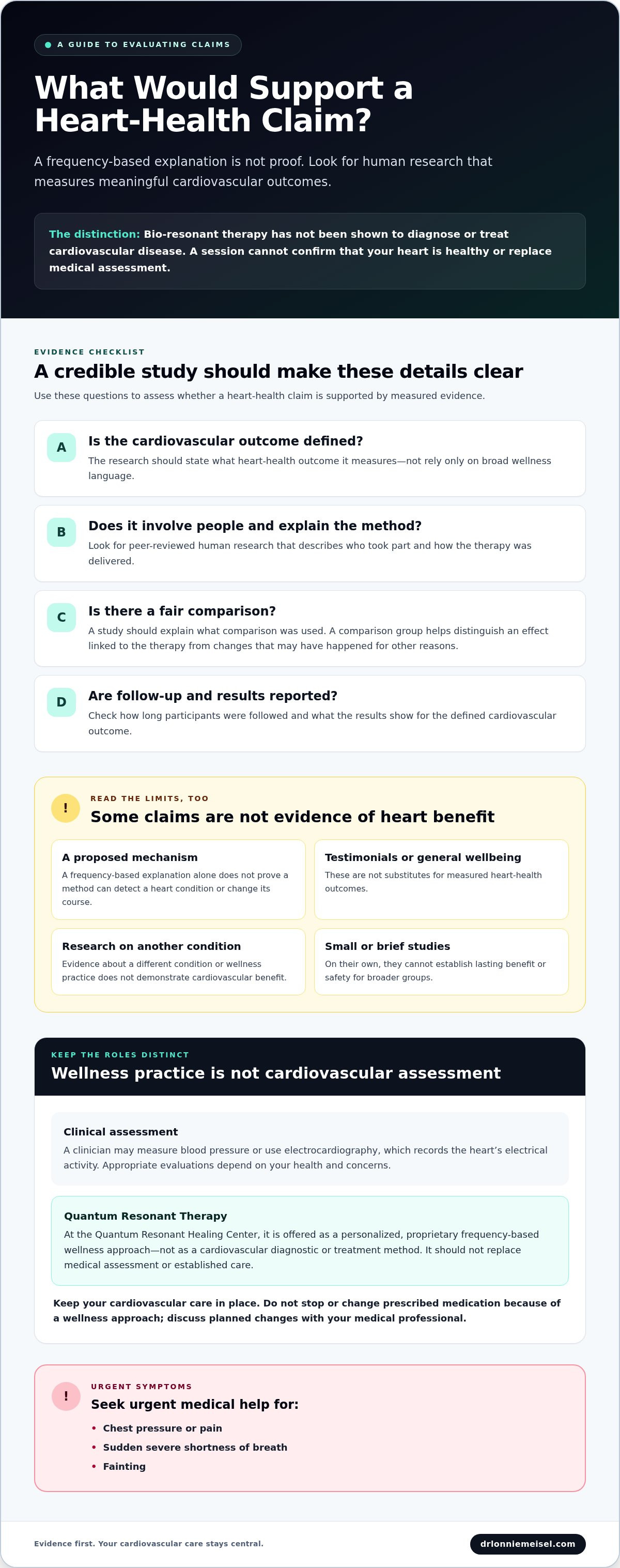
For example, a clinician may measure blood pressure or use electrocardiography, which records the heart’s electrical activity. These are established assessment methods, although the evaluations that are appropriate depend on your health and concerns. Frequency-related language or health-related readings do not make a bio-resonant session a diagnostic substitute.
Keep the roles distinct. If you have a cardiovascular concern, seek appropriate medical assessment. A wellness practice may be a separate personal choice, but it should not be used to rule out disease, interpret symptoms, or decide that medical evaluation is unnecessary.
How Is Bio-Resonant Therapy Described, and What Evidence Would Support a Heart-Health Claim?
A therapy’s description explains how its proponents understand the method. It does not, by itself, show that the therapy improves health. At the Quantum Resonant Healing Center, Quantum Resonant Therapy is a proprietary, frequency-based wellness approach. That description does not establish a mechanism for affecting the heart or blood vessels, or make the approach a cardiovascular treatment.
A proposed mechanism alone does not establish clinical benefit. To support a heart-health claim, evidence would need to show that people receiving the approach experience meaningful cardiovascular outcomes, using methods that allow a fair assessment of whether the therapy made a difference.
What would credible cardiovascular evidence need to show?
Look for peer-reviewed human research that defines the cardiovascular outcome being measured. A study should explain who took part, how the therapy was delivered, what comparison was used, how long participants were followed, and what the results show. A comparison group helps researchers distinguish an effect linked to the therapy from changes that may have occurred for other reasons.
Study limitations matter. A small or brief study may raise a question worth examining, but it cannot establish lasting benefit or safety for broader groups on its own. For bio-resonant therapy for cardiovascular wellness, testimonials and reports of general wellbeing are not substitutes for measured heart-health outcomes. Evidence about a different condition or wellness practice also does not demonstrate cardiovascular benefit.
Can a frequency-based explanation prove a treatment works?
No. A plausible-sounding explanation, including claims about detecting or responding to frequencies, does not prove that a method can identify a heart condition or change its course. Such claims require independent clinical testing, not only a practitioner’s account of how the modality is intended to work. Memorial Sloan Kettering Cancer Center describes bioresonance as based on unproven theories in its assessment of unsupported bioresonance claims. That review concerns an integrative medicine context, not cardiovascular outcomes, but it provides context for weighing claims.
Keep product and treatment claims distinct as well. Quantum Resonant Remedies are non-pharmaceutical, bio-informational tools designed to support the intestinal lining’s resonant state and reduce inflammation. That defined purpose should not be extended into a claim that they treat or prevent cardiovascular disease.
If you’re exploring a holistic approach, you can learn about Quantum Resonant Therapy as a personalized wellness practice while keeping cardiovascular decisions grounded in appropriate medical care.
Bio-Resonant Therapy and Heart Care: What Is Established, Uncertain, or Unsupported?
Bio-resonant therapy is not a proven replacement for cardiovascular care. A wellness session cannot establish that your heart is healthy, rule out heart disease, or determine what care you need. You can still explore holistic approaches, but they should sit alongside, not take the place of, appropriate clinical assessment.
What is established: cardiovascular care uses clinical assessment, including blood pressure measurement and testing selected by a clinician for your circumstances. What remains uncertain: whether bio-resonant practices have any cardiovascular benefit. What is unsupported: treating a session or frequency-based reading as a reliable way to diagnose, prevent, or treat heart disease. Memorial Sloan Kettering Cancer Center describes bioresonance as based on unproven theories. This is useful context, not evidence of cardiovascular efficacy.
| Established clinical assessment | Wellness practice | Claims requiring stronger evidence |
|---|---|---|
| Blood pressure measurement and clinician-directed testing to assess cardiovascular concerns. | A personal wellness approach explored for general wellbeing, without treating it as a heart test. | Claims that bio-resonance can detect, prevent, or treat cardiovascular disease. |
What should not be confused with evidence-based cardiovascular assessment?
A proprietary bio-informational assessment may describe frequency disruptions within the nervous system, but that description does not make it a test for heart or blood-vessel conditions. A wellness session cannot rule out disease or assess an emergency. If you have concerning or sudden symptoms, seek prompt medical attention rather than relying on a wellness reading. Your interest in holistic care need not conflict with conventional care; keep each approach within its proper role.
Why are testimonials not enough to establish cardiovascular benefit?
A person’s account can be meaningful to them, but it cannot show that a therapy caused a change. Symptoms may shift for many reasons, and cardiovascular risk depends on clinical context, not one individual story. To evaluate a treatment claim, look for human studies that measure defined heart-health outcomes, use an appropriate comparison, and explain their limitations. Personal experiences should not be presented as typical results or promises.
For bio-resonant therapy for cardiovascular wellness, keep the evidence distinction clear: established assessment guides heart-care decisions; a wellness practice may be a separate personal choice; and cardiovascular treatment claims need reliable clinical evidence. This lets you explore holistic interests without mistaking them for diagnosis or care.
How Can You Explore Bio-Resonant Therapy Without Compromising Heart Safety?
You can explore wellness approaches while keeping cardiovascular care on a clear, safe footing. Use these steps to protect your health and set realistic expectations:
- Preserve your existing care. Keep scheduled appointments and follow your clinician’s care plan. Don’t stop, skip, or change prescribed medication because of a wellness modality. Discuss any treatment changes with the clinician who prescribed it.
- Clarify what the session claims to do. Ask what happens during the session, what its findings can establish, and what they cannot establish. A frequency-based explanation is not the same as a validated heart test.
- Discuss your plans and health history. Share relevant diagnoses, symptoms, medications, and other treatments with the clinician managing your cardiovascular care. Ask whether adding a wellness session raises concerns for your individual situation.
- Pay attention to symptoms. A wellness session cannot assess an acute cardiac emergency. Don’t wait for an appointment or session if symptoms are sudden or severe.
What should you discuss before adding a wellness session?
Be specific about what you hope to explore and how the session is described. Consider whether it is intended for general wellness, whether any results are presented as a diagnosis, and what evidence supports claims about cardiovascular outcomes. These questions help you distinguish a wellness experience from clinical assessment without assuming the two must be mutually exclusive.
Keep the clinician responsible for your heart care informed, particularly if you have a cardiovascular diagnosis or take prescribed medication. This supports coordinated decisions and helps you avoid relying on a wellness interpretation in place of medical advice.
When should cardiovascular symptoms take priority?
Possible heart attack symptoms can include chest discomfort, shortness of breath, discomfort in the arms, back, neck, jaw, or stomach, cold sweats, nausea, or lightheadedness. The American Heart Association’s heart attack guidance advises calling 911 for these warning signs. If you’re outside the United States, contact your local emergency number. This list isn’t exhaustive and can’t determine what is causing your symptoms. If symptoms are sudden, severe, or concerning, seek urgent medical help rather than attending a wellness appointment.
If you’re considering a private, personalized conversation about Quantum Resonant Therapy as a wellness approach, explore appointments with Dr. Meisel. Keep that exploration separate from decisions about cardiovascular diagnosis or treatment.
What to Expect When Exploring Quantum Resonant Therapy at the Quantum Resonant Healing Center
At the Quantum Resonant Healing Center, Dr. Meisel offers his proprietary Quantum Resonant Therapy as a personalized, frequency-based holistic approach. It is a wellness modality, not a way to diagnose, treat, or prevent cardiovascular disease. If you’re considering bio-resonant therapy for cardiovascular wellness, keep that boundary clear: heart-health decisions belong with the medical professionals managing your cardiovascular care.
The center provides personal, one-on-one appointments with Dr. Meisel in a private setting. You have space to discuss your wellness interests with discretion and individual attention. The appointment does not change what the therapy can establish about your heart, and no cardiovascular outcome should be assumed or promised.
How does a personalized Quantum Resonant Therapy appointment fit into a wellness plan?
You can consider an appointment as a separate part of your personal wellness exploration while maintaining your existing medical care. Continue cardiovascular assessment and treatment through your care team. Don’t use a session or its interpretation to replace clinical advice, testing, or prescribed treatment.
Keep the purpose of related offerings distinct, too. Quantum Resonant Remedies are non-pharmaceutical, bio-informational tools designed to support the intestinal lining’s resonant state and reduce inflammation. That stated purpose is not a claim about cardiovascular health, and the remedies should not be treated as heart treatment or prevention.
How can you take a thoughtful next step?
Before an appointment, consider what you hope to learn and note questions about the approach’s scope, process, and realistic expectations. You may want to clarify what the session is intended to support and what it cannot establish. If you have a cardiovascular condition or are receiving treatment, keep your medical care team informed and continue to rely on them for heart-related decisions.
A considered approach lets you explore a private, personalized wellness experience without confusing it with cardiovascular care. If this distinction fits your goals, explore a private appointment with Dr. Meisel.
Keep Your Heart Care Grounded as You Explore Wellness
Bio-resonant therapy for cardiovascular wellness is a wellness interest, not a proven way to diagnose, treat, or prevent heart disease. Frequency-based explanations and personal experiences do not establish cardiovascular benefit. Keep your medical assessment and prescribed care in place, and seek prompt medical attention for sudden or severe symptoms.
At the Quantum Resonant Healing Center, Dr. Lonnie Meisel offers personal appointments to explore his proprietary Quantum Resonant Therapy as a holistic wellness approach. The center provides private, personalized care for a global clientele, with discretion and individual attention. This experience is distinct from cardiovascular diagnosis or treatment and should not replace guidance from your medical care team.
If you’re interested in exploring the approach with clear expectations, explore a private appointment. Take a thoughtful next step while keeping your heart care grounded in appropriate medical guidance.
Frequently Asked Questions
Does bio-resonant therapy improve cardiovascular wellness?
Current evidence does not establish that bio-resonant therapy improves cardiovascular wellness. A frequency-based explanation, proposed mechanism, or personal account cannot show that a method changes heart-health outcomes. Look for well-designed human studies measuring defined cardiovascular outcomes, and discuss heart concerns with the clinician responsible for your care. At the Quantum Resonant Healing Center, Quantum Resonant Therapy is a proprietary wellness approach, not a proven cardiovascular treatment.
Can bio-resonant therapy diagnose heart disease?
No. A bio-resonant session should not be treated as a diagnostic test for heart disease or as a way to rule it out. Cardiovascular assessment involves clinical evaluation and testing selected by a qualified medical professional. If you have symptoms or concerns, seek medical advice rather than relying on a frequency-based assessment. A wellness session is not a substitute for appropriate testing or care.
Is bio-resonant therapy safe if I have a heart condition?
Whether a session is appropriate depends on your health circumstances and what the session involves. Don’t delay medical assessment, change prescribed treatment, or stop medication to try a wellness approach. Discuss complementary practices with the clinician managing your heart care, especially if you have a diagnosed condition or new symptoms. If symptoms are sudden or severe, seek urgent medical attention rather than waiting for a wellness appointment.
Can I stop taking heart medication if I try bio-resonant therapy?
No. Don’t stop, reduce, or replace prescribed heart medication because of bio-resonant therapy or another wellness claim. Discuss any proposed change with the clinician who prescribed or manages your treatment. Quantum Resonant Therapy is a wellness approach, not a substitute for cardiovascular care. If you’re concerned about medication effects or your treatment plan, raise those concerns promptly with your medical team before making changes.
What happens during a Quantum Resonant Therapy appointment?
Quantum Resonant Therapy is the Quantum Resonant Healing Center’s proprietary approach, offered through personal appointments with Dr. Meisel. The appointment is not a heart diagnostic test or cardiovascular treatment, and no heart-health result should be assumed. Prepare questions about the session’s purpose, process, limits, and how it fits alongside your existing care. Continue to rely on your medical care team for cardiovascular assessment and treatment decisions.
Can Quantum Resonant Remedies support heart health?
The remedies’ stated purpose does not establish a cardiovascular effect, so don’t treat them as heart treatment or prevention. For heart-health concerns, rely on appropriate clinical assessment and discuss any wellness practice with the clinician managing your care. Keep the remedies’ stated purpose distinct from cardiovascular claims.
What should I do if I have chest pain or sudden shortness of breath?
Seek urgent medical attention for sudden or severe symptoms rather than scheduling a wellness session or waiting to see if symptoms change. Possible heart attack warning signs can include chest discomfort, shortness of breath, discomfort in the arms, back, neck, jaw, or stomach, cold sweats, nausea, or lightheadedness. Follow emergency guidance in your location and contact your local emergency number. This list can’t diagnose you or cover every emergency.


