
Could the safest alternative to an immunosuppressant be a different treatment plan, rather than stopping treatment altogether? If you’re concerned about side effects or long-term risks, it’s understandable to explore alternatives to immunosuppressants for autoimmune conditions. The options depend on your diagnosis, disease activity, and health history, and a drug-free approach isn’t appropriate for everyone.
Some people may discuss disease-specific medicines that target particular immune pathways, while lifestyle measures and holistic care may offer complementary support. These approaches differ in evidence, purpose, and risk. An option considered for one condition or person may not suit another, so don’t stop, taper, or change prescribed medication without guidance from your treating clinician.
This article explains how to compare treatment approaches, prepare for a medical appointment, and explore personalized holistic care alongside prescribed treatment. At Quantum Resonant Healing Center, Dr. Lonnie Meisel provides personalized appointments and proprietary frequency-based care, including Quantum Resonant Remedies. This holistic approach is complementary, not a replacement for disease-modifying treatment. The aim is to help you make informed decisions with appropriate medical oversight.
Key Takeaways
- “Alternatives” can mean a different clinician-directed medicine, non-drug disease management, or complementary support. These options serve different purposes.
- Compare alternatives to immunosuppressants for autoimmune conditions by their evidence, intended role, relevance to your diagnosis, and monitoring needs.
- Before a treatment discussion, gather your diagnosis details, current medicines, previous treatment responses, and specific concerns.
- Explore personalized holistic care, including Quantum Resonant Remedies, as complementary support rather than a replacement for prescribed treatment.
- Use your treating clinician’s guidance to assess whether a proposed medication change or added therapy is appropriate for you.
Alternatives to immunosuppressants: what the term means for autoimmune conditions
If you’re weighing treatment options, “alternative” can mean several different things. An immunosuppressant is a medicine that reduces or dampens immune activity. Some treatments act broadly, while others target particular immune signals. The terms can overlap: a targeted immune-modifying medicine may still suppress aspects of immune function. This overview of immunosuppressive drugs describes their mechanisms and different classes.
So, alternatives to immunosuppressants for autoimmune conditions don’t necessarily mean avoiding medical treatment. They may involve a different prescribed therapy, symptom relief, supportive care, or complementary wellness approaches. These options have different aims and evidence. A strategy that supports comfort or day-to-day wellbeing should not be assumed to control the underlying disease.
What counts as an alternative to immunosuppressants?
A clinician-directed medication change may involve a different treatment class or approach. That is still active medical care, not “no treatment.” Symptom management, such as addressing pain or fatigue, may support quality of life without replacing disease-directed therapy. Complementary approaches, including lifestyle or holistic support, may be part of a wider care plan, but “natural” or non-pharmaceutical does not automatically mean safer or effective. Discuss potential benefits, risks, and interactions with your treating clinician.
Why the diagnosis changes the answer
Autoimmune conditions can affect different tissues and organs, follow different patterns, and respond differently to treatment. The right discussion depends on factors such as disease activity, which organs are involved, your previous response to treatment, and your individual risks. Your clinician can interpret these details alongside current guidance for your diagnosis. There is no universal substitute for immunosuppressants; appropriate alternatives depend on the condition, its activity, and your health history.
That distinction matters even if your main concern is a medication’s unwanted effects. A change that may be reasonable in one clinical situation could leave another condition inadequately controlled. Supportive or complementary care can be considered as part of a personalized plan, but it should not be treated as a replacement for prescribed disease-modifying treatment. Don’t stop or reduce a prescribed medicine on your own. Speak with your treating clinician before changing your treatment plan, including before adding supplements or other complementary therapies.
Which treatment approaches may be discussed instead of an immunosuppressant?
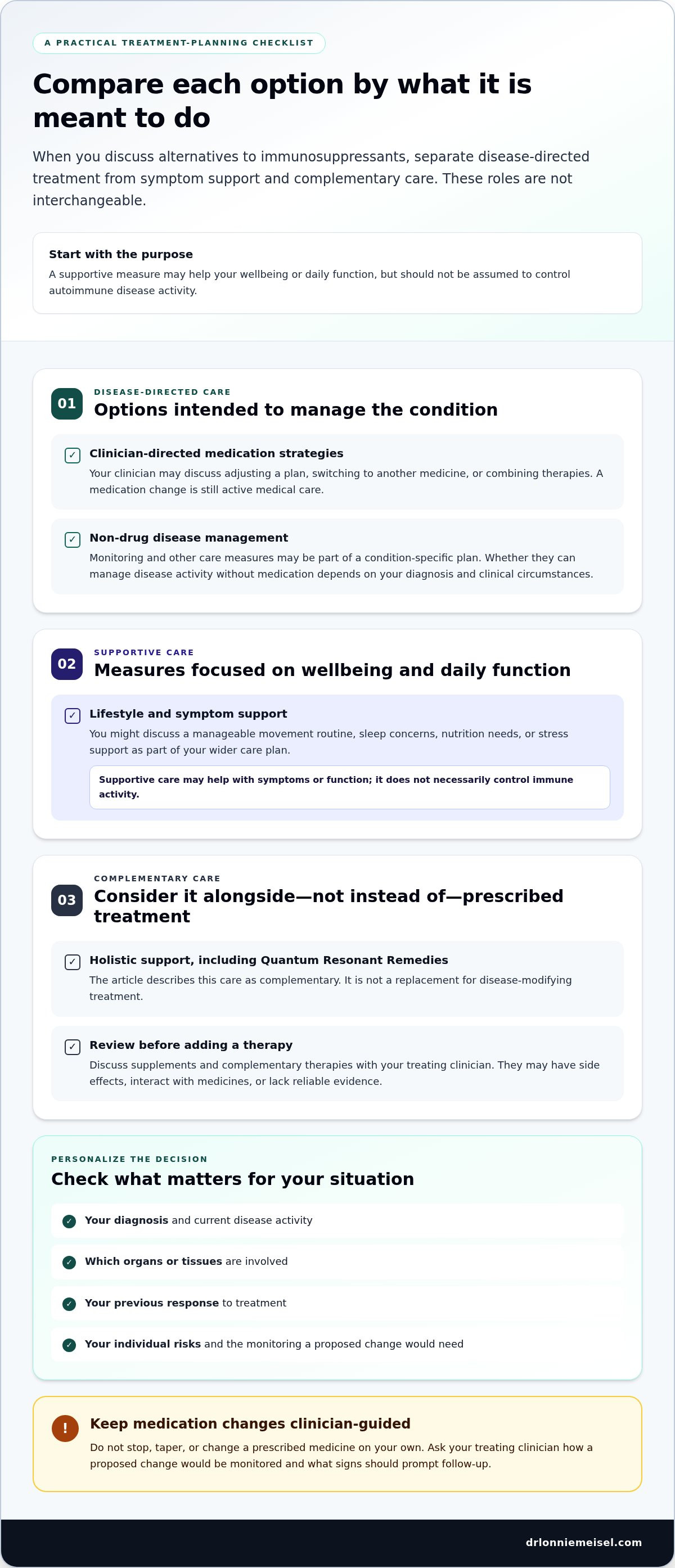
When you and your treating clinician review alternatives to immunosuppressants for autoimmune conditions, separate the options by purpose. Some aim to control disease activity; others focus on symptoms, everyday function, or general wellbeing. These roles are not interchangeable. A supportive measure may not prevent inflammation or organ damage.
- Clinician-directed medication strategies: A clinician may discuss adjusting a treatment plan, switching to another medicine, or combining therapies. The choice depends on your diagnosis, current disease activity, prior response, and personal risks.
- Non-drug disease management: Monitoring and other care measures may form part of a condition-specific plan. Whether they can manage disease activity without medication depends on the diagnosis and clinical circumstances.
- Supportive and complementary care: Sleep routines, appropriate movement, balanced nutrition, and stress support may help address wellbeing and daily function. They should not be assumed to control the autoimmune disease itself.
Clinician-directed medication strategies
A medication change is still treatment, even if it involves a different class from the one you currently take. Switching, adjusting, or combining medicines requires clinical oversight because benefits, risks, and monitoring differ among therapies and conditions. Disease-specific guidance and your medical history help shape the decision. Don’t change or reduce a prescribed medicine on your own. Ask your treating clinician how a proposed change would be monitored and what signs should prompt follow-up.
There is no single alternative that applies safely to every autoimmune condition. A treatment discussed for one diagnosis may not suit another. It may also be inappropriate for you because of disease activity, affected organs, previous treatment response, or other health risks.
Supportive and complementary approaches
Practical wellness measures can complement medical care. You might discuss a manageable movement routine, sleep concerns, nutrition needs, or stress support as part of your broader plan. Their role differs from disease-modifying treatment: supportive care may help with symptoms or function, but it doesn’t necessarily control immune activity.
Review supplements and complementary therapies with your treating clinician before adding them. They can have side effects, interact with medicines, or lack reliable evidence for the outcome you’re seeking. At Quantum Resonant Healing Center, Dr. Lonnie Meisel provides personalized appointments focused on holistic care. Learn about personalized holistic care, including Quantum Resonant Remedies, as complementary support rather than a substitute for prescribed therapy.
Immunosuppressants versus alternatives: compare evidence, purpose, and risk
Comparing treatment options means looking beyond whether a therapy is described as “conventional” or “natural.” Ask what it is intended to do, what evidence supports that purpose for your diagnosis, and how benefit and risk will be monitored. The table offers a framework, not a ranking. The same approach may have a different role depending on your condition and medical history.
| Approach | Purpose | Evidence and condition relevance | Monitoring and key uncertainties |
|---|---|---|---|
| Prescribed immunosuppressive or immune-modifying treatment | Control disease activity or reduce the risk of disease-related harm. | Evidence and recommendations are specific to the medicine and diagnosis. A treatment supported for one condition cannot be assumed appropriate for another. | Follow-up depends on the medicine and your health circumstances. Possible treatment risks must be weighed against the risks of uncontrolled disease. |
| Another clinician-directed disease-modifying treatment | Manage disease activity through a different treatment strategy. | Support varies by treatment, condition, and individual circumstances. “Different class” does not mean “no immune effect” or “lower risk for everyone.” | Your clinician can explain the intended outcome, monitoring plan, and what remains uncertain for your situation. |
| Symptom and function support | Address concerns such as pain, fatigue, mobility, or day-to-day function. | Evidence relates to the specific symptom or outcome; symptom relief alone does not establish control of the underlying disease. | Track the outcome being addressed and keep disease monitoring distinct from symptom tracking. |
| Complementary wellness support | Support general wellbeing alongside medical care. | Evidence varies by approach and intended outcome. It should not be treated as proof of disease-modifying benefit. | Review potential interactions, safety, and evidence with your treating clinician, especially before adding supplements. |
How to interpret benefits and risks
Evidence for controlling disease activity is not the same as evidence for easing a symptom or supporting wellbeing. The 2026 European Alliance of Associations for Rheumatology update on rheumatoid arthritis emphasizes continuing effective medication to maintain remission. The British Society for Rheumatology’s 2026 systemic lupus erythematosus guideline is another reminder that recommendations are condition-specific. Neither point can determine what is right for you without clinical review.
Stopping immune-modifying treatment is not automatically safer. Your decision involves weighing potential medication harms against the consequences of disease activity returning or worsening. Complementary support may contribute to wellbeing, but it is not equivalent to proven disease-modifying treatment. Evidence may also be preliminary, limited to a different population, or focused on an outcome other than the one you need.
Questions to ask about a proposed alternative
Bring these questions to your treating clinician: What outcome is this approach intended to change, and how will we measure it? What evidence applies to my diagnosis? What monitoring, interactions, or risks should I consider? What could happen if treatment is delayed or changed? Your concerns deserve a clear, individualized discussion before any treatment decision.
How to discuss medication changes safely with your treating clinician
If you’re considering a treatment change, prepare for a focused conversation rather than trying an adjustment on your own. Your treating clinician can assess your diagnosis, current disease activity, treatment history, and personal risks before discussing whether a change is appropriate. Preparing ahead can help you raise concerns about side effects without feeling pressured to make an immediate decision.
Prepare for a treatment review
Bring a clear record of your health history and the changes you’ve noticed. Include:
- Your diagnosis and any relevant recent test results or care updates.
- All current prescription medicines, supplements, and other therapies, including how you take them.
- Known allergies, previous treatments, and how you responded to each.
- Side effects or other concerns, with details about when they began and how they affect daily life.
- Recent symptoms and changes in function, such as difficulty with usual activities or shifts in energy.
Write down what you hope to address. Ask what outcome a proposed alternative is intended to affect, what evidence supports it for your condition, and how you and your clinician will assess whether it is helping. You can also ask about possible risks, interactions, monitoring, and the expected timeline for review. These questions help you compare options without assuming a treatment change is automatically safer.
Agree on a monitored plan
If a change is appropriate, make sure you understand the plan before it begins. Tapering or switching is a prescriber-led decision, not a self-directed experiment. Clarify how disease activity and possible adverse effects will be followed, when the next review should take place, and what information to record between appointments. Ask whom to contact if symptoms change after an agreed adjustment.
Don’t stop, reduce, or switch a prescribed medicine while you wait for an appointment. If you’re considering complementary support alongside prescribed care, tell your treating clinician what you’re considering, including any supplements, so potential interactions and safety concerns can be reviewed. Decisions about alternatives to immunosuppressants for autoimmune conditions should reflect your diagnosis and be followed with an agreed plan.
For individualized holistic support alongside appropriate medical oversight, explore a personal appointment with Dr. Meisel. Quantum Resonant Remedies are part of the center’s proprietary frequency-based approach, not a substitute for prescribed autoimmune treatment.
Holistic Care & Quantum Resonant Remedies for Autoimmunity
Holistic care may be one part of a broader plan for your wellbeing, but it has a different role from established disease-modifying treatment. Lonnie Meisel provides personalized appointments shaped around your health goals and concerns. The center’s proprietary, frequency-based approach includes Quantum Resonant Therapy and bio-informational healing. These approaches should not be presented as proven methods to cure, reverse, or control autoimmune disease.
What a personalized holistic approach can address
Quantum Resonant Remedies are non-pharmaceutical, bio-informational tools designed to support the intestinal lining’s resonant state and reduce inflammation. This describes their intended role within the center’s holistic approach, not proof that they modify autoimmune disease. They are not a substitute for prescribed immunosuppressants, other disease-modifying treatment, or clinician-directed monitoring.
If you’re exploring complementary care, keep its purpose clear. A holistic appointment offers a setting to discuss your wellness priorities and the center’s frequency-based approach. Your treating clinician remains central to decisions about disease activity, medication, and medical follow-up. Share any complementary therapies or remedies you’re considering so they can be considered alongside your existing care.
For more context, read about Quantum Resonant Remedies and bio-informational healing and the center’s exclusive resonant healing protocols. These resources explain the approach without confusing complementary support with established disease-modifying treatment.
A considered next step for personalized care
Exploring holistic care doesn’t require you to compromise your prescribed plan. Keep your medical treatment and monitoring in place, and approach any complementary option as a separate discussion about your broader wellness priorities. This distinction matters as you consider alternatives to immunosuppressants for autoimmune conditions: frequency-based therapies and remedies should not replace clinician-directed decisions about medication.
For individuals who value attentive, discreet care, the center’s VIP concierge service and personalized appointments provide a private setting to engage with Dr. Meisel. You can explore the center’s holistic approach while maintaining your established medical care. The conversation is an opportunity to understand the approach, not a promise of autoimmune treatment or a reason to change prescribed medication.
Make Your Next Treatment Conversation Informed and Personal
The right approach depends on your diagnosis, disease activity, medical history, and treatment goals. Alternatives to immunosuppressants for autoimmune conditions may include another clinician-directed therapy, symptom support, or complementary care, but these options serve different purposes and carry different uncertainties.
Bring your questions and treatment history to your clinician, and don’t stop or change prescribed medication without their guidance. Holistic support can be explored alongside appropriate medical care, not in place of prescribed treatment or monitoring.
Lonnie Meisel provides personalized appointments in a discreet VIP concierge setting, with the opportunity to explore proprietary Quantum Resonant Therapy and Quantum Resonant Remedies. Explore personalized care at the Quantum Resonant Healing Center as a considered next step in your wellness journey. With informed guidance and care tailored to you, you can move forward with greater clarity and confidence.
Frequently Asked Questions
Can I stop taking immunosuppressants if I feel better?
No, don’t stop or reduce your medication without guidance from your treating clinician. Feeling better may reflect that your current treatment is controlling disease activity, and stopping or changing it could carry risks that depend on your diagnosis and health history. If side effects or other concerns are affecting you, arrange a treatment review and discuss possible options, monitoring, and next steps before making any change.
Are there natural alternatives to immunosuppressants for autoimmune conditions?
There isn’t one natural option proven to replace prescribed treatment across autoimmune diseases. Sleep, movement, nutrition, and stress support may contribute to general wellbeing, but they don’t necessarily control disease activity. “Natural” also doesn’t guarantee safety: supplements and complementary therapies can have risks or interact with medicines. Discuss any approach you’re considering with your treating clinician, especially before changing medication or adding a supplement.
What medications can replace immunosuppressants?
There’s no single replacement medication suitable for every autoimmune condition. Depending on your diagnosis and circumstances, your clinician may discuss a different treatment class, an adjustment, or a combination approach. The options, evidence, risks, and monitoring requirements vary. Ask what the proposed medicine is intended to achieve for your condition, how its effects will be assessed, and what risks matter given your medical history.
Can lifestyle changes control an autoimmune condition without medication?
Usually, lifestyle measures shouldn’t be assumed to control autoimmune disease or replace medication. Support for sleep, appropriate physical activity, nutrition, and stress may help with general wellbeing or some aspects of daily function, but that is different from controlling the disease itself. Whether treatment can change depends on your condition and individual risk. Keep prescribed care and monitoring in place unless your clinician recommends a change.
Are holistic remedies safe to use with immunosuppressants?
Safety depends on the specific remedy, its ingredients or method, your prescribed medicines, and your health history. Some supplements can cause side effects or interact with medication, so tell your treating clinician what you’re considering before you begin. Don’t assume a holistic or non-pharmaceutical approach is automatically safe. Keep your prescribed treatment and monitoring in place unless your clinician advises otherwise.
How should I prepare to discuss alternatives with my doctor?
Bring your diagnosis details, current prescriptions and supplements, allergies, previous therapies, and any effects or side effects you’ve experienced. Note recent symptoms and changes in daily function. Prepare questions about the goals of a proposed alternative, evidence for your condition, possible risks or interactions, and how progress will be monitored. Agree on follow-up and next steps before any clinician-directed treatment change.
Can Quantum Resonant Remedies replace prescribed autoimmune treatment?
No. Quantum Resonant Remedies are non-pharmaceutical, bio-informational tools designed to support the intestinal lining’s resonant state and reduce inflammation, but they aren’t a substitute for prescribed immunosuppressants or other disease-modifying treatment. The Quantum Resonant Healing Center provides its proprietary holistic approach as complementary care, not as a proven replacement for autoimmune treatment. Discuss any remedy with your treating clinician and continue prescribed care and monitoring unless advised otherwise.


