
A personalized, frequency-based session may feel meaningful, but it can’t establish whether lupus is present, explain disease activity, or prove that lupus is being treated. If you’re considering bio-resonant therapy for lupus support, that distinction matters: lupus care should be guided by qualified medical professionals, and bioresonance hasn’t been shown to diagnose or treat the disease.
Your questions are reasonable. Personal accounts can describe what one person experienced, but they don’t replace clinical evidence or show that an approach is safe or effective for you. You also deserve clarity about how complementary wellness discussions fit alongside your prescriptions, monitoring, and care team.
This article explains what the evidence can and can’t establish, what to consider when discussing safety and coordination with your clinician, and which questions can help you decide whether a private, individualized wellness conversation suits your needs. At the Quantum Resonant Healing Center, Dr. Meisel offers a proprietary frequency-based approach that includes Quantum Resonant Testing and non-pharmaceutical Quantum Resonant Remedies. These are part of the center’s holistic approach, not proven lupus treatments or substitutes for medical care. Your medical decisions remain with you and your lupus care team.
Key Takeaways
- Understand why bio-resonant therapy for lupus support should be viewed as complementary wellness, not a way to diagnose or treat lupus.
- Learn how to distinguish personal testimonials and proposed explanations from controlled clinical evidence.
- Keep lupus monitoring and prescribed treatment decisions with your medical team when considering complementary support.
- Use clear goals, careful review of claims, and a conversation with your treating clinician to assess safety.
- Explore how a private appointment with Dr. Meisel and a relaxed Quantum Resonant Testing session can support an individualized wellness discussion, without establishing lupus-related medical outcomes.
Lupus and complementary support: what bioresonant therapy means
Systemic lupus erythematosus (SLE) is a chronic autoimmune disease. In an autoimmune condition, the immune system mistakenly attacks the body’s own tissues. Lupus can affect different organs, cause symptoms that vary from person to person, and change over time. Your treating medical team is best placed to assess symptoms, monitor disease activity, and guide decisions about diagnosis and treatment.
Complementary support may address personal wellbeing goals alongside medical care, but no single approach is suitable for everyone. You might want to discuss fatigue, stress, sleep, or other concerns with your clinician. These experiences can have different causes, so a wellness session or personal symptom record cannot determine whether lupus is active or what care you need.
What does lupus support involve?
Think of support as a conversation about your priorities, not a substitute treatment plan. Note when a symptom occurs, how it affects daily life, and what you want to ask your clinician. Bring those observations to your medical appointments. They can help you describe your experience, but they aren’t a diagnostic test and shouldn’t guide changes to prescribed care on their own.
What does bioresonant therapy claim to do?
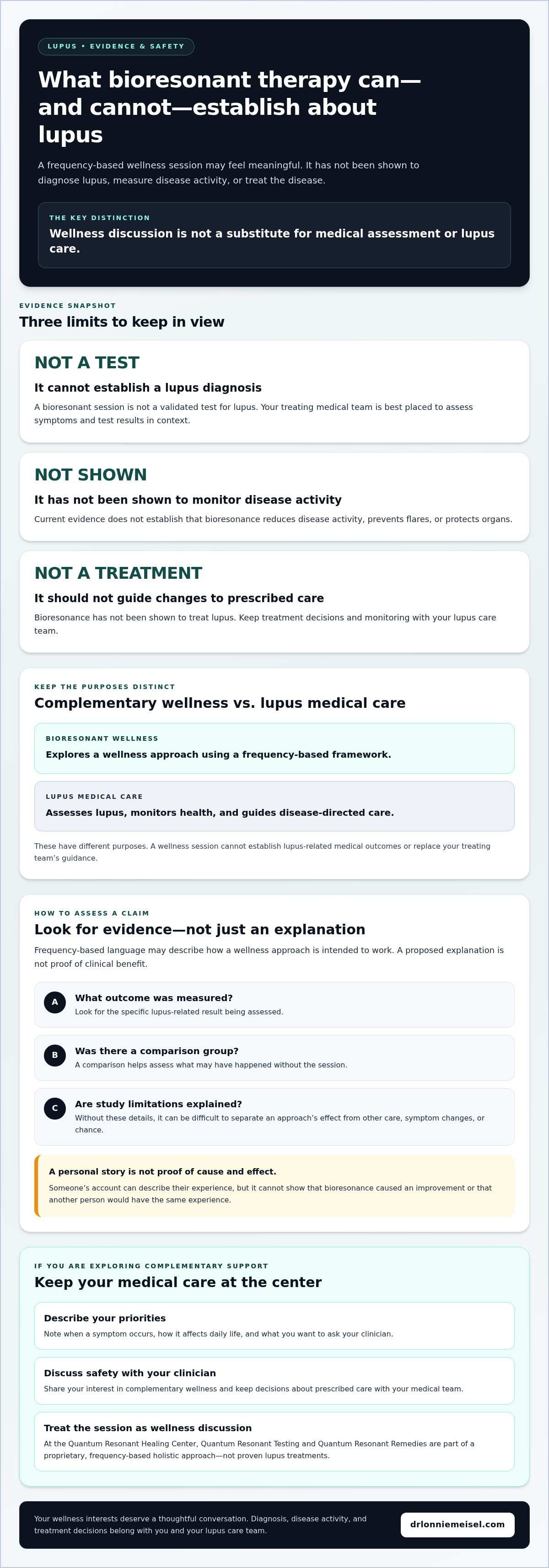
Bioresonant approaches use frequency-based language to describe how they understand the body and wellness. That framework is not established lupus biology, and a proposed explanation is not the same as demonstrated clinical benefit. This overview of bioresonance therapy describes the approach and notes the lack of supporting scientific evidence. A session should not be treated as a validated test for lupus or disease activity.
In brief: bio-resonant therapy for lupus support refers to a complementary wellness approach, not a proven method to diagnose, treat, or monitor lupus. At the Quantum Resonant Healing Center, Quantum Resonant Testing and Quantum Resonant Remedies are part of a proprietary, frequency-based holistic approach. They offer a setting to discuss your wellness interests privately, but they cannot establish lupus-related medical outcomes or replace your treating team’s guidance.
What does the evidence say about bioresonant therapy for lupus?
The central question is whether bioresonance has been shown to improve lupus outcomes in well-designed clinical research. Current evidence does not establish that it reduces disease activity, prevents flares, protects organs, or improves other lupus-related outcomes. A frequency-based explanation may describe how a wellness approach is intended to work, but it is not proof that the approach changes lupus or benefits patients.
Memorial Sloan Kettering Cancer Center characterizes bioresonance as based on unproven theories and reports that it has not been shown to diagnose or treat disease. This does not mean a person’s experience has no value. It means an individual account cannot establish that bioresonance caused an improvement or that someone else would have the same experience.
How to interpret claims and patient stories
A testimonial can help you understand what someone says they experienced, but it cannot show what would have happened without the session. When you review a claim, look for the specific outcome measured, a comparison group, and an account of study limitations. Without these, it is difficult to separate the effect of an approach from changes in symptoms, other care, or chance. Claims that bioresonance cures lupus, controls disease, or replaces prescribed treatment aren’t supported by established clinical evidence.
What established lupus care is designed to do
The American College of Rheumatology’s patient guidance describes systemic lupus erythematosus as a condition that can affect people differently, with care decisions shaped by a clinician’s assessment of the individual. Medical management is intended to monitor the condition and guide care based on a person’s health and needs. Your treating clinician can assess symptoms and test results in context. Don’t use a complementary wellness session to make treatment decisions or change prescribed care.
Wellness interest can guide a personal conversation, but it is not evidence of clinical effectiveness for lupus. If you’re considering bio-resonant therapy for lupus support, keep that distinction clear: a private, individualized wellness discussion may explore your interests, while questions about diagnosis, disease activity, and treatment belong with your medical team. You can learn more about personal appointments with Dr. Meisel as a space to discuss wellness interests, not as lupus treatment.
Bioresonant therapy versus lupus treatment: the safety distinction
Complementary wellness and lupus care have different purposes. Bioresonant therapy is not an established method to diagnose lupus, monitor disease activity, or guide treatment. This distinction matters because lupus can affect health in changing ways, and decisions about medical care depend on your individual condition and clinical assessment.
| Aspect | Bioresonant wellness | Lupus medical care |
|---|---|---|
| Purpose | Explore a wellness approach using a frequency-based framework. | Assess lupus, monitor health, and guide disease-directed care. |
| Evidence basis | Not established as effective for lupus outcomes. | Guided by clinical evaluation and medical evidence. |
| Decision-making role | May inform personal wellness interests, but cannot determine diagnosis or treatment. | Your treating clinician guides decisions about diagnosis, monitoring, and prescribed care. |
Memorial Sloan Kettering Cancer Center’s overview of the scientific evidence on bioresonance therapy describes the approach as unproven. A wellness session should not delay evaluation of new concerns or take the place of ongoing lupus care.
Can bioresonant therapy replace lupus medication?
No. Don’t stop, reduce, or substitute prescribed medication based on a bioresonant session or a wellness claim. Changing treatment without guidance from the clinician managing your lupus may allow the disease to become active or worsen. Your individual risks depend on your health and care plan. If you have concerns about a medication or want to explore complementary support, raise them with your clinician before making changes.
What risks should readers consider?
The clearest concerns are practical and clinical: delaying care, relying on promises that exceed the evidence, or committing personal resources without a clear understanding of what a session can and cannot establish. Claims that bioresonance cures lupus, controls disease, or makes medical treatment unnecessary should be treated with caution. Evidence does not support those conclusions.
If symptoms are severe or worsening rapidly, seek urgent medical attention rather than waiting for a complementary appointment. For other concerns, contact your treating clinician for guidance. Complementary wellness may support personal exploration, but it is not lupus treatment and must not replace diagnosis, monitoring, or prescribed care. If you’re considering bio-resonant therapy for lupus support, keep your medical decisions with your lupus care team.
How to explore complementary lupus support safely
You can explore wellness options thoughtfully while keeping your lupus care continuous. Start by naming what you hope to gain, such as a space to discuss general wellbeing or personal wellness goals. Then review the claims carefully, maintain your existing medical care, and discuss relevant plans with the clinician who manages your lupus.
A brief written record can help you prepare. Note symptoms you want to discuss, when they occur, and the questions you have. This helps you communicate your experience, but it is not a tool for diagnosing lupus or judging disease activity. Share only health information relevant to the conversation, and handle personal records with discretion.
Questions to clarify before a wellness session
Before agreeing to a session, make sure you understand its purpose and limits. Consider asking:
- What does the session assess, and is it intended to diagnose or treat lupus?
- How are findings explained, and what evidence supports any health-related claim?
- What can the session establish, and what can’t it establish about my health?
- How can I explore this approach without changing my prescribed treatment or usual medical follow-up?
Clear answers help you distinguish a wellness discussion from medical evaluation. For example, a frequency-based session may reflect the framework of a complementary approach, but it cannot confirm a lupus diagnosis or determine whether the disease is active.
How to keep your medical care continuous
Keep appointments with the clinician responsible for your lupus care, even if you decide to explore complementary support. Share relevant plans when appropriate, particularly if you have questions about how they fit alongside your existing care. Don’t use a wellness session to postpone assessment of new or worsening symptoms. If symptoms are severe or rapidly worsening, seek urgent medical attention.
For bio-resonant therapy for lupus support, a useful boundary is simple: explore wellness only in a way that leaves diagnosis, monitoring, and treatment decisions with your medical team. At the Quantum Resonant Healing Center, a personal appointment with Dr. Meisel provides a private setting to discuss your wellness interests and the role of proprietary, frequency-based methods, without presenting them as lupus treatment.
Arrange a personal wellness conversation with Dr. Meisel to discuss your interests in a discreet, individualized setting.
A personalized conversation at the Quantum Resonant Healing Center
At the Quantum Resonant Healing Center, Dr. Meisel’s personalized appointments offer a private setting to discuss your wellness interests and personal context. The center’s proprietary, frequency-based methods are part of its holistic approach. They are not established lupus treatments and don’t replace care from the medical team managing your condition.
What a personalized Quantum Resonant Testing session involves
Quantum Resonant Testing is a diagnostic session performed in a relaxed atmosphere that can last 1-3 hours and may be conducted at the clinic or at your home. It offers an opportunity to explore the center’s wellness framework in an individualized setting. The session does not establish whether you have lupus, assess lupus activity, or replace medical evaluation. Questions about symptoms, diagnosis, or disease management remain matters for your treating clinician.
You can make the conversation more focused by identifying your wellness interests and the questions you want answered. A clear discussion of what the session can and cannot establish helps you understand its role before proceeding, while keeping medical decisions separate.
Where Quantum Resonant Remedies fit
Quantum Resonant Remedies are non-pharmaceutical, bio-informational tools designed to support the intestinal lining’s resonant state and reduce inflammation. This description reflects the center’s approach; it should not be interpreted as evidence that the remedies reduce lupus inflammation, prevent flares, or improve lupus outcomes.
If you’re considering any complementary approach, keep your prescribed care and follow-up with your medical team in place. Discuss relevant plans with your treating clinician, particularly if you’re unsure how a wellness option fits with your health needs. Don’t stop or change prescribed treatment based on a wellness session or remedy.
For you, bio-resonant therapy for lupus support may be a subject for a discreet, individualized wellness conversation, provided its boundaries are clear. At the Quantum Resonant Healing Center, the focus is on exploring the center’s holistic, frequency-based approach without presenting it as lupus diagnosis or treatment. You can learn about the approach while keeping clinical questions and treatment decisions with your medical team.
Choose complementary support with clarity
Exploring bio-resonant therapy for lupus support starts with a clear distinction: a frequency-based wellness approach may be a personal interest, but it isn’t established to diagnose or treat lupus. Keep medical decisions, monitoring, and prescribed care with your lupus team, and discuss complementary plans with your clinician.
If you’re considering an individualized wellness conversation, Dr. Meisel offers personal appointments through a privacy-conscious, high-touch service model. Quantum Resonant Testing is a relaxed session lasting 1-3 hours, at the clinic or your home. It does not establish lupus diagnosis or replace medical assessment.
You deserve space to ask questions, understand what a session can and cannot establish, and make choices that fit your priorities without losing sight of evidence. Explore Dr. Meisel’s personalized holistic appointments to learn about the center’s approach. Your questions are a thoughtful place to begin.
Frequently Asked Questions
Is bioresonant therapy proven to treat lupus?
No. The evidence summarized here does not establish bioresonant therapy as a proven lupus treatment. A frequency-based wellness framework may explain how an approach is intended to work, but that explanation is not the same as demonstrated clinical benefit. Assess health claims against reliable, current research, and continue diagnosis, monitoring, and care with your treating medical team. Personal stories may be meaningful, but they can’t establish that a therapy caused a particular outcome.
Can bioresonant therapy support someone with lupus alongside medical care?
You may explore a complementary wellness approach as a personal interest, but that doesn’t establish that it improves lupus. If bio-resonant therapy for lupus support is something you’re considering, keep your usual medical follow-up with the clinician managing your condition. Discuss relevant plans with them, and don’t change prescribed treatment based on a wellness session. Any potential role should remain a personal wellness conversation, not a substitute for disease monitoring or medical care.
What happens during Quantum Resonant Testing?
Quantum Resonant Testing is a relaxed session lasting 1-3 hours, conducted at the clinic or at your home. It is part of the Quantum Resonant Healing Center’s proprietary, frequency-based approach. Despite the word “Testing,” the session should not be represented as a validated lupus diagnostic test. It cannot establish whether you have lupus or replace medical assessment. Your diagnosis and disease monitoring remain matters for your treating medical team.
Is bioresonant therapy safe for people with lupus?
There isn’t a blanket safety guarantee for every person or approach. Consider whether a complementary session could interfere with your established care, delay medical assessment, or encourage unsupported treatment claims. Keep your treating clinician informed about relevant plans, especially if symptoms change or new concerns arise. Don’t alter prescribed treatment because of a wellness session. If symptoms are severe or rapidly worsening, seek urgent medical attention rather than waiting for complementary support.
What should I ask before considering bioresonant therapy for lupus support?
Ask what the session is intended to assess, what evidence supports its claims, and what it cannot establish about lupus. Clarify how the approach fits alongside your ongoing care without changing prescribed treatment. You can also ask how personal health records are handled and share only information relevant to the discussion. Answers should be clear and measured. Be cautious of pressure to stop treatment or promises that the approach can cure or control lupus. To discuss your wellness interests in a private, individualized setting, explore personal appointments with Dr. Meisel.


