
What would a wellness relationship look like if it were shaped around your priorities rather than a standard appointment template? For a family office, a private wellness physician for family offices should offer more than convenience. The approach must respect privacy, fit the individual’s preferences, and have a clearly defined scope. It’s reasonable to want to understand how concierge wellness differs from primary or emergency care before deciding whether it fits. This article explains what a tailored relationship can provide, where its scope begins and ends, and how you can assess whether Dr. Meisel’s approach aligns with the principal’s priorities.
At the Quantum Resonant Healing Center, Dr. Lonnie Meisel provides VIP concierge services and personal appointments grounded in a holistic approach, including proprietary Quantum Resonant Therapy and Quantum Resonant Remedies. An individualized appointment can start with the principal’s priorities and relevant records. The Pre-Exam Consultation is a preparatory meeting where patients email lab reports and medical records to Dr. Meisel before the initial discovery consultation.
You’ll also learn how Quantum Resonant Testing fits into the process and how the center’s offering differs from emergency services and insurance-based primary care. The goal is to give you a clear understanding of the model, its boundaries, and how to approach a discreet, personalized engagement.
Key Takeaways
- Clarify what a private wellness physician for family offices can provide, and distinguish a tailored holistic relationship from emergency and insurance-based primary care.
- Compare wellness models by scope, personalization, communication preferences, and location to identify what best aligns with the principal’s priorities.
- Understand bio-informational healing as an approach focused on the body’s informational field and resonant frequencies, without assuming a particular health outcome.
- Prepare for an individualized engagement by defining priorities and gathering relevant records. The Pre-Exam Consultation includes emailing lab reports and medical records to Dr. Meisel before the initial discovery consultation.
- Learn how Dr. Meisel’s VIP concierge service and personal appointments at the Quantum Resonant Healing Center connect with the center’s proprietary holistic approach.
What a Private Wellness Physician for a Family Office Can, and Cannot, Mean
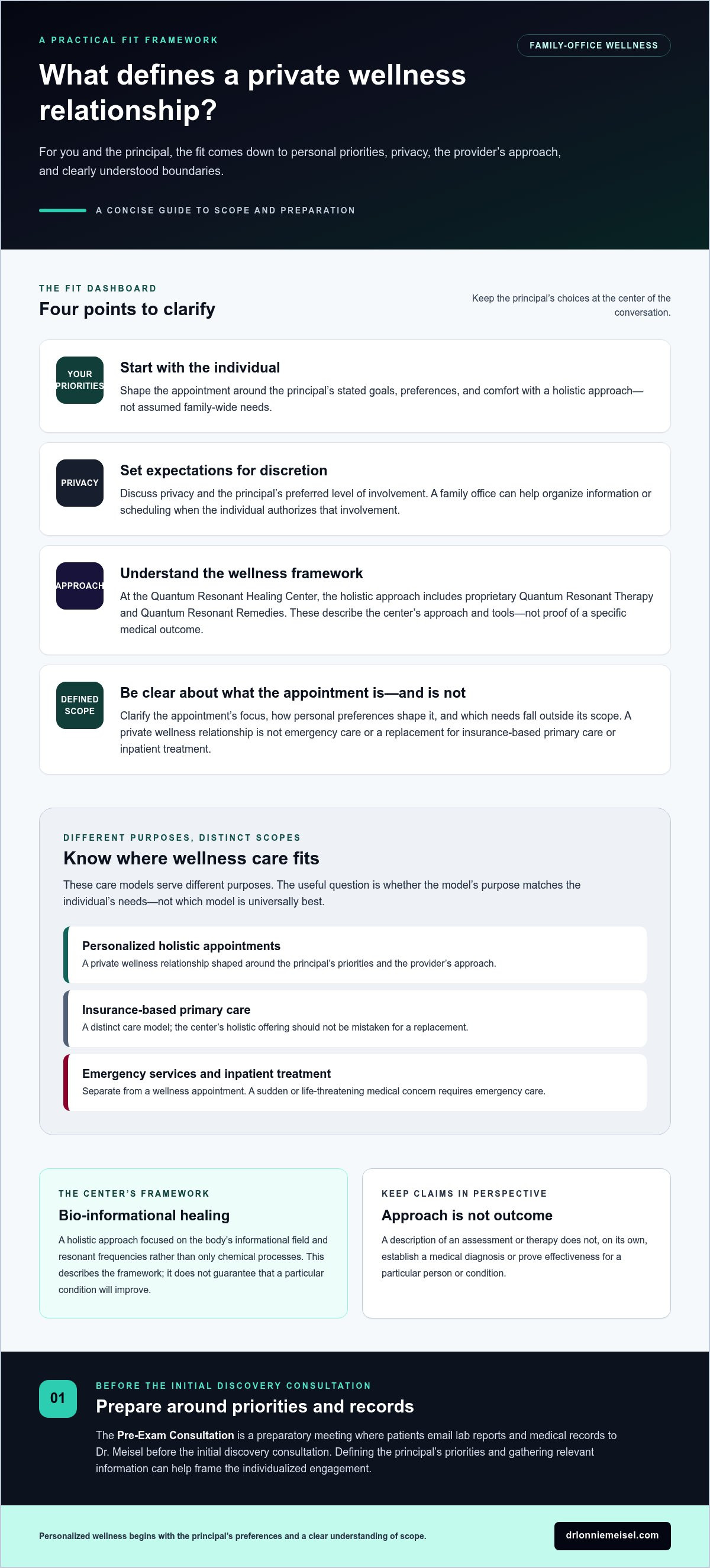
A private wellness physician for family offices is a physician relationship considered by a family office on behalf of a principal, with the appointment shaped around that individual’s priorities rather than assumed family-wide needs. The phrase describes a private, individualized wellness approach, not one standard package. To assess the fit, look at the principal’s preferences, the provider’s approach, and the services included.
Privacy and scope deserve attention from the outset. A discreet, personalized appointment is different from emergency care, inpatient treatment, or insurance-based primary care. Each model has a distinct purpose. Clear boundaries help you decide whether a holistic wellness relationship fits alongside the principal’s existing arrangements or addresses the type of support they are seeking.
A useful definition is: “A private physician for high net worth individuals is a medical professional offering exclusive, on-demand care to affluent patients.” The phrase describes a broad type of relationship; it does not establish a particular schedule, service scope, or clinical result. The specific model matters. At the Quantum Resonant Healing Center, the offering is holistic, with personalized appointments and proprietary approaches including Quantum Resonant Therapy and Quantum Resonant Remedies.
Why family offices may explore a private wellness relationship
Begin with the principal’s stated goals, privacy expectations, and schedule. One person may prioritize a more individualized wellness experience; another may prefer to keep existing care arrangements unchanged. A family office can help organize relevant information or scheduling preferences when the individual authorizes that involvement. The principal’s choices should guide the process.
Family members may also differ in their health goals, comfort with holistic approaches, and preferred level of involvement. Avoid treating one person’s priorities as a family-wide mandate. Personalized Medicine offers a useful reference point for thinking about care tailored to individual characteristics. The methods and boundaries of a particular wellness appointment depend on the provider.
How this model differs from general and emergency care
Personalized holistic appointments are not emergency medical services. A sudden or life-threatening medical concern requires emergency care, not a wellness appointment. The center’s offering also differs from insurance-based primary care and inpatient treatment, and should not be mistaken for a replacement for either. Understanding these distinctions helps you assess the role a private wellness relationship may have within the principal’s broader care choices.
General clinic care, insurance-based primary care, emergency services, inpatient treatment, and holistic concierge appointments have distinct scopes. The relevant question is not which model is universally best, but whether its purpose matches the individual’s needs. Before deciding, clarify what the appointment focuses on, how personal preferences shape it, and which needs fall outside its scope. That gives you a practical basis for evaluating fit without assuming that every family member wants the same kind of care.
How Personalized Holistic Wellness Takes Shape at the Center
At the Quantum Resonant Healing Center, an individualized approach starts with the person, not a preset promise. The principal’s priorities, relevant health information, and comfort with the process help shape a personal appointment. The center’s holistic approach includes proprietary Quantum Resonant Therapy and Quantum Resonant Remedies. These names describe the center’s approach and tools, not proof of a specific medical outcome.
In this context, bio‑informational healing is a holistic approach that treats the body’s informational field and resonant frequencies rather than only chemical processes. The term describes the framework used at the center; it does not guarantee that a particular condition will improve. For a private wellness physician for family offices, this distinction helps the principal consider whether the approach aligns with personal preferences.
What the center means by bio-informational assessment
A bio‑informational assessment is a diagnostic process that identifies frequency disruptions within the nervous system. In plain language, it refers to the center’s way of interpreting patterns through its frequency-based framework. The definition alone does not establish a medical diagnosis. Assessment language and treatment claims are separate questions: a description of what a process assesses does not establish that a therapy is effective for a particular person or condition.
This distinction supports an informed conversation. You can clarify what the assessment is intended to describe, how its terminology relates to the individual’s priorities, and how the information informs the personalized approach. The aim is to understand the center’s method without confusing its proprietary framework with established clinical evidence or a promised result.
Where Quantum Resonant Remedies fit
Quantum Resonant Remedies are non-pharmaceutical, bio-informational tools designed to support the intestinal lining’s resonant state and reduce inflammation. This describes their intended role within the center’s approach. It does not establish a guaranteed effect for an individual or mean that the remedies replace prescribed medication or established medical care. Keep those distinctions clear as you consider how the tools relate to the principal’s goals.
To evaluate the approach, separate three things: the individual’s stated wellness priorities, the center’s assessment terminology, and the tools proposed within its proprietary framework. This keeps expectations specific and helps you discuss fit without assuming a particular outcome. The center’s holistic approach is designed around an individual’s priorities, but it does not guarantee a treatment result.
For more context on how this philosophy informs personal appointments, read Dr. Meisel’s holistic wellness approach and consider which questions matter most to you.
A Family-Office Framework for Comparing Private Wellness Models
For a family office, comparing wellness models is less about finding a universal winner and more about matching the format to one person’s priorities. A private wellness physician for family offices may refer to a distinctive holistic appointment, while general clinic care and concierge medicine describe different scopes and communication styles. Use the same criteria for each option: purpose, personalization, communication, and location. Then consider how the principal wants the relationship to fit alongside existing care.
| Model | Care scope | Personalization | Communication preferences | Location |
|---|---|---|---|---|
| General clinic care | Varies by clinic and appointment purpose. | Shaped by the visit and the clinic’s approach. | Follows the clinic’s usual communication process. | Typically at the clinic. |
| Concierge medicine | A private-care model whose services depend on the practice. | May be structured around an ongoing physician relationship. | Direct physician communication may be part of the model; details vary. | Depends on the practice and appointment format. |
| Proprietary holistic appointment | Focused on the center’s holistic approach, not emergency services or insurance-based primary care. | Can begin with the individual’s priorities and relevant information. | Discuss the principal’s preferred communication and any authorized coordination. | Quantum Resonant Testing may take place at the clinic or the patient’s home. |
This comparison describes differences in format, not relative medical outcomes. A model’s label alone will not tell you whether it meets a particular need. Consider how the center’s VIP concierge approach fits the principal’s preferences for personalization, communication, and appointment setting.
Questions that clarify scope and personal fit
Start by naming the need. Is the principal seeking holistic appointments, primary care, emergency coverage, or a combination of arrangements? Then clarify the appointment format, the individual’s priorities, and what the model is intended to address. A defined scope helps you assess suitability without treating one service as a substitute for another or assuming a desired health outcome.
Privacy and coordination without assumptions
Privacy begins with a conversation about preferences: who may help with scheduling, what administrative details may be shared, and which discussions should remain directly between the principal and physician. Family-office coordination should happen only when the individual authorizes it. Separating administrative support from clinical conversations can keep the principal’s preferences central without assuming that staff need access to personal health discussions.
These questions give you a practical basis for comparing options. The principal’s priorities should guide the decision, including how much coordination feels appropriate and which model’s scope aligns with the care they are seeking.
How to Prepare for a Private Wellness Engagement
A focused preparation process helps make an individualized appointment more relevant to the principal’s priorities. Before beginning, identify what the individual wants to discuss, gather relevant records, and decide whether the family office will have a role in administrative coordination. Staff participation should reflect the individual’s preferences and authorization.
- Identify priorities. Note the concerns or wellness goals the individual wants to raise. Keep the list personal rather than assuming another family member has the same needs.
- Gather relevant records. Collect the lab reports and medical records the patient wants Dr. Meisel to review.
- Complete the preparatory meeting. The Pre-Exam Consultation is a preparatory meeting where patients email lab reports and medical records to Dr. Meisel before the initial discovery consultation.
- Discuss the appointment format. Clarify what the individual hopes to address and how they prefer to take part in the process.
Before the initial discovery consultation
The Pre-Exam Consultation gives Dr. Meisel relevant records ahead of the initial discovery consultation. The patient emails lab reports and medical records before that meeting. This sequence creates a clear starting point for discussing personal priorities. No particular result should be presumed; the focus is preparation for a tailored conversation.
What the named assessments are designed to examine
The center uses named assessments within its proprietary approach. The Quantum Core Diagnostic Exam is the foundational examination that detects hidden infections, toxins, and energetic stressors. The Quantum EMF Analysis is a proprietary analysis that detects electromagnetic field-related parasites, candida, mold, and toxins in the body. The Emotional Empowering Exam identifies unresolved emotional stress and subconscious patterns contributing to chronic health issues. These descriptions explain what each assessment is designed to examine; they should not be read as a guarantee of diagnosis or outcome.
Quantum Resonant Testing is a diagnostic session performed in a relaxed atmosphere that can last 1-3 hours and may be conducted at the clinic or at the patient’s home. Knowing the format and duration can help the individual decide how it fits their schedule and preferences.
For a private wellness physician for family offices, preparation should preserve the principal’s control over personal information and the conversation. When authorized, the family office can help organize records or logistics, while the individual remains the source of priorities and preferences.
To see how this preparation connects with a personalized concierge engagement, read about the center’s VIP concierge approach.
Dr. Meisel’s Private Wellness Approach for Family-Office Clients
Dr. Lonnie Meisel operates the Quantum Resonant Healing Center in Fort Lauderdale and serves a global clientele through VIP concierge services and personal appointments. For a principal considering a private wellness physician for family offices, the center’s model connects a personal appointment with an individualized holistic approach. The starting point is the individual: their priorities, relevant information, and appointment preferences.
This approach is for someone interested in the center’s proprietary, frequency-based therapies as part of a holistic wellness experience. It is distinct from emergency medical services, insurance-based primary care, and inpatient treatment. Those boundaries matter. The center’s concierge and personal appointments are not a substitute for emergency care or a promise of a particular medical result.
A proprietary approach with clear language
Quantum Resonant Therapy is the center’s proprietary frequency-based approach. That description identifies the framework used at the center; it should not be interpreted as proof of established clinical evidence or a guarantee of treatment success. Keeping those ideas separate helps you understand the approach and form realistic expectations. The individual can consider how it aligns with their wellness priorities without assuming it replaces other medical care.
For a family office, this distinction makes conversations more precise. Separate what the center’s method is designed to explore from what the principal hopes to address, then consider whether an appointment focused on holistic wellness feels appropriate. The decision remains personal. One family member’s interest in frequency-based therapies does not mean another will share the same goals or preferences.
Choosing a next step that respects the individual
Before moving forward, consider what the principal wants from an appointment: a focused discussion of personal wellness priorities, an introduction to the center’s approach, or an experience shaped around relevant records. The individual should guide what information is shared and whether family-office staff assist with administrative coordination. This keeps the next step tailored to the principal rather than presuming a family-wide plan.
For more context on the center’s concierge model, VIP Concierge Medicine: The Definitive Guide to Holistic Care in 2026 explores its approach to personalized holistic care. As you review the information, consider whether the model’s focus and boundaries match the individual’s expectations.
If the approach aligns with the principal’s priorities, explore a personalized appointment with Dr. Meisel. The next step can begin with the individual’s priorities and a clear understanding of the appointment’s purpose.
Let the Principal’s Priorities Shape the Next Step
A considered next step can be simple: give the principal space to decide what a useful wellness relationship would look like before making a commitment. You can help clarify which qualities matter most, such as the style of interaction, the topics they want to address, and how much assistance they want from family-office staff. Treat these as the individual’s preferences, not as a standing plan for the whole family.
A private wellness physician for family offices is a meaningful fit only when the principal’s expectations align with the appointment’s purpose and boundaries. Use the questions raised in this article to create a short list of points the individual wants to understand. That list can guide a focused conversation and help the principal decide whether to take another step, pause, or revisit the decision later.
There’s no need to rush a personal choice. When the principal is ready to explore the possibility, schedule a personalized appointment with Dr. Meisel. A clear sense of what matters to the individual can make the next step thoughtful and self-directed.
Frequently Asked Questions
What does a private wellness physician for a family office do?
A private wellness physician for family offices provides a principal with an individualized setting to discuss wellness priorities and the provider’s approach. Start by defining what the principal wants from the relationship, rather than assuming the physician serves the entire family or manages every aspect of care. That distinction keeps expectations personal and focused on the individual’s stated goals.
How is a private wellness physician different from a concierge primary care doctor?
The difference depends on the purpose of the relationship. A concierge primary care doctor is associated with primary-care needs, while a private holistic wellness appointment has a different focus. Before choosing a model, identify whether the principal wants routine medical care, a holistic wellness conversation, or both through separate arrangements. This makes the expected role of each appointment clearer and helps avoid relying on a service outside its intended scope.
Can a family office coordinate a private wellness appointment for a principal?
Yes. A family office can assist with practical arrangements when the principal wants that support. For example, staff may help identify preferred appointment windows or organize travel details, while the principal sets the agenda for personal health discussions. A clear division of roles can prevent logistical help from becoming unrequested involvement in clinical decisions. The individual should remain in control of what is discussed and who participates.
Is Quantum Resonant Therapy a replacement for conventional medical care?
No. Quantum Resonant Therapy is the center’s proprietary approach and should not be treated as a substitute for conventional medical care. If the principal is receiving care for a condition, decisions about medications, testing, or changes to an existing plan should be discussed with the clinician responsible for that care. This allows the individual to consider a holistic appointment without assuming it replaces other medical guidance or guarantees a particular result.
What happens during Quantum Resonant Testing?
Quantum Resonant Testing is a session within the center’s approach. The patient can bring questions about what the session is intended to explore and how its observations will be explained. It can also help to clarify how any suggested next steps relate to the patient’s stated priorities. The session’s terminology describes the center’s process, not a guaranteed finding or outcome.
How should a patient prepare for a Pre-Exam Consultation?
Prepare by deciding what you want Dr. Meisel to understand before the initial discovery consultation. You can arrange relevant records in date order and note questions that are not obvious from the documents themselves. If someone assists with preparation, let the patient decide what to include and what should remain private. A focused set of questions can help keep the discussion centered on the individual’s concerns.
Does the Quantum Resonant Healing Center provide emergency medical services?
No. The center does not provide emergency medical services. If a person is experiencing a sudden or potentially life-threatening problem, don’t wait for a wellness appointment; seek emergency help. This distinction helps you choose an appropriate response based on the urgency of the situation. A planned holistic appointment has a different purpose and cannot serve as emergency evaluation or treatment.


