
A natural remedy may support general wellbeing without treating chronic inflammatory response syndrome (CIRS). That distinction matters when symptoms such as fatigue, brain fog, or joint pain can have many causes, and claims about mold, supplements, and recovery are difficult to evaluate. If you’re considering natural remedies for chronic inflammatory response syndrome, you deserve options that are both useful and safe.
You don’t need to try a long list of supplements or assume one exposure explains every symptom. A suspected environmental trigger and a CIRS diagnosis call for careful assessment; symptoms alone can’t establish the cause. This article explains how to distinguish general wellness support from treatment claims, compare approaches, and prepare questions about safety.
You’ll find a practical way to weigh what’s known and uncertain before discussing your options. At the Quantum Resonant Healing Center, Dr. Lonnie Meisel offers personalized appointments to discuss your history and goals. The Center’s Quantum Resonant Remedies are a proprietary, non-pharmaceutical approach, not an established CIRS treatment. The focus is on helping you consider next steps in light of your needs.
Key Takeaways
- Build a symptom and exposure timeline to organize what you’ve noticed, without treating timing alone as proof of cause.
- Consider sleep regularity, balanced nutrition, and physical activity as individualized wellbeing supports, not established CIRS cures.
- Assess natural remedies for chronic inflammatory response syndrome by their intended role, evidence limits, potential risks, and fit with your care plan.
- Bring questions about evidence, safety, and follow-up to a personalized care discussion before changing supplements or routines.
- Understand how the Quantum Resonant Healing Center presents Quantum Resonant Remedies as a proprietary approach, distinct from established CIRS treatments.
What CIRS Means, and Why Natural Remedies Need Context
Chronic Inflammatory Response Syndrome (CIRS) is a term used in some medical and patient discussions for a proposed pattern of persistent, multisystem symptoms associated with an inflammatory response, sometimes linked to biotoxin exposure. The term alone doesn’t confirm a diagnosis or establish what caused your symptoms. If you’re exploring natural remedies for chronic inflammatory response syndrome, first clarify what is known about your health and what still needs assessment.
What does chronic inflammatory response syndrome refer to?
CIRS is often discussed in relation to biotoxin exposure, including possible exposure in water-damaged buildings. Descriptions of the condition and approaches to diagnosis can differ. A general overview such as Chronic Inflammatory Response Syndrome (CIRS) may explain how the term is used, but it should not be treated as a diagnostic standard.
Fatigue, difficulty concentrating, headaches, and joint discomfort can occur for many reasons. These symptoms can affect daily life and deserve attention, but none proves CIRS on its own. Noticing symptoms after a possible exposure is useful information, but it doesn’t prove that the exposure caused them. A careful assessment keeps those distinctions clear and avoids turning a possible explanation into a conclusion too soon.
Why diagnosis should come before a remedy plan
Persistent or worsening symptoms merit discussion with a qualified clinician. A useful review considers your symptom history, possible exposures, relevant medical records, and other explanations that may need attention. No single symptom checklist, exposure history, or test result should be treated as definitive on its own. Interpretation depends on the broader clinical picture and current medical guidance.
Make that conversation more focused with a brief timeline. Record when symptoms began, how they change, where you spend time, and any changes in your home or work environment. Note relevant diagnoses, medicines, and supplements. Include questions about the purpose and limits of any proposed test. This organizes what you know without assuming that events occurring together share a cause.
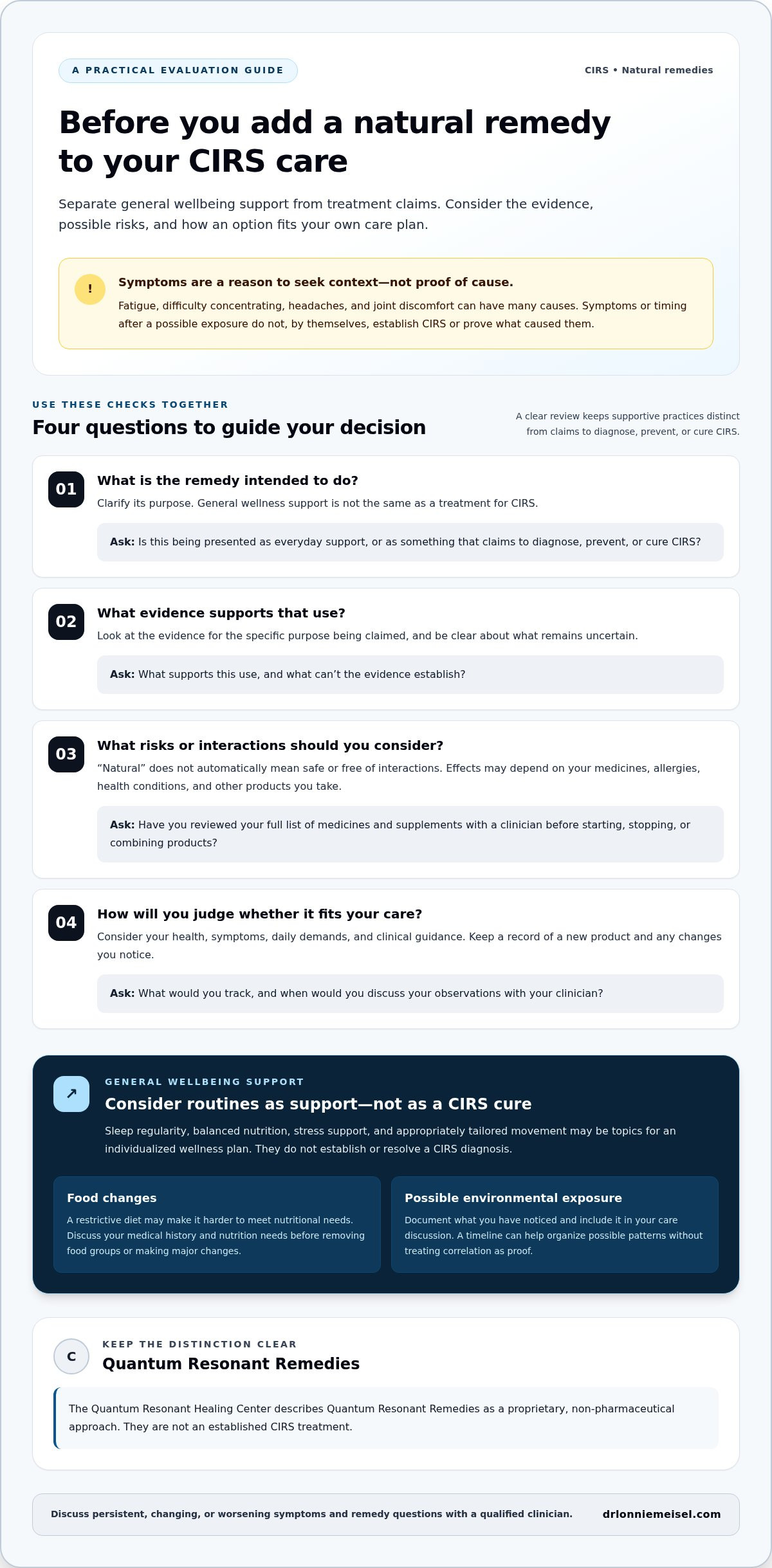
Keep supportive wellness practices separate from treatment claims. Regular sleep, balanced meals, and appropriately tailored activity may be discussed as general health support. That is different from claiming a practice can diagnose, prevent, or cure CIRS. A remedy plan should not replace assessment or delay attention to symptoms that are persistent, changing, or worsening.
Bring specific questions to your appointment: What possibilities could explain these symptoms? What can this test establish, and what can’t it establish? What risks or interactions should I consider before trying a supplement or other approach? These questions help you make decisions with context rather than relying on a symptom match or a confident promise.
Which Natural Approaches May Support Wellbeing Alongside CIRS Care?
Supportive routines may help you care for your general wellbeing, but they shouldn’t be presented as proven ways to treat or cure CIRS. The right approach depends on your health, symptoms, daily demands, and clinical guidance. Treat each change as a practical question to consider, not a universal protocol.
Lifestyle measures: reasonable topics for an individualized plan
Sleep regularity, balanced nutrition, stress support, and movement can be useful topics for a personal wellness plan. You might consider whether a steadier sleep schedule or gentle activity fits your current capacity. These steps may support everyday health, but they don’t establish or resolve a CIRS diagnosis.
Food changes need particular care. A restrictive diet may make it harder to meet your nutritional needs, and a diet that suits one person may not suit another. Before removing food groups or making major changes, discuss your medical history and nutritional needs with a clinician. If you try an adjustment, note what changed and how you felt rather than assuming a short-term shift proves a cause.
Exposure management is separate from supplements and wellness therapies. If you suspect an ongoing environmental exposure, document what you’ve noticed and include the concern in your care discussion. Don’t assume a suspected exposure explains every symptom or that a supplement can address the source. A timeline can help you track possible patterns without treating correlation as proof.
Supplements and natural products: assess evidence and safety
“Natural” doesn’t automatically mean safe, effective, or free of interactions. A supplement may affect you differently depending on your medicines, allergies, health conditions, and other products you take. Review your full list with a clinician before starting, stopping, or combining supplements, and be cautious of claims that promise to diagnose, prevent, or cure CIRS.
Rather than choosing a product because it is promoted for inflammation, ask what it is intended to do, what evidence supports that use, what risks are known, and how you’ll judge whether it’s appropriate for you. Avoid building a supplement stack or following dosing advice without reliable evidence and individual context. Keep a record of any new product and changes you notice so you can discuss them clearly.
The Center’s Quantum Resonant Remedies approach reflects its proprietary, bio-informational model. The Center describes these remedies as non-pharmaceutical tools designed to support the intestinal lining’s resonant state and reduce inflammation. This is the Center’s holistic approach, not an established CIRS treatment or proof of a clinical outcome. If you value a private, individualized conversation about your history and goals, you can explore personal appointments with Dr. Meisel.
How to Compare CIRS Remedies Without Overstating the Evidence
Claims about natural remedies for chronic inflammatory response syndrome can sound equally persuasive, even when the approaches and evidence differ. Compare each option by its intended role, the outcomes studied, potential risks, and fit with your care. A proposed mechanism may explain why an approach is being considered, but it doesn’t establish that it works for people with CIRS.
A plausible biological rationale is a reason to investigate a remedy, not proof that it improves a clinical outcome. Keep that distinction in mind when a claim refers to inflammation, toxins, immune balance, or the body’s frequencies.
| Approach | Intended role | Evidence limits | Risks to consider | Clinician discussion |
|---|---|---|---|---|
| Sleep, nutrition, and activity habits | Support general wellbeing and daily function. | Benefits for general health don’t prove a CIRS-specific effect. | Plans may be unsuitable if they ignore your health needs or lead to restrictive changes. | What adjustments are appropriate for your current health and capacity? |
| Supplements or other natural products | Address a proposed nutritional or health goal. | Evidence for an ingredient or another condition may not apply to CIRS. | Interactions, allergies, and effects related to existing conditions may matter. | Could this interact with medications or other products you take? |
| Exposure management | Respond to a suspected ongoing environmental concern. | A suspected exposure or timing pattern alone doesn’t establish the cause of symptoms. | Acting on an unverified assumption may distract from other explanations. | What information would help assess this concern in context? |
| Proprietary or frequency-based approaches | Offer a complementary framework for supporting wellbeing. | A proposed bio-informational mechanism is not, by itself, evidence of a CIRS treatment effect. | Clarify the approach’s limits and avoid substituting it for needed assessment. | What is claimed, what is established, and how will decisions be reviewed? |
For any remedy claim, ask three practical questions: What specific outcome is expected? How was that outcome measured? Were people with a comparable condition or health profile studied? Then consider whether the support comes from published clinical research, a proposed theory, personal testimonials, or promotional language. These sources aren’t interchangeable. Study quality and relevance matter, and findings in another population don’t automatically establish benefit for CIRS.
How the Center describes Quantum Resonant Remedies
At the Quantum Resonant Healing Center, Quantum Resonant Remedies are proprietary, non-pharmaceutical, bio-informational tools designed to support the intestinal lining’s resonant state and reduce inflammation. This describes the Center’s approach; it is not an established CIRS treatment or proof of a clinical outcome. If you’re considering a frequency-based approach, discuss its intended role, limits, and place alongside your broader care as you would with any other option.
A Safer, More Practical Plan for Exploring Natural CIRS Support
A considered process can help you explore an option without letting it displace appropriate care. Before you begin, agree on what you want to learn, what would make the approach unsuitable, and when you’ll review the decision.
- Define your priority. Identify the main concern you want to address and how it affects your daily life. A specific goal makes the discussion more focused than a general aim to “feel better.”
- Examine the claim. Clarify what a remedy is intended to do and what evidence supports that use. Distinguish clinical research from a proposed mechanism, testimonials, or promotional language.
- Review personal safety. Consider your medications, supplements, allergies, and health conditions before making a change. Include the product’s ingredients and instructions in the discussion.
- Set a review plan. Decide how you’ll assess whether the approach remains appropriate, when you’ll revisit the decision, and what concerns should prompt you to stop or seek advice.
Prepare for an informed care discussion
Bring a concise summary of your main concerns, a current medication and supplement list, and relevant prior records. Write down what you hope to gain from considering a remedy, along with questions about its intended role and limitations. You may also want to agree on practical boundaries, such as not changing prescribed care without clinical guidance.
If you and your clinician decide a new approach is reasonable, discuss whether to introduce it separately from other changes. Starting multiple new practices at once can make it harder to judge which, if any, is worth continuing. Agree on when to review your experience and what would be a reason to reconsider the plan.
A simple way to sort your options
- Supportive care: General wellbeing practices considered in light of your needs, without assuming a CIRS-specific treatment effect.
- Uncertain claims: Approaches whose support rests mainly on a proposed explanation, personal stories, or promotional statements. Clarify what outcome has been assessed.
- Individualized clinical decisions: Choices considered alongside your health context, preferences, and an agreed plan for review.
Know when self-directed remedies are not enough
Severe, rapidly worsening, or alarming symptoms call for prompt medical attention. Don’t wait to see whether a natural remedy helps. Sudden difficulty breathing, chest pain, fainting, or new severe confusion warrant urgent attention. If you believe you may be experiencing a medical emergency, contact local emergency services.
A suspected environmental concern and a health concern may need different forms of assessment; one shouldn’t be treated as proof of the other. If you’re weighing natural remedies for chronic inflammatory response syndrome, a personalized discussion can help clarify your priorities and the questions you want to address next. Arrange a personal appointment with Dr. Meisel to discuss your goals and options.
How Personalized Care at the Quantum Resonant Healing Center Fits In
Once you’ve considered evidence and safety, you may value a care conversation centered on your priorities. At the Quantum Resonant Healing Center, Dr. Lonnie Meisel offers personalized appointments and VIP Concierge care. Use the time to explain what you hope to understand and what matters most as you consider next steps.
What a personalized appointment can help you discuss
An appointment gives you space to talk through your health history, current concerns, and goals. Bring questions about symptoms, previous care, or approaches you’re considering, then discuss which topics are most relevant to you. A focused exchange can help organize your concerns and clarify what you want to explore further.
The Center’s holistic model uses its own language for frequency-based care, including Quantum Resonant Therapy. If you’re unfamiliar with this framework, ask how its concepts relate to the topics you want to discuss and what questions remain important to you. The Center’s VIP concierge holistic care resource offers additional context about its care model.
Your preferences matter in shaping the conversation. You may want a discreet setting, time to organize a complex health history, or a discussion that keeps your goals in view. Direct, thoughtful communication can help you understand the approach being discussed and decide what feels appropriate for your circumstances.
Choose a considered next step
Before an appointment, consider what you most want to clarify. Identify a primary concern, note the questions you want answered, and bring relevant records or a current list of medicines and supplements. These details can help keep the discussion focused on your situation and preferences.
- Which concern would you most like to address?
- What would you like to understand about the Center’s approach?
- What information or follow-up would help you make a considered decision?
If a private, individualized conversation fits your preferences, explore personalized appointments with Dr. Meisel at the Quantum Resonant Healing Center.
Take Your Next Step with Clarity
You don’t have to settle every question about your health before moving forward. Start with one decision: what would you most like help understanding? It may be how to interpret a symptom pattern, weigh a remedy claim, or make a care plan fit your priorities. Naming that concern can make the next conversation more focused and help you avoid feeling pressured to try several approaches at once.
As you consider natural remedies for chronic inflammatory response syndrome, give yourself room to ask for clear explanations, discuss uncertainty, and make choices at a considered pace. A useful next step respects your circumstances and keeps your questions at the center of the discussion.
If you’re ready for a private, individualized conversation about your health goals, explore personalized appointments with Dr. Meisel at the Quantum Resonant Healing Center.
Frequently Asked Questions
Can natural remedies cure chronic inflammatory response syndrome?
No natural remedy should be relied on as a proven CIRS cure. If a product or program makes that promise, ask what specific outcome was measured, whether the evidence involved people with CIRS, and what independent clinical research supports the claim. Treat a guarantee of recovery as a reason to pause and seek a clear explanation before making decisions about your care.
Is mold exposure enough to diagnose CIRS?
No. Evidence of mold in a building describes an environmental condition; it does not diagnose a health condition in an individual. Environmental sampling and medical evaluation answer different questions, so don’t treat a home test or inspection result as a personal diagnosis. Keep information about a building separate from your health records and discuss both appropriately.
Are supplements safe to take for CIRS?
Not all supplements are safe for every person. Before trying one, take its container or a clear photo of the label to a clinician or pharmacist. Ask about duplicate ingredients across products, potential interactions, and whether the listed amount is appropriate for your circumstances. Don’t stop prescribed medicine or replace it with a supplement unless the clinician responsible for your care advises you to do so.
What should I track while exploring supportive approaches?
Choose one practical outcome that matters to you, such as completing a usual workday or managing a routine task, and record how consistently you can do it. Note the approach you’re assessing and any major changes to your routine. Reviewing the same measure over time can make the discussion more specific, but a change in function alone cannot establish why it happened.
Can diet alone resolve CIRS symptoms?
There’s no basis to assume diet alone will resolve CIRS symptoms. If you’re considering a dietary change, define its purpose first, such as addressing a particular nutrition concern, and avoid broad restrictions without a clear rationale. Notice whether the change makes eating difficult or reduces the variety of foods you can manage, and raise those concerns in a care discussion.
What are Quantum Resonant Remedies?
Quantum Resonant Remedies are the Quantum Resonant Healing Center’s non-pharmaceutical, bio-informational tools, designed to support the intestinal lining’s resonant state and reduce inflammation. If you discuss them in an appointment, ask what the proposed use involves, what instructions apply, and how the approach fits with your other care decisions. Clear answers can help you understand the Center’s terminology and decide whether you want to explore it further.
When should I seek prompt medical attention instead of trying a natural remedy?
Seek prompt medical attention if a symptom feels severe, is worsening quickly, or causes you significant concern; don’t wait to see whether a natural remedy changes it. If you’re unsure how urgent the situation is, contact an appropriate local medical service for guidance. A wellness approach is not a substitute for timely evaluation when your condition may need immediate attention.


