
What if the path to regaining physical autonomy wasn't found in a crowded waiting room, but through the precise recalibration of your body’s own resonant frequencies? While historical data suggested this condition was one in a million, recent epidemiological studies confirm that stiff person syndrome is more prevalent, affecting between 1.36 and 2.11 per 100,000 people. For high-performing individuals, this diagnosis often feels like an abrupt loss of control, where sudden spasms and environmental triggers dictate the rhythm of your day. You've likely felt the frustration of traditional clinical settings that prioritize rigid protocol over personal privacy, leaving you to manage a progressive disability in a public, often impersonal environment.
You deserve a health advisory that matches the caliber of your lifestyle. This article provides the latest insights into managing the condition through elite, concierge-level holistic protocols designed to support neurological stability and long-term wellness. We'll explore how shifting the focus toward resonant frequency balance can help you resume your professional activities with confidence. We'll also preview the transition from standard medical models to a more discreet, world-class framework that prioritizes your privacy and individual needs above all else. This methodical approach ensures you're not just managing symptoms, but actively restoring the order and stability your life requires.
Key Takeaways
- Gain clarity on the latest 2026 neurological insights regarding GABA deficiency and how it drives the progression of stiff person syndrome.
- Differentiate between the various spectrum types, including Classic and SPS Plus, to map out a more accurate path toward neurological stability.
- Evaluate the limitations of standard hospital-based care and the benefits of a private, concierge-led health advisory for maintaining professional autonomy and privacy.
- Understand the principles of bio-informational healing and how Quantum Resonant Remedies address the root frequency of neurological hyper-excitability.
- Preview the structured, high-touch process of a personalized assessment designed to re-tune the nervous system for long-term wellness and a return to professional life.
Understanding Stiff Person Syndrome (SPS): Symptoms and 2026 Insights
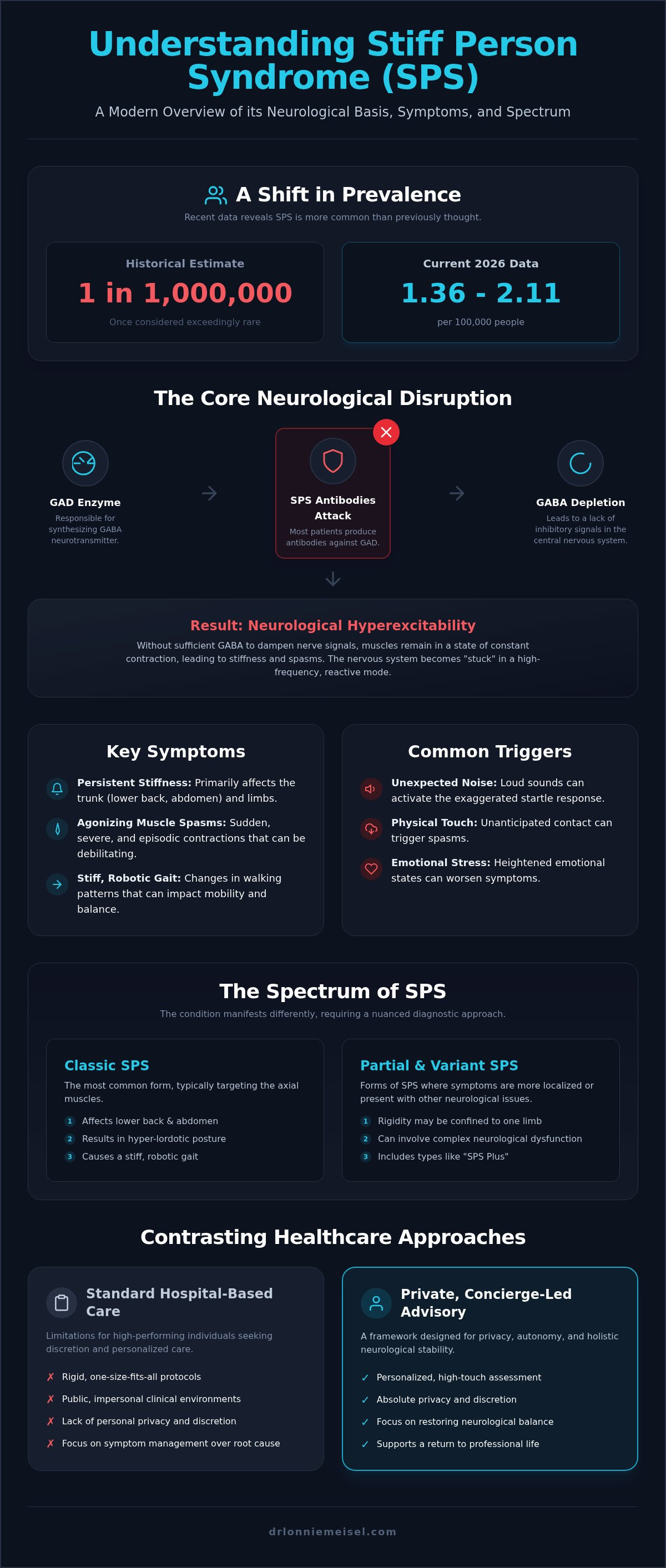
Stiff Person Syndrome is a complex autoimmune neurological disorder characterized by fluctuating muscle rigidity and episodic spasms. While it was once considered an exceedingly rare condition, recent 2026 data indicates a prevalence between 1.36 and 2.11 per 100,000 individuals. This shift in data reflects better diagnostic tools and a deeper understanding of how the condition manifests across a broad spectrum rather than as a single, static state. The disorder primarily targets the central nervous system, leading to a progressive loss of physical autonomy that can disrupt both professional and personal life.
Common symptoms include persistent stiffness in the trunk and limbs, alongside agonizing muscle spasms. These spasms are often triggered by unexpected noise, physical touch, or emotional stress. The condition's unpredictable nature creates a constant state of vigilance for those affected. By 2026, experts have moved toward a spectrum-based classification, recognizing that the severity and localization of symptoms can vary significantly between individuals.
The Neurological Mechanism: GABA and GAD Antibodies
At the core of stiff person syndrome is a disruption in the body's ability to regulate muscle activity. Most patients produce antibodies against glutamic acid decarboxylase (GAD), the enzyme responsible for synthesizing gamma-aminobutyric acid (GABA). Because GABA is the primary inhibitory neurotransmitter in the central nervous system, its depletion leads to a state of neurological "hyperexcitability." Without sufficient GABA to dampen nerve signals, the muscles remain in a state of constant contraction.
This biochemical imbalance directly impacts the "startle response." In high-stress environments, a simple loud noise or a sudden movement can trigger a cascading neurological event. For the high-performing professional, this means the nervous system is essentially "stuck" in a high-frequency, reactive mode, making it difficult to maintain the composure required in demanding settings.
Recognizing Early Warning Signs in High Performers
Early identification is vital for maintaining neurological stability. High performers often notice subtle changes before a formal diagnosis is reached. You might experience an unusual "locking" of the leg muscles during a walk or a slight change in gait that feels uncharacteristic. These early warning signs are often dismissed as simple fatigue or stress, yet they represent the initial stages of the body's resonant frequency falling out of balance.
The emotional toll of these unpredictable physical interruptions shouldn't be underestimated. The fear of a public spasm can lead to social withdrawal and a loss of confidence in professional arenas. Seeking intervention through VIP concierge medicine allows for a level of discretion and personalized attention that standard clinical models often lack. Addressing these signs early through a holistic lens ensures that your nervous system receives the precise tuning it needs to remain resilient.
The Spectrum of SPS: Categorizing Types and Progression
Identifying the specific variant of stiff person syndrome is the first step toward reclaiming physical autonomy. Diagnosis isn't a final destination; it's the start of a nuanced journey. According to Stiff-Person Syndrome Information provided by the NINDS, the condition doesn't manifest identically in every patient. It exists on a spectrum that ranges from localized rigidity to complex neurological dysfunction involving the brainstem. Understanding where you fall on this spectrum is essential for developing a protocol that preserves your professional mobility.
Classic vs. Partial Stiff Person Syndrome
Classic SPS typically targets the axial muscles, specifically the lower back and abdomen. This results in a hyper-lordotic posture and a stiff, robotic gait that makes movement feel like an uphill battle. In contrast, Partial SPS, often referred to as Stiff-Limb Syndrome, remains confined to a single extremity. While it sounds less severe, the localized nature often leads to painful dystonic posturing. These variants require different management strategies. One focuses on core stability while the other prioritizes targeted limb mobility to prevent permanent joint immobility.
SPS Plus and Paraneoplastic Variants
SPS Plus represents a more aggressive progression of the disorder. It includes the standard rigidity but adds cerebellar signs like ataxia or brainstem dysfunction, which can affect eye movements and swallowing. There's also a paraneoplastic variant, where the immune response is triggered by an underlying systemic issue. Managing these complex variants requires a comprehensive holistic health optimization plan that looks beyond the surface symptoms to address the body's entire internal environment.
As the disorder moves from a localized to a generalized state, the involvement of the spinal cord and brainstem becomes more pronounced. This progression isn't just a physical tightening; it's a deep-seated neurological shift that demands a sophisticated diagnostic review. You can't rely on a one-size-fits-all approach when your neurological stability is at stake. Every case is unique. For those seeking a more refined perspective on their recovery, private health advisory services offer the precise, expert guidance necessary to navigate this complex spectrum with confidence.
Why Standard Clinical Models May Fall Short for High-Profile Patients
Standard medical facilities prioritize high-volume throughput, which often clashes with the privacy requirements of public figures. While institutions like Johns Hopkins provide a foundational understanding of Stiff Person Syndrome (SPS), the logistical reality of a public-facing hospital can be a significant deterrent. For high-profile individuals, the lack of discretion in waiting rooms or during diagnostic testing isn't just an inconvenience; it's a risk to their professional image and personal peace. Conventional models are designed for the masses, often ignoring the specific stressors and environmental demands placed upon those in the public eye.
Accessing top-tier specialists on short notice is another significant hurdle in conventional settings. When managing a rare condition like stiff person syndrome, waiting weeks for a consultation isn't a viable option. This is where the model of a private physician for high net worth individuals becomes indispensable. This concierge approach provides a level of responsiveness that traditional systems simply can't match, ensuring that your care is as dynamic as your schedule and as private as your home life.
The Need for Discretion and Personalized Access
A concierge model is essential for maintaining a high-stakes career while addressing complex neurological needs. Having 24/7 access to a dedicated health advisor means that environmental triggers or sudden flare-ups are managed immediately, rather than after a bureaucratic delay. Private-center or home-based appointments ensure that your health journey remains entirely confidential. This allows you to focus on recovery without the intrusion of the public eye or the discomfort of traditional clinical environments that lack the necessary refinement for an elite clientele.
Moving Beyond Symptom Suppression
Standard pharmaceutical protocols often rely heavily on high doses of benzodiazepines and muscle relaxants. While these can offer temporary relief, they frequently cause heavy sedation that can impair cognitive performance and professional focus. For a high performer, the goal isn't just to mask spasms; it's to maintain a high level of function. Instead of settling for symptom suppression, the focus should shift toward balancing the body's internal state. Dr. Meisel utilizes exclusive resonant healing protocols designed to address the root frequency of the nervous system's excitability. This approach seeks to harmonize the system rather than simply dulling its responses, ensuring you remain alert and capable in your professional sphere. By moving away from a "one-size-fits-all" pharmaceutical lens, you can achieve a state of neurological stability that supports both your wellness and your career ambitions.
Quantum Resonant Perspectives on Neurological Stability
Traditional medical models often view the human body as a series of chemical reactions to be suppressed or stimulated. When managing stiff person syndrome, this limited perspective leads to a heavy reliance on pharmaceutical interventions that often carry debilitating side effects. Bio-informational healing offers a more refined lens. It suggests that the nervous system operates not just through chemistry, but through specific resonant frequencies that coordinate every physical movement. When these frequencies fall out of alignment, the result is the hyper-excitability and muscle rigidity that characterizes this condition.
By utilizing quantum resonant remedies, we can support cellular communication by addressing the bio-informational field directly. This approach contrasts sharply with the "chemical-only" model. Instead of simply masking symptoms, resonant remedies aim to restore the body's natural "tuning." This is a crucial distinction for high performers who need to maintain neurological stability without the cognitive fog associated with standard treatments.
The Science of Frequency and Nervous System Regulation
Biological systems are inherently electrical. Every cell in your body communicates through subtle electromagnetic signals. Resonance is the physical principle where a system vibrates at a specific frequency with greater amplitude, allowing for efficient energy transfer. In the context of nervous system regulation, specific frequencies are used to stabilize GABAergic pathways. This non-invasive bio-optimization is particularly effective for chronic autoimmune conditions where the system is "stuck" in a high-stress, reactive mode. It provides a direct path to neurological calm, helping the body return to a state of homeostasis without the need for invasive procedures.
Quantum Resonant Therapy (QRT) for SPS
A session of Quantum Resonant Therapy is a highly personalized experience designed as a sanctuary of tranquility. It focuses on precise frequency alignment to achieve a profound state of neurological calm. The primary goal is reducing both the intensity and frequency of muscle spasms through resonant balancing. This process re-trains the nervous system to remain stable, even when you're faced with the noise or stress of a demanding professional environment.
This methodology represents a significant advancement in quantum healing for high performers. It's a sophisticated tool for those who require peak physical and mental performance. To learn how these resonant protocols can be tailored to your specific needs, request a private appointment to begin your journey toward lasting stability.
Personalized Protocols: Managing SPS with Quantum Resonant Healing
Managing stiff person syndrome requires a methodical, step-by-step approach that aligns your biological frequency with your professional demands. At the Quantum Resonant Healing Center, we move beyond the standard clinical model by providing a structured path toward neurological stability. This isn't a passive treatment plan; it's an active recalibration of your system. Every step is designed to restore the order your lifestyle requires while maintaining the highest level of discretion.
The protocol follows four distinct phases:
- Step 1: Deep bio-informational assessment. We identify the specific frequency disruptions within your nervous system, looking past surface symptoms to the root of the hyper-excitability.
- Step 2: Customization of proprietary Quantum Resonant Remedies. These are tailored to your specific resonant signature to support cellular communication.
- Step 3: Implementation of private, high-touch frequency therapy sessions. These sessions focus on re-tuning the nervous system to a state of calm and resilience.
- Step 4: Environmental and lifestyle optimization. We provide a tactical framework for trigger reduction, minimizing the impact of external stressors in your daily life.
Customizing Quantum Resonant Remedies
Generic treatments often fail because they don't account for the individual’s specific resonant signature. Each person’s nervous system has a unique frequency profile. Our remedies are tailored to match this profile, acting as a non-pharmaceutical support layer that facilitates clearer cellular communication. Unlike traditional options that rely on temporary sedation, these remedies focus on long-term vitality. They help the body maintain its own balance, ensuring you don't have to choose between symptom control and cognitive clarity. This approach supports your body’s natural ability to regulate itself, providing a foundation for lasting wellness.
Elite Environmental and Lifestyle Management
For high performers, "avoiding triggers" isn't always a simple task. Professional settings often involve unpredictable noise, intense lighting, and high-stress interactions. We provide specific protocols for managing these sensory inputs without withdrawing from your career. This includes stress-mitigation techniques designed for high-stakes environments, such as boardrooms or stages, where composure is non-negotiable. By optimizing your environment, we reduce the load on your nervous system, allowing the resonant therapy to take deeper root. To begin your personalized protocol and regain control over your physical autonomy, Book a private consultation with Dr. Meisel. This is the first step toward a discreet, world-class health advisory experience tailored to your elite lifestyle.
Reclaiming Your Neurological Stability
Managing a diagnosis like stiff person syndrome doesn't mean retreating from your professional life or settling for a future defined by progressive disability. We've explored how moving beyond standard pharmaceutical models allows for a more refined approach to wellness. By focusing on resonant frequency balance and private, high-touch protocols, you can address the root of neurological hyper-excitability directly. This methodology ensures you remain alert and capable in your professional sphere while prioritizing the absolute discretion your position demands. It’s about restoring order to your system so you can focus on the activities that matter most.
Dr. Lonnie Meisel provides proprietary Quantum Resonant Therapy through a global concierge model, offering the specialized expertise required for high-net-worth health advisory. This service provides a seamless, high-touch experience designed to support your long-term vitality without the constraints of traditional clinical settings. To begin your journey toward lasting stability with unparalleled privacy, Request an Exclusive Consultation with Dr. Lonnie Meisel. You don't have to navigate this path alone; expert guidance is ready to help you regain your physical autonomy.
Frequently Asked Questions
Is Stiff Person Syndrome a progressive condition?
Stiff person syndrome is generally considered a progressive disorder, though the trajectory differs for every individual. Symptoms often begin with intermittent stiffness in the axial muscles and can advance to include the limbs and brainstem. Without precise intervention, this progression can lead to a significant loss of physical autonomy. Our focus remains on achieving neurological stability early through resonant frequency balance to mitigate the long-term impact on your professional and personal life.
Can Quantum Resonant Therapy cure SPS?
We focus on achieving long-term neurological stability and wellness rather than using the term "cure" for chronic autoimmune conditions. Quantum Resonant Therapy aims to re-tune a hyper-excitable nervous system by addressing the bio-informational state of the body. This approach helps reduce the intensity of spasms and supports the body’s natural ability to maintain order. Every protocol is customized to the client's unique resonant signature to ensure the most effective path toward physical autonomy.
What triggers the muscle spasms associated with SPS?
Muscle spasms are frequently triggered by unexpected environmental stimuli such as sudden noises, physical touch, or heightened emotional stress. These triggers cause a cascading neurological event in a system already lacking sufficient GABA. High performers often find that high-stakes professional environments provide a constant source of these triggers. Our protocols include elite environmental management strategies designed to reduce sensory overload and stabilize the nervous system's response to these external disruptions.
How does concierge medicine differ from standard neurological care for SPS?
Concierge care prioritizes unparalleled discretion and immediate access, which standard clinical settings often lack. Instead of navigating public waiting rooms and rigid hospital protocols, you receive a private health advisory experience tailored to your schedule. This model allows for deep, bio-informational assessments and personal appointments with Dr. Meisel that focus on resonant healing. It’s a high-touch service that ensures your health journey remains confidential while providing the most advanced holistic support available globally.
Are Quantum Resonant Remedies safe to use with other treatments?
Quantum Resonant Remedies are holistic, non-pharmaceutical solutions designed to support cellular communication through resonant methods. They don't rely on the chemical suppression found in traditional pharmaceuticals, making them a refined alternative for those seeking bio-optimization. While these remedies focus on system harmony, we recommend a comprehensive review during your personal appointment. This ensures your personalized protocol is perfectly balanced and aligns with your overall goals for long-term vitality and professional performance.
What is the role of GAD antibodies in diagnosing SPS?
GAD antibodies are a primary diagnostic marker for stiff person syndrome because they interfere with the production of GABA. When these antibodies are present at high levels, the central nervous system loses its ability to inhibit muscle activity, leading to persistent rigidity. A precise assessment of these antibody levels helps us understand the degree of neurological disruption. This information is essential for creating a targeted resonant frequency protocol that addresses your specific state of hyperexcitability.
How can high-profile individuals maintain privacy while seeking SPS treatment?
High-profile individuals can maintain total privacy by utilizing a global VIP concierge model that bypasses traditional medical institutions. At the Quantum Resonant Healing Center, we offer private appointments in Fort Lauderdale or through global concierge travel to your location. This ensures that your health data and treatment remain entirely confidential. You don't have to sacrifice your professional image or personal peace to receive world-class care for complex neurological challenges.
Can resonant therapy help with the anxiety associated with SPS?
Resonant therapy is highly effective at addressing the underlying neurological roots of anxiety. In patients with this condition, anxiety is often a physiological response to a hyper-reactive startle reflex. By using specific frequencies to re-tune the nervous system, we can achieve a profound state of neurological calm. This reduces the frequency of the "startle response" and helps you maintain composure in demanding professional settings, providing both physical relief and mental clarity.


