
What does advanced resonant therapy for wellness involve, and how can you consider it alongside your existing medical care? At the Quantum Resonant Healing Center, Dr. Lonnie Meisel describes a proprietary, frequency-based approach tailored to the individual.
Resonance therapies can refer to very different practices, and confident promotional language does not establish that a method is effective. Evidence for bioresonance remains limited and controversial, so it helps to understand what a practice involves, what its claims mean, and what an assessment can and cannot establish. You deserve a clear explanation without pressure or sweeping promises.
This guide explains how the center frames Quantum Resonant Therapy, what Quantum Resonant Testing involves, and how to prepare for a personalized appointment. You’ll also learn how the center’s Quantum Resonant Protocol fits into its approach and how to keep wellness recommendations distinct from established medical findings. Quantum Resonant Testing is conducted in a relaxed atmosphere, can last 1-3 hours, and may take place at the clinic or in your home.
Key Takeaways
- Resonance therapy can refer to different practices; this guide focuses on the Quantum Resonant Healing Center’s proprietary, frequency-based approach.
- Understand how a Pre-Exam Consultation, Quantum Resonant Testing, and a personalized Quantum Resonant Protocol fit together.
- Consider advanced resonant therapy for wellness as a complementary framework, not proof of clinical efficacy or a replacement for medical care.
- Prepare for a consultation by organizing your health questions and identifying the priorities you want to discuss.
- Explore how Dr. Lonnie Meisel’s personalized appointments and VIP Concierge Service are designed around individual needs, privacy, and discretion.
Advanced Resonant Therapy for Wellness: What the Approach Means
“Resonance therapy” can describe different things, from speech work focused on vocal sound to vibration-based practices and holistic wellness approaches. A shared word does not mean the methods, goals, or evidence are the same. If you’re exploring advanced resonant therapy for wellness, first identify the specific approach and what its claims refer to.
This guide focuses on the Quantum Resonant Healing Center’s proprietary, frequency-based Quantum Resonant Therapy. The center describes its approach through bio-informational healing, a holistic framework focused on the body’s informational field and resonant frequencies rather than only chemical processes. This terminology explains the center’s model. It is not, by itself, proof of a biological mechanism or a demonstrated clinical effect.
How Quantum Resonant Therapy differs from resonant voice therapy
Resonant voice therapy belongs to a speech and communication context. Better Speech discusses vocal quality, resonance, and communication, while Voice therapy and resonant voice techniques offers a broad overview of voice therapy. The center’s Quantum Resonant Therapy is framed as holistic wellness, not speech training. The practices have different purposes, and the comparison does not imply shared techniques, evidence, or outcomes.
What frequency-based wellness means in the center's terminology
In the center’s terminology, frequency-based describes the lens used to frame its personalized wellness approach. Bio-informational healing refers to a focus on informational fields and resonant frequencies within that framework. This is a description of the center’s model, not an independently verified account of how the body works. Keep that distinction in mind when considering what the terminology does and does not establish.
A precise description is useful: Quantum Resonant Therapy is the center’s proprietary wellness approach, expressed in frequency-based and bio-informational terms. It is distinct from resonant voice therapy, which addresses voice and communication. Neither the word “resonance” nor a frequency-based description alone demonstrates that an approach can diagnose, prevent, or treat a health condition.
This distinction lets you assess the center’s approach without dismissing your interest or assuming more than its terminology supports. Ask what the approach is intended to do, separate that stated purpose from established medical findings, and consider it within your broader care. The center’s framing helps explain its personalized wellness model, but it does not guarantee a particular clinical result.
How Quantum Resonant Testing Shapes a Personalized Wellness Plan
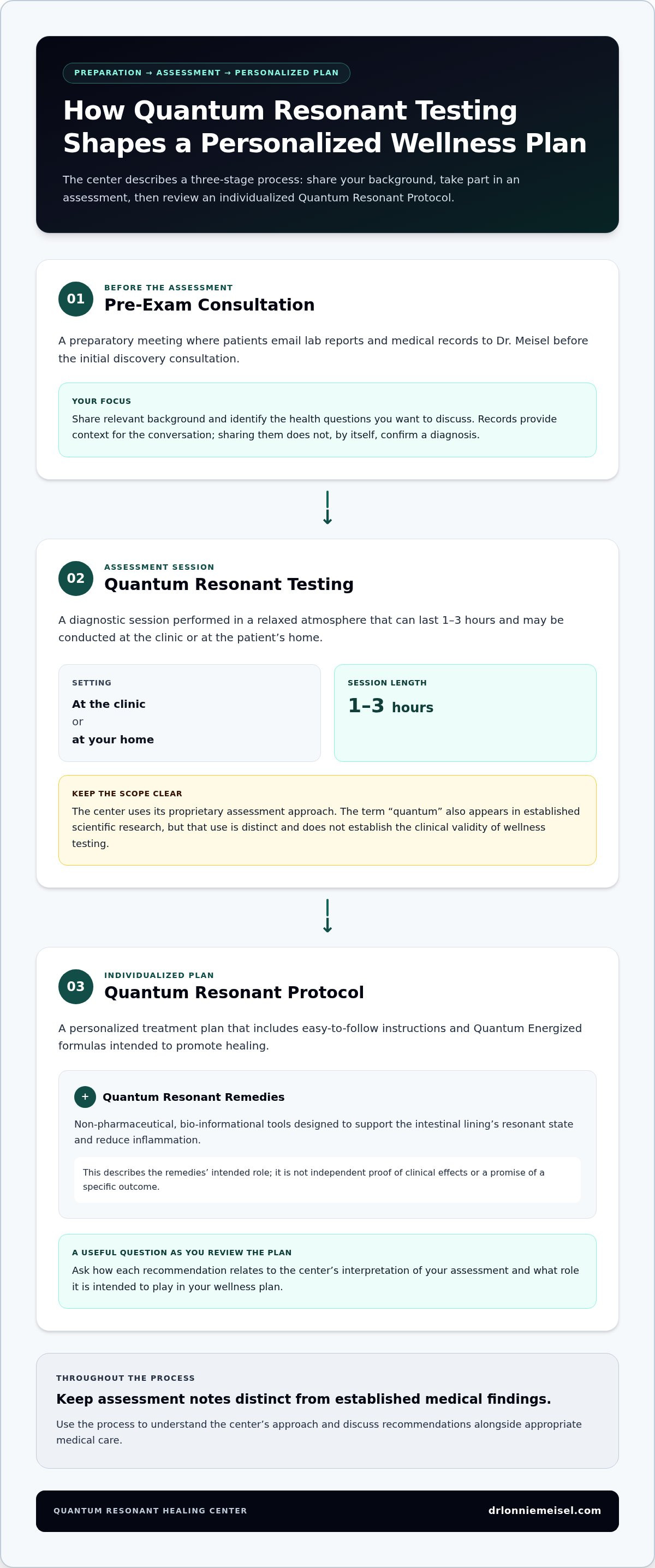
The center’s process moves from preparation to assessment and then to an individualized plan. Knowing what each stage involves can help you arrive with clear expectations and distinguish the purpose of the center’s process from what an assessment can independently establish.
What happens before and during Quantum Resonant Testing
The Pre-Exam Consultation is a preparatory meeting where patients email lab reports and medical records to Dr. Meisel before the initial discovery consultation. Use this stage to share relevant background and identify the topics you want to discuss. Your records provide context for the conversation; sharing them does not, by itself, confirm a diagnosis.
Quantum Resonant Testing is a diagnostic session conducted in a relaxed atmosphere. During the session, Dr. Meisel uses the center’s proprietary assessment approach. The word “quantum” also appears in established scientific research, but that use is not evidence for wellness testing. For example, the National Institute of Standards and Technology’s Quantum resonant technologies and measurement project concerns resonators used in quantum computing. Its subject is distinct from the center’s wellness assessment and does not establish the assessment’s clinical validity.
How assessment findings inform the Quantum Resonant Protocol
After the assessment, Dr. Meisel develops a Quantum Resonant Protocol, a personalized treatment plan with easy-to-follow instructions and Quantum Energized formulas intended to promote healing. The plan is tailored to the individual rather than presented as a uniform routine. As you review it, ask how each recommendation relates to the center’s interpretation of your assessment and what role it is intended to play in your wellness plan.
Quantum Energized formulas are part of the center’s stated approach, but their inclusion does not promise a specific outcome. The center’s Quantum Resonant Remedies are non-pharmaceutical, bio-informational tools designed to support the intestinal lining’s resonant state and reduce inflammation. This wording describes the intended role of the remedies; it is not independent proof of clinical effects. The article “Quantum Resonant Remedies Explained: The Future of Bio-Informational Healing” provides additional context about the center’s terminology.
As you consider advanced resonant therapy for wellness, keep assessment notes and proposed recommendations distinct from established medical findings. This makes it easier to discuss the approach and make informed decisions alongside appropriate medical care. To explore the center’s personalized process, you can arrange a personal appointment with Dr. Meisel.
What Resonant Wellness Claims Mean, and What Evidence Can Support
A frequency-based wellness framework describes how a service is understood; it does not, by itself, show that the service produces a clinical effect. This distinction matters when you encounter terms such as “resonance,” “frequency,” or “healing.” Evidence for bioresonance and related approaches remains limited and controversial. Weigh claims against independent, replicated clinical research rather than confident wording alone.
How to read claims about resonance, frequency, and healing
Consider whether a statement describes a model or reports a tested outcome. Phrases such as “informational field” or “resonant state” may explain a provider’s framework. They should not be presented as established biological mechanisms unless suitable research supports that interpretation. When reading about a proprietary method, look for clear attribution, such as “the center describes its approach as,” rather than treating its explanation as scientific consensus.
Wellness and speech approaches also have different subjects and purposes. Resonant voice therapy concerns voice and communication. Vibrational resonance approaches describe wellness practices involving frequency, sound, or vibration. The Quantum Resonant Healing Center frames its proprietary approach through bio-informational healing. Comparing these descriptions clarifies what each practice says it does; it does not show that they share techniques, clinical evidence, or effects.
Look at the detail behind a claim, too. A broad statement about relaxation, sleep, pain, recovery, mood, or “energetic alignment” is not equivalent to evidence that an intervention reliably changes that outcome. An article may introduce concepts without providing enough study detail to assess its conclusions. To evaluate a health claim, look for relevant studies, methods, comparison groups, and replicated results, not just technical vocabulary or testimonials.
Wellness descriptions explain how a service is framed; they should not be mistaken for proven treatment effects.
Why resonant wellness should not replace medical care
Keep the roles clear. A wellness consultation can offer a personalized way to explore the center’s approach, while conventional medical care addresses health concerns through established clinical evaluation and treatment. These roles are not interchangeable. Don’t stop prescribed care, postpone an assessment, or change treatment because of a resonance-based interpretation or promised benefit.
If you have an ongoing symptom or diagnosis, discuss any complementary wellness practice with the clinician involved in your care. This can help you consider how it fits alongside your current plan and avoid conflicting recommendations. Share relevant information about the practice and any products or formulas you’re considering. If a new or worsening concern arises, seek appropriate medical evaluation rather than relying on a wellness assessment to determine its cause.
A responsible view of advanced resonant therapy for wellness allows room for personal interest while keeping evidence in perspective. Understand the center’s stated purpose, ask what a claim is based on, and make decisions without treating a wellness framework as a diagnosis or a guaranteed clinical result.
How to Prepare for a Resonant Wellness Consultation
A thoughtful consultation starts with a clear picture of what you want to discuss. Before exploring advanced resonant therapy for wellness, organize your goals, relevant health information, and questions. This preparation helps you describe your priorities accurately and approach the consultation as a personalized wellness conversation, not a promise of a medical result.
Set clear wellness goals and questions
Start with what you hope to understand, rather than assuming a particular outcome. You may want to learn how an assessment is framed, what the center intends a protocol to address, or how its approach fits alongside your broader care. Keep personal aims separate from guaranteed clinical outcomes. A written list can help you stay focused during a private, individualized discussion.
Consider organizing your notes into three areas:
- Your goals: Describe the concerns or aspects of wellness you want to discuss in plain, specific language.
- Your questions: Note what you want to understand about the assessment, how findings are interpreted, and the intended role of any recommendations.
- Your expectations: Identify what would help you feel informed, while recognizing that a wellness framework does not establish a diagnosis or guarantee a result.
Keep current care and health information in view
Prepare an accurate summary of relevant health history and current care. Include diagnoses you have received, ongoing concerns, and the clinicians involved in your care. You don’t need to draw conclusions from this information; the aim is to describe your situation clearly. Keep the summary factual, and note anything you’re unsure about so you don’t present a guess as established information.
If you have a current health concern, write down questions about how a wellness consultation can coexist with your medical care. Raise care-coordination questions with the appropriate healthcare professional, especially if you are considering adding a wellness practice to an existing plan. Don’t stop, delay, or change prescribed medication, diagnosis, or treatment based on an article or resonance-based content. Decisions about medical care belong in discussion with your treating clinician.
Before the appointment, review your notes and choose the questions that matter most. For example, clarify which parts of a recommendation reflect the center’s approach and which have support from established medical evidence. This distinction can help you engage openly while keeping expectations grounded. To discuss your priorities in a personal appointment, schedule a consultation with Dr. Meisel.
Personalized Resonant Wellness at the Quantum Resonant Healing Center
At the Quantum Resonant Healing Center in Fort Lauderdale, Dr. Lonnie Meisel provides personalized appointments and a VIP Concierge Service for a global clientele. The center’s proprietary, frequency-based approach is delivered through an individualized experience, rather than a single routine for every person. If you’re considering advanced resonant therapy for wellness, a private appointment gives you the opportunity to discuss your priorities directly and understand how the center frames its approach.
A discreet, individualized approach to wellness
Privacy and discretion matter when you’re discussing personal health concerns. The center’s model is built around your circumstances and questions, with personalized care rather than a one-size-fits-all routine. Its terminology includes bio-informational healing, a holistic approach focused on the body’s informational field and resonant frequencies. This describes the center’s framework; it should not be taken as proof of a biological mechanism or a particular clinical result.
The center brings its proprietary resonant methods together with individualized appointments and VIP Concierge service. In a consultation, you can clarify what the center means by its frequency-based approach, how it conducts and interprets the assessment, and what role its recommendations are intended to play. A focused conversation can help you decide whether the framework aligns with your interests while keeping its descriptions separate from established medical findings.
If you’re exploring the center’s concierge model, the article “VIP Concierge Guide: Holistic Health & Optimization” offers related context. Readers interested in the language of performance and bio-optimization may also find “Quantum Healing for High Performers: The New Frontier of Bio-Optimization in 2026” relevant to the broader discussion. Use these topics to frame questions for a private consultation, not as guarantees of wellness outcomes.
Choosing a clear next step
You now have a clearer picture of how the center describes its assessment and personalized protocol, and why those descriptions should remain separate from independently established medical evidence. Carry that distinction into any next conversation: ask what a recommendation is intended to address, how it is framed, and how it fits alongside your ongoing care. Keep appropriate medical evaluation and prescribed care in place.
A private discussion can be a considered next step if you want to explore the center’s approach in relation to your own priorities. Bring the questions that matter to you and take the time you need to understand the framework. To explore a private appointment with Dr. Meisel, start with an individualized conversation and make your decision without assuming a particular outcome.
Choose Your Next Step With Clarity
Exploring advanced resonant therapy for wellness can help you clarify what matters to you; it is not a reason to rush into a decision. Before taking a next step, consider what you want from a wellness conversation, which questions remain unanswered, and how you’ll keep any new approach aligned with your broader care. A measured decision respects both your curiosity and your need for reliable health guidance.
Bring your priorities to a private discussion and use the conversation to understand whether the center’s approach is relevant to your interests. Keep your expectations grounded, and continue working with your healthcare professionals on medical concerns and treatment decisions. The choice remains yours.
If you’re ready to explore the center’s personalized approach, request a private consultation with Dr. Meisel.
Frequently Asked Questions
Is advanced resonant therapy the same as resonant voice therapy?
No. The terms refer to different contexts, so compare the stated purpose rather than the shared word “resonance.” If you’re discussing advanced resonant therapy for wellness, clarify whether the conversation concerns the center’s wellness framework or speech and vocal communication. This distinction helps you interpret descriptions accurately without assuming that a term used in one field explains the methods or evidence in another.
Can resonant wellness replace conventional medical care?
No. Keep decisions about diagnosis and treatment within appropriate medical care. As a practical step, write down any health decision you’re considering and raise it with the clinician who manages that aspect of your care. This lets you discuss your circumstances directly instead of relying on general wellness information to determine what is appropriate for you.
How should I prepare for a Pre-Exam Consultation?
Prepare a short, factual list of the topics you want to cover. Note what you hope to understand, which health concerns are most relevant to you, and what questions you want answered before deciding on next steps. Keep observations separate from assumptions, and mark anything you’re uncertain about so you can discuss it clearly rather than treating it as a confirmed conclusion.
What is a bio-informational assessment?
It is the center’s term for a diagnostic process intended to identify frequency disruptions within the nervous system. For a clearer discussion, ask what a finding means in everyday language, how it is distinguished from a conventional medical diagnosis, and what decisions it is intended to inform. These questions help you understand how the terminology is being used without assuming it describes an established medical mechanism.
Can I continue seeing my regular healthcare professionals while exploring resonant wellness?
Yes. You can maintain your existing healthcare relationships while exploring a wellness service. Keep a current list of the professionals involved in your care and note any questions that cross between services. This gives you a practical way to raise coordination matters with the relevant clinician, without treating a wellness consultation as a substitute for their guidance.
What is the difference between Quantum Resonant Testing and a Quantum Resonant Protocol?
They are different stages in the center’s process: Quantum Resonant Testing is the assessment, while the Quantum Resonant Protocol is the personalized plan. When reviewing a proposed plan, ask which recommendations relate to the assessment and which steps you are expected to follow. This makes the plan easier to understand and gives you a clear basis for discussing questions before deciding how to proceed.
Are Quantum Resonant Remedies pharmaceutical medications?
No. The center describes Quantum Resonant Remedies as non-pharmaceutical, bio-informational tools. If you’re considering a remedy alongside your existing care, keep its name and the center’s description available for discussion with the healthcare professional who advises you. “Non-pharmaceutical” does not mean a remedy can replace medication or is appropriate for every person or circumstance.


